IntroductionRNNs trained with backpropagation through time (BPTT) solve tasks through reliance on global error signals [1], while evolutionary algorithms and activity-dependent plasticity rules are gradient-free alternatives to solve the same tasks. How the choice of training paradigm biases the solutions that models arrive at remains unclear. Here we compare four paradigms—BPTT, evolution strategies (ES) [2], a genetic algorithm (GA), and GA with Oja’s Hebbian plasticity (GA+Oja)—on n-back recall, in which the network reports which of five symbols appeared n steps earlier. Beyond task accuracy, we analyze the connectivity changes that occur under each paradigm, finding that training method shapes structure far more than it determines performance.
MethodsWe trained RNNs (32, 128, 256 units) on a 5-symbol n-back task. BPTT employed gradient descent with the Adam optimizer (2000 iterations). ES estimated gradients from 128 perturbed copies of the network (perturbation σ = 0.02, 500 generations). GA used tournament selection with neuron-level crossover and self-adaptive mutation (128 individuals, 500 generations). GA+Oja co-evolved two Oja's rule parameters (learning rate and weight bound) which update recurrent weights via correlated activity, enabling within-lifetime adaptation atop evolved connectivity. We tested n-back 1–4 steps, measuring accuracy (chance accuracy = 20%), per-layer weight-change fractions, effective rank of the recurrent weight matrix, and total weight-change magnitude.ResultsAll methods converged to ~100% at 2-back, although ES showed high variance at 1-back (~85%; Fig. 1A). At 4-back, ES maintained ~100%, whereas GA declined to ~80% and GA+Oja to ~89%; BPTT remained at ~100%. Connectivity analysis revealed a strikingly different structure despite comparable accuracy. BPTT produced low effective rank recurrent matrices (~8 at 1-back) that increased with difficulty (~26 at 4-back). In contrast, evolutionary methods clustered at a higher rank (~16) with less variation across levels (Fig. 1B). BPTT increasingly allocated weight changes to the output layer with difficulty (~29% to ~43%). In comparison, all evolutionary methods remained flat at ~21% (Fig. 1C).
DiscussionGradient-based and evolutionary training produce comparably accurate networks with fundamentally different connectivity. BPTT finds low-rank recurrent solutions and progressively shifts learning toward output weights as difficulty increases, consistent with efficient credit assignment [3]. Evolutionary methods converge on distributed, high-rank solutions with uniform layer allocation — a qualitatively different regime. These results caution that studies inferring biological principles from trained RNNs may reflect the training algorithm rather than computational necessity. BPTT’s concentration of learning in output weights could mislead analyses of how recurrent dynamics support memory if the readout is not examined separately.
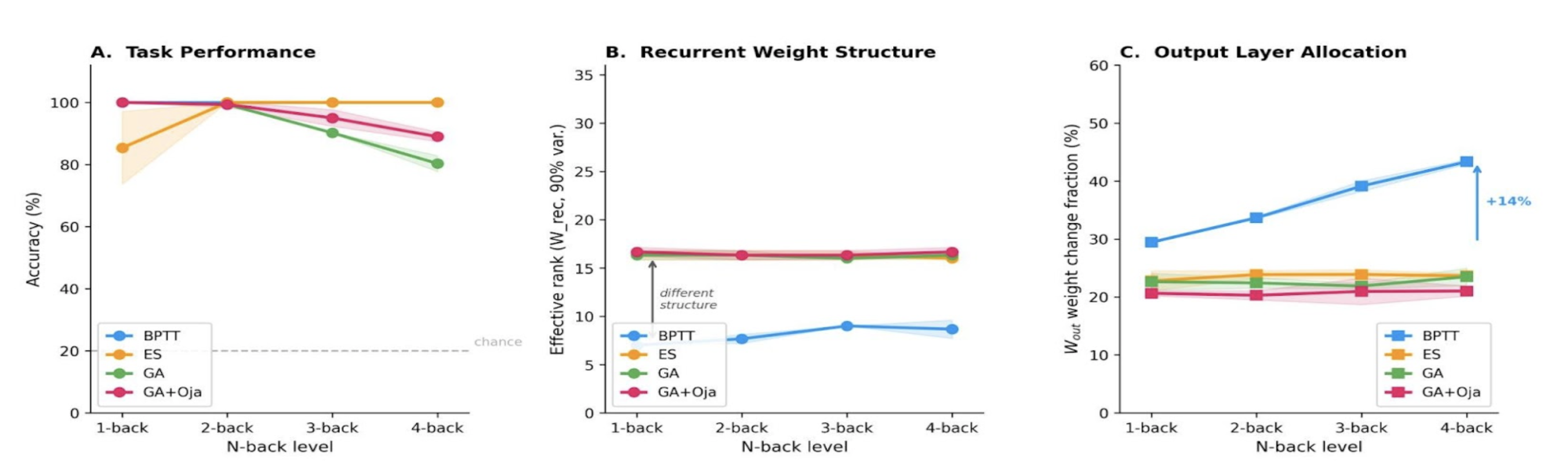 Figure 1. (A) Accuracy vs. n-back level: methods converge at 2-back; ES maintains ~100% at 4-back, whereas GA declines to ~80%. (B) BPTT effective rank increases from ~8 to ~26 with difficulty; evolutionary methods cluster at ~16. (C) BPTT shifts learning to the output layer (+14%); evolutionary methods stay flat. 32 neurons, mean ± std, 3 seeds.
References1. Neftci, E. O., Mostafa, H., & Zenke, F. (2019). Surrogate gradient learning in spiking neural networks.
IEEE Signal Processing Magazine, 36(6), 51–63.
https://doi.org/10.1109/MSP.2019.2931595 2. Salimans, T., Ho, J., Chen, X., Sidor, S., & Sutskever, I. (2017). Evolution strategies as a scalable alternative to reinforcement learning.
arXiv:1703.03864.
https://arxiv.org/abs/1703.03864 3. Izhikevich, E. M. (2007). Solving the distal reward problem through linkage of STDP and dopamine signaling.
Cerebral Cortex, 17(10), 2443–2452.
https://doi.org/10.1093/cercor/bhl152 AcknowledgementWe thank Dora Jiayue Li and the Pomona College Summer Undergraduate Research Program (SURP) for supporting early exploration on this project, as well as the Pomona College Department of Neuroscience for their senior thesis support.