IntroductionA comprehensive behavioural decision can be made based on a preliminary aesthetic assessment that harmonizes a variety of factors. Subjective prediction can cover at least 20-30% of brain regions, from sensory and motor areas to the cerebral cortex [1]. To study such processes, neuroaesthetic tools are being developed that combine computational rating models with neurophysiological methods [2].
In our work, we analysed how an aesthetic assessment of a location affects the choice of route for a traveller through natural landscapes. We have shown that computational neuroaesthetics, supplemented by spatial trajectory analysis, can be used to identify significant landscape factors and to predict attractiveness of tourist destinations.
MethodsOur goal was to identify indicators that determine the aesthetic appeal of natural attractions. We calculated topological and visual characteristics for three different tourist sites near Bishkek, Kyrgyzstan, with different Google Maps ratings and different frequencies of mentions on Internet (FM) (Figure 1):
A) topological features of routes and average densities of tourist flows (attendance) based on GPS tracks of activity tracking service (https://www.strava.com);
B) visibility pools and visual perception trails, softness of relief lines and spot colour balance based on remote sensing data.
The analysis was performed using QGIS spatial tools (https://qgis.org).
ResultsWe performed calculations for three tourist locations and compared the results with 6 non-tourist locations near Bishkek. Then we identified topological and visual indicators that differed by at least 25% between tourist sites and other locations.
Based on our analysis, we determined the "comfortable" properties of the locations, such as: visual openness of space, softness of lines, neutral natural colours.
Similar quality metrics of visual walkability perception in urban pedestrians have been found by Li Y et al. using panoramic street view images, virtual reality, and deep learning [3].
The applied methods and identified indicators can be used in machine learning tasks of artificial neural networks to detect high-rated tourist areas.
DiscussionWhen receiving information from different sensory systems, the brain processes it, forming a complex response to multi-layered data sets.
Aesthetic ratings of natural scenes can correlate with empirical data on visual comfort, while aesthetic preferences may be driven by optimization of decision-making processes in favour of lower-energy states of brain activity [4].
This is consistent with tourists\' reviews of natural attractions near Bishkek as "soothing" and "relaxing" locations.
In future studies, we plan to continue studying the influence of aesthetic characteristics of complex spatial stimuli on route selection, including comparing data on brain activity and data on movement trajectories.
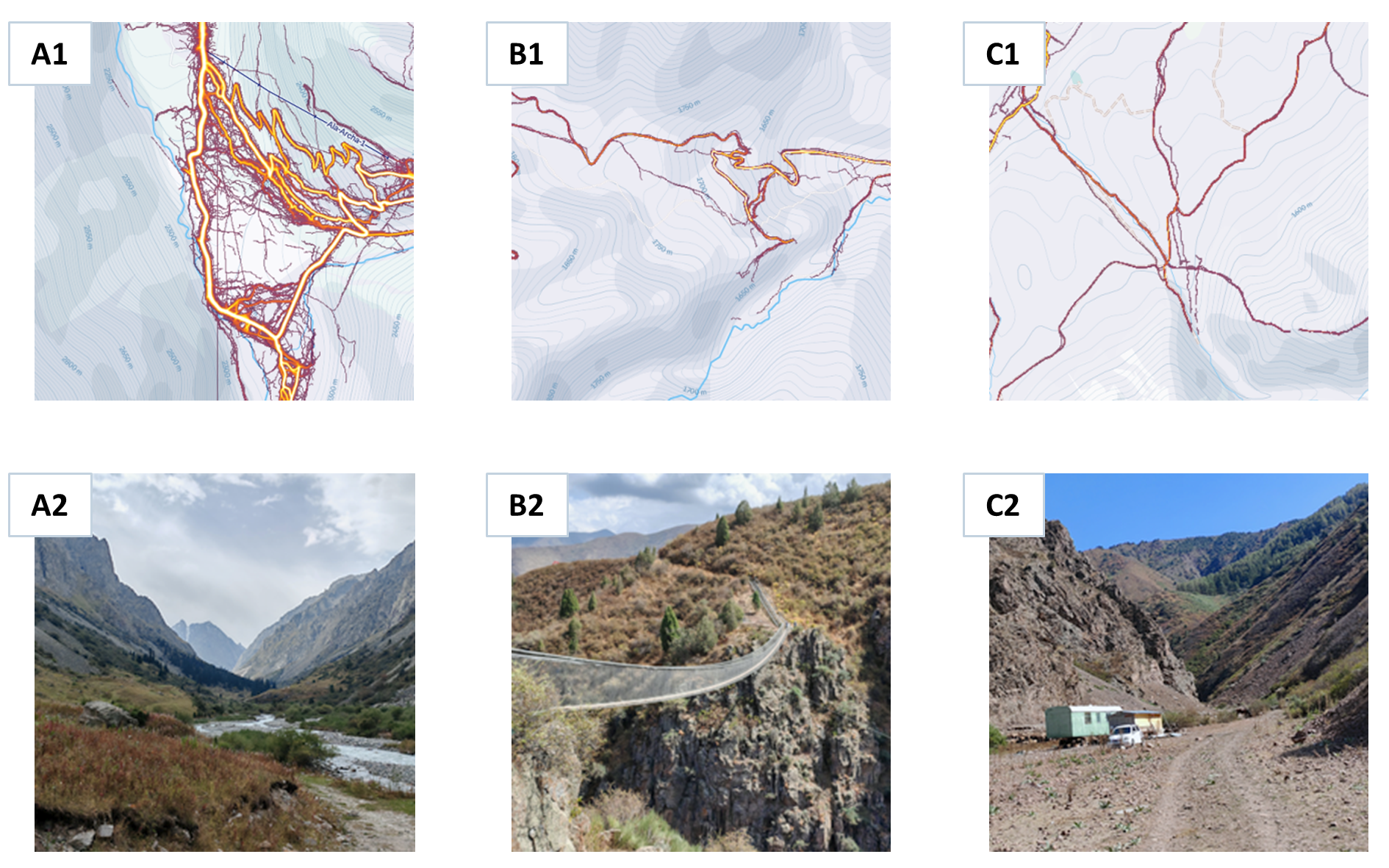 Figure 1. A1, A2: GPS tracks and photo of the location "Ala-Archa" (FM – 1.6 million, attendance 215 people/hour, rating 4.7), B1, B2: GPS tracks and photo of the location "Sky Bridge" (FM – 39.8 thousand, attendance 36 people/hour, rating 4.5). C1, C2: GPS tracks and a photo of the location "Raspberry Gorge" (FM 2.9 thousand, attendance 4 people/hour, rating 4.0).
References1. Findling, C., et al. (2025). Brain-wide representations of prior information in mouse decision-making. Nature, 645, 192–200. https://doi.org/10.1038/s41586-025-09226-1
2. Li, R., & Zhang, J. (2020). Review of computational neuroaesthetics: bridging the gap between neuroaesthetics and computer science. Brain Informatics, 7, 16. https://doi.org/10.1186/s40708-020-00118-w
3. Li, Y., et al. (2022). Measuring visual walkability perception using panoramic street view images, virtual reality, and deep learning. Sustain Cities Soc, 86, 104140. https://doi.org/10.1016/j.scs.2022.104140
4. Tang, Y., et al. (2025). Less is more: Aesthetic liking is inversely related to metabolic expense by the visual system. PNAS Nexus, 4, pgaf347. https://doi.org/10.1093/pnasnexus/pgaf347
AcknowledgementWe gratefully acknowledge the applications and tools provided by QGIS. This platform is constantly evolving, expanding the possibilities of spatial analysis for all fields of knowledge.