IntroductionThis study addresses the need for standard workflows and best practices in developing evidence-based computational tools and models in neuroscience [1]. Linking multiscale molecular and cellular interactions (e.g., between neurons and glia) are yet to be mainstream in Systems Neuroscience. As a step in this direction, we present an organized workflow to consolidate causal evidence of intermolecular, multicellular and multifunctional crosstalk, and to develop novel functional interactomes in neural systems (FINS). As proof-of-concept, we apply our workflow to test the hypothesis that neuroinflammatory and excitability functions are in a closed loop of multicellular molecular interactions between neurons and microglia.
MethodsOur workflow involves 1) screening primary research articles (PRAs), 2) extracting structured meta-summaries (SMS), 3) generating the FINS network graph model. We screened >120 heterogenous published studies from 2002-2025, of which 65 reporting validated causal functional associations were included. Diverse features of biomolecules such as functional identity, cell type, experimental methodology, species, and brain regions were curated. We identified pleiotropic actions of activator molecules on targets at the molecular (expression and function), cellular (excitability, cell survival), and neural circuit levels (synaptic effects). We then assembled pairwise interactors to create a network graph using the open-source Cytoscape software.ResultsThe resulting FINS network revealed a non-random, hub-like topology (see Figure. 1). We introduce a Functional Interaction Score (FIS) that encodes edge thickness to capture the magnitude and direction of literature evidence between two nodes/interactors. Thicker edges correspond to greater reproducibility of empirical effects. Furthermore, edge annotations encode activator-mediated increase (solid lines) v/s decrease (dashed lines) in target function. Node size encodes total PRAs that report the node. Overall, the proinflammatory cytokines, particularly TNF-α, emerge as activator hubs with ion channel proteins mediating neural excitability (e.g., Nav1.8), as convergence points of these inflammatory mediators between neurons and microglia.DiscussionThe systematic pipeline of activities can be widely adopted to develop multiscale network models of molecular interactions that integrate diverse evidence into unified network graphs. Unlike predicted networks, our FINS model represents a validated network of molecular interactors across the brain scale. The case of neuroimmune crosstalk demonstrated in this study identifies significant neuroimmune modulation of neural excitability by microglial cytokines, which alter the expression and function of intrinsic and synaptic ion channels in neurons. This framework provides a new direction for Systems Neuroscience to combine neural circuit-level biomolecular interactors to investigate nervous system function and dysfunction.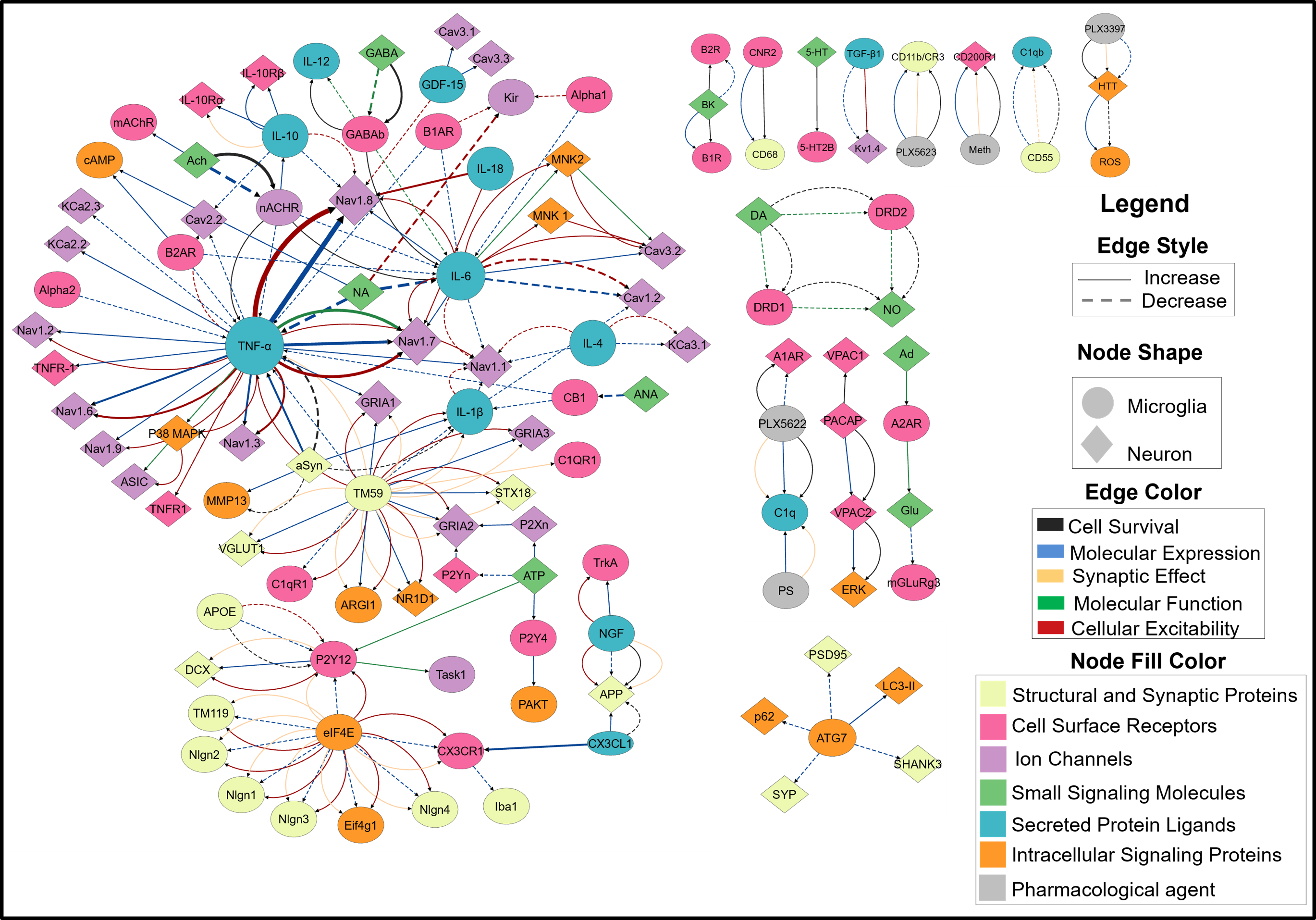 Figure 1. A FINS model of neuroimmune crosstalk. Nodes represent biomolecules, node shape indicates the cell type in which one or more studies reported its localization. The node size corresponds to the number of PRAs in which the node was studied. The node color correspond to the functional category assigned in the nervous system. Edge represents pairwise interaction. Their color shows interaction types, a
ReferencesMcDougal RA, Bulanova AS, Lytton WW (2016). Reproducibility in Computational Neuroscience Models and Simulations. IEEE Trans Biomed Eng. 2016 Oct;63(10):2021-35. doi: 10.1109/TBME.2016.2539602.
AcknowledgementThis work was partly supported by the Leslie K\u202fWynston\u202fSummer Research Assistantship, awarded to MZY by the California State University Long Beach (CSULB) College of Natural Sciences and Mathematics (CNSM), and by the CSULB CNSM new faculty startup funds to SV. We thank many student contributors for their assistance in data consolidation.