IntroductionHuman neurons show remarkable variation, even among the same type. Contrary to the belief that it is noise, within-cell-type heterogeneity enhances information coding and, as our recent work has shown, endows dynamical resilience to insults [1]. Furthermore, our work has shown that heterogeneity is malleable and is reduced in seizures and [1] under correlated inputs [2,3].
We focus on intrinsic biophysical heterogeneity--relating to passive and firing properties of a neuron--which is influenced by ion channels. We have discovered that blocking one type of ion channel, the HCN channel, can restore heterogeneity under certain conditions [2]. This study aims to clarify the mechanism and conditions under which the effect emerges.
MethodsFollowing common approaches, large ensembles of human L5 pyramidal neuron models were built from a pre-tuned model, sampling ion channel conductances across empirically defined ranges and validating the resulting populations against experimental datasets. Intrinsic heterogeneity was quantified through variance of normalized spiking metrics and information-theoretic measures analogous to those used in our experimental work, so that the results may be directly compared.
ResultsOur results at this time show that upregulation of specific ion channels, particularly HCN, strongly influences population heterogeneity ofsome intrinsic properties such as resting membrane potential (RMP) and input resistance (Fig. 1). While trends appear modest across the full log-scale conductance range, focusing on the physiological regime (10
-4–10⁻³) reveals a sharp decline in variance. In contrast, transient sodium and M-type potassium channels show weak correlations with the variance of most intrinsic properties.
DiscussionWe hypothesize that HCN channels’ unique influence on population-level heterogeneity arises from their involvement in a voltage-dependent negative feedback, such that increased expression of HCN channels reduces the range of potential intrinsic properties. However, the counterargument is that, despite similar feedback, M-type potassium channels do not show this effect. Owing to inter-channel interactions and degeneracy, further systematic investigation is needed to understand these non-linear relationships fully. Given the established role of ion channels in diseases and our finding that reduced heterogeneity drives pathology, this work will inform strategies for modulating intrinsic heterogeneity as a novel therapeutic approach.
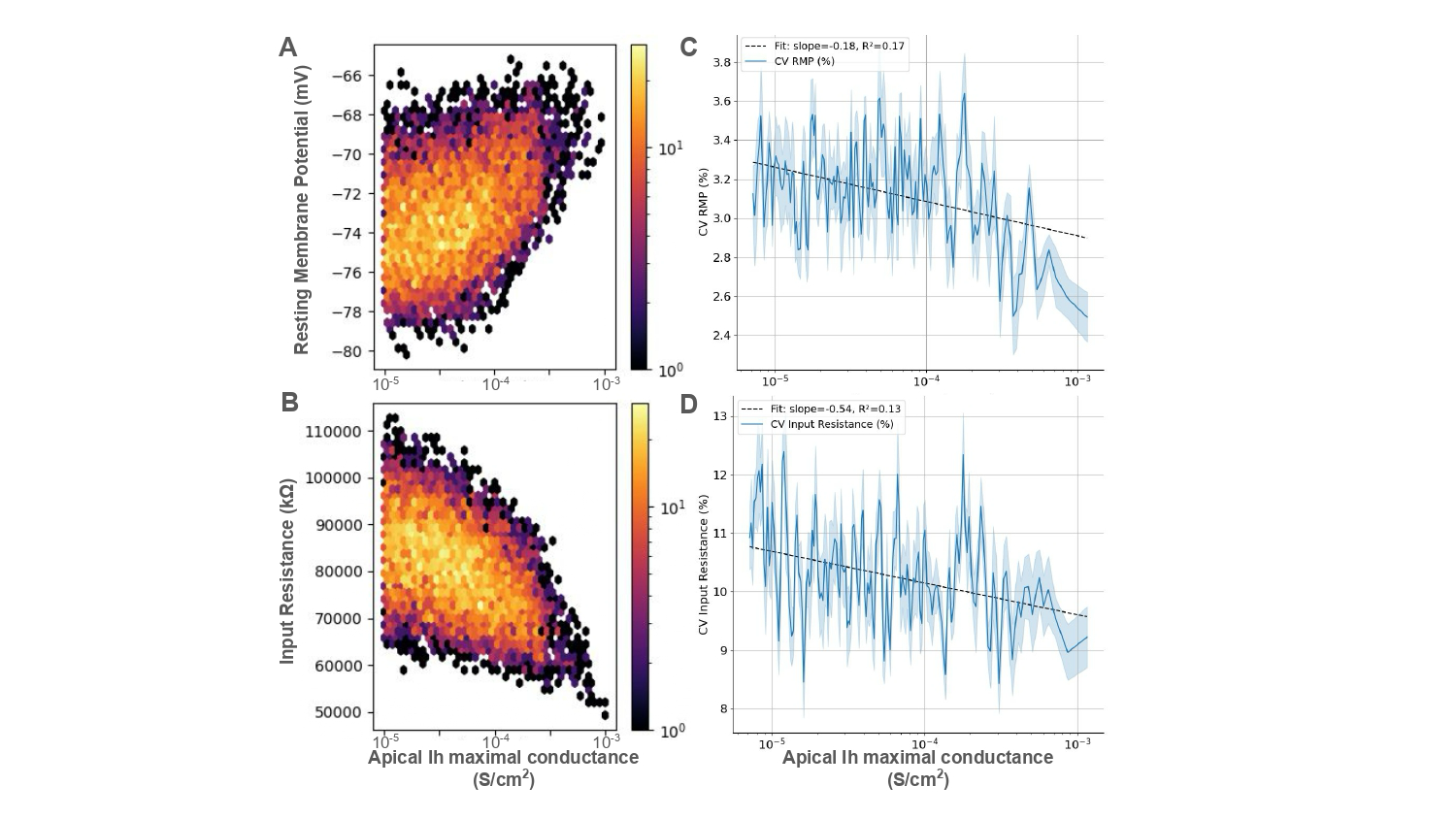 Figure 1. Scatter plot of the (A) resting membrane potential (RMP) and (B) input resistance of a population of ~8000 neurons sorted in increasing order of apical H-current (Ih) maximal conductance, with the coefficient of variation (CV) of RMP (C) and input resistance (D) respectively plotted on the right.
References1. Rich, S., Moradi Chameh, H., Lefebvre, J., & Valiante, T. A. (2022). Loss of neuronal heterogeneity in epileptogenic human tissue impairs network resilience to sudden changes in synchrony. Cell Reports, 39(8), 110863.
2. Chameh, H. M., Falby, M., Yang, Y., Movahed, M., Arbabi, K., Sarathy, C., Tripathy, S. J., Zhang, L., Lefebvre, J., & Valiante, T. A. (2025). Hyperpolarization-activated cation channel mediated intrinsic plasticity changes underlie the malleability of within cell-type electrophysiological heterogeneity. In Neuroscience. bioRxiv.
3. Trotter, D., Valiante, T., & Lefebvre, J. (2026). Intrinsic plasticity underlies the malleability of neural network heterogeneity. PRX Life, 4(1), 013023.
AcknowledgementThis work is supported by the Ontario Graduate Scholarship and the Canada Graduate Research Scholarship through Canadian Institutes of Health Research (CIHR).