IntroductionOptogenetic modulation of pyramidal cells using potassium selective opsins has been shown to inhibit neuronal activity, making it a promising strategy for suppressing seizures [1]. A prior study in a point‑neuron hippocampal model showed seizure termination after brief opsin activation, but different seizure generation mechanisms may alter intervention efficacy [2]. In this study, we examine optogenetic modulation in a multicompartment model based on the potassium hypothesis, in which elevated extracellular potassium drives seizure initiation and maintenance.
MethodsWe extended the potassium based seizure model of Gentiletti et al. (2022) by adding a synaptically connected cell (0) without extracellular coupling and incorporating the WiChR opsin model proposed by Weyn et al. (2025) into all principal cell (1-4) compartments, as schematically shown in (Fig.\u202f1A) [1,3]. We illuminated different subsets of principal cells for varying illumination durations (tI) and quantified (1) mFRall, the mean firing rate of cells\u202f1-4; (2) FR0, the firing rate of cell\u202f0 as a measure of SLE related synaptic propagation; (3) seizure-like event (SLE) duration, defined as periods where mFRall\u202f>\u202f2.5\u202fHz for\u202f>\u202f7\u202fs; and (4) SLE end time.
ResultsThe results are shown in Fig.\u202f1B. mFRall was consistently reduced during illumination, with stronger suppression when larger fractions of the onset zone were targeted. FR0 was highly sensitive to the number of illuminated cells and returned to pre‑SLE (<1\u202fHz) levels only when 75% of the zone was targeted. Longer tI further decreased firing, although similar reductions also occurred without stimulation due to intrinsic SLE dynamics. Despite transient suppression, the increased SLE end time shows that activity resumed after illumination. Only prolonged, centered (cells 2/3) partial or full onset‑zone (cells\u202f1-4) targeting fully abolished the SLE, reducing both duration and end time.
DiscussionIn potassium driven SLEs, inhibiting a large proportion of the onset zone is necessary to prevent synaptic propagation during illumination. Furthermore, transient complete pyramidal inhibition is insufficient for SLE termination, as activity reliably resumes once illumination ceases. Effective suppression depends on the target zone and requires prolonged illumination that outlasts the potassium driven dynamics sustaining SLEs. These findings contrast with the earlier point‑neuron study, where short optogenetic intervention fully stopped SLEs, suggesting that the efficacy of optogenetic strategies critically depends on the underlying biophysical mechanism and the need for mechanism specific intervention design.
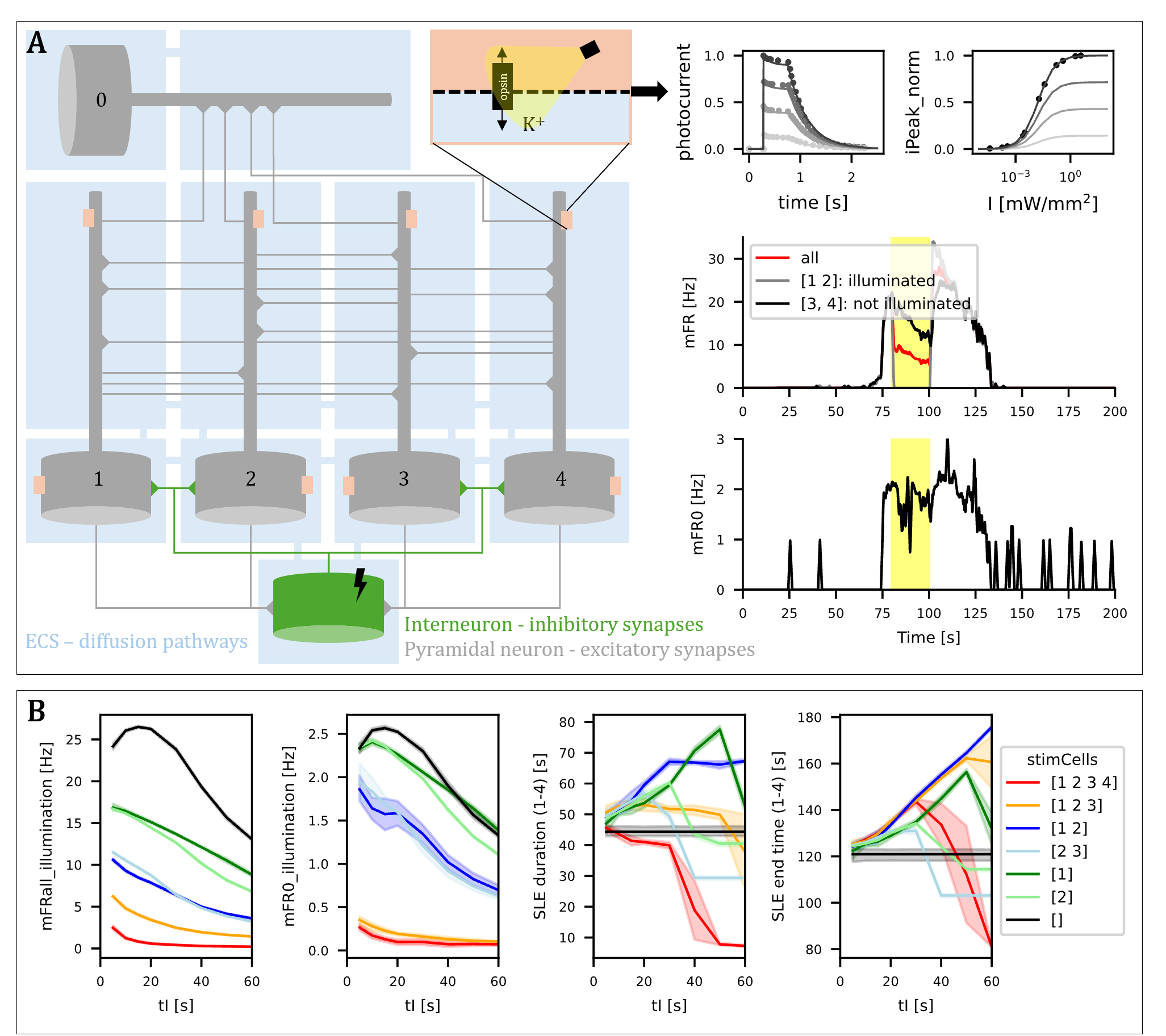 Figure 1. A. Schematic representation of the model and example output. B. Impact of illumination duration (tI) and targeted cell subsets (stimCells) on firing rates during illumination (mFR_all, mFR0) and on SLE duration and end time.
References[1] Weyn, L., Tarnaud, T., Schoeters, R., De Becker, X., Joseph, W., Raedt, R., & Tanghe, E. (2025). Computational analysis of optogenetic inhibition of CA1 neurons using a data‑efficient potassium‑ and chloride‑conducting opsin model. Journal of Neural Engineering, 22(4), 046051.
https://doi.org/10.1088/1741-2552/adf94a[2] Weyn, L., Tarnaud, T., Joseph, W., Raedt, R., & Tanghe, E. (2026). Optogenetic inhibition of a hippocampal network model. Journal of Computational Neuroscience, 54(Suppl 1).
https://doi.org/10.1007/s10827-025-00915-4[3] Gentiletti, D., de Curtis, M., Gnatkovsky, V., & Suffczynski, P. (2022). Focal seizures organized by feedback between neural activity and ion concentration changes. eLife, 11, e68541.
https://doi.org/10.7554/eLife.68541 AcknowledgementThis work is supported by BOF project SOFTRESET.