IntroductionDeep brain stimulation (DBS) is widely used to treat motor symptoms of Parkinson’s disease, but the mechanism by which it alters neural dynamics is still not fully understood. DBS typically consists of short, high-frequency electrical pulses delivered through an implanted electrode, and its effects are attributed to strong electric fields near the electrode. However, studies of non-invasive brain stimulation show that weak sinusoidal electric fields below 1V/m can modulate spike timing and neural synchronization [1]. This raises the possibility that weak electric fields during DBS (Fig. 1A) can affect cortical neuron dynamics. We test this hypothesis by investigating entrainment of multi-compartment neuron models under weak DBS fields.
MethodsWe employed morphologically realistic multi-compartment models of cortical neurons (Fig 1B), comprising five cell types from different cortical layers [2]. The models were subjected to an externally applied electric field (Fig. 1C) designed to reproduce high-frequency DBS pulses. The orientation of the electric field was varied relative to neural morphology using the polar angle θ. Entrainment was quantified using the phase-locking value across a range of electric field amplitudes and orientations.
ResultsWeak DBS fields can entrain the spike timing of single cortical neurons (Fig. 1D). Spikes tend to cluster at specific phases of the applied DBS waveform, producing a non-uniform spike-time distribution and an increase in phase-locking value. The preferred entrainment phase varies across neuron types and stimulation amplitudes. Differences in neural morphology and electric field orientation contribute to heterogeneous entrainment patterns across cells. However, when the electric field is aligned with each neuron’s preferred orientation, consistent and stronger entrainment emerges.
DiscussionOur results suggest that electric fields with amplitudes below 10 V/m can synchronize the spike timing of individual cortical neurons with the applied stimulation. This finding implies that weak fields, despite being far smaller than those near the electrode, may still influence cortical activity during DBS. Such effects could interact with the effects of stronger fields present at the stimulation site and potentially contribute to both therapeutic outcomes and stimulation-related side effects. Future work will investigate synchronization in network models composed of two-compartment neurons to determine whether network interactions enhance these effects and whether they can promote synchronization at the population level.
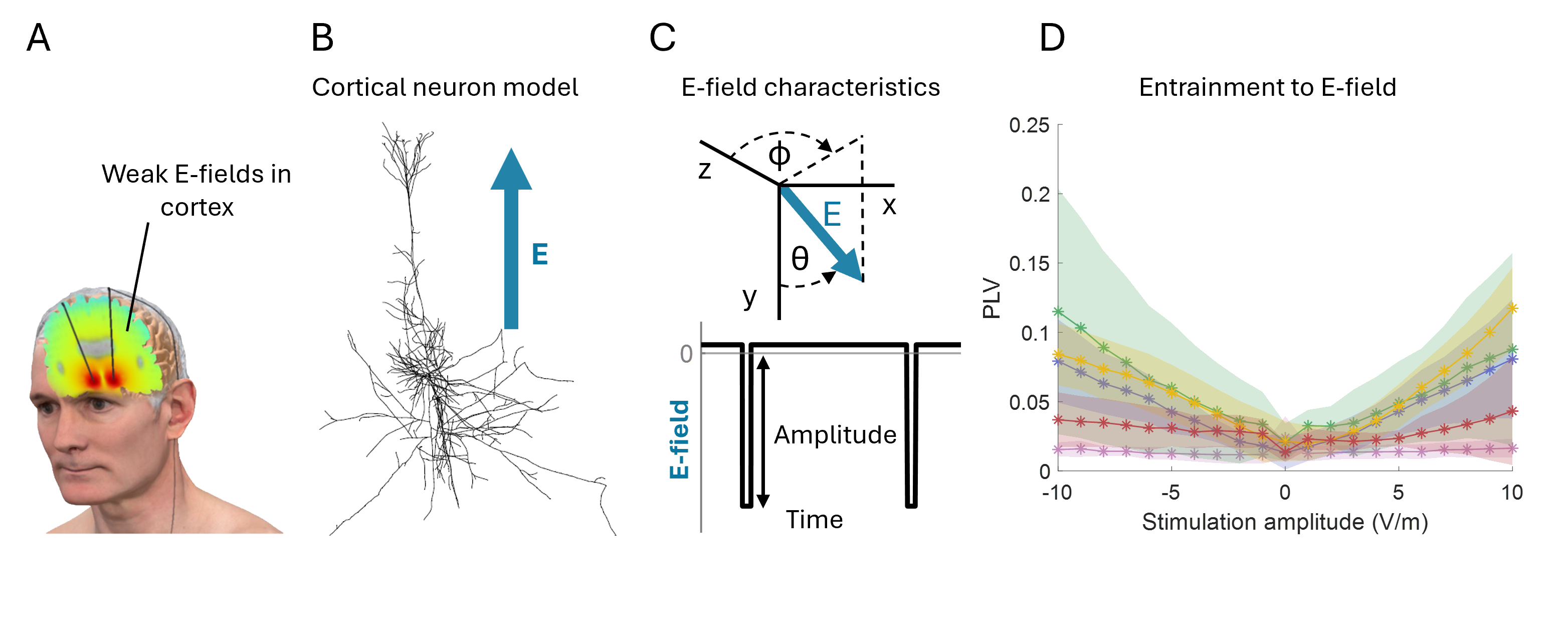 Figure 1. Cortical neuron entrainment by weak electric DBS fields. (A) Illustration of electric fields generated in the brain during DBS. (B) Multi-compartment models of cortical neurons. (C) Electric field orientation relative to the neural morphology. Waveform of the applied field, representing a DBS-like stimulus. (D) Mean phase-locking value increases when amplitude increases.
References[1] Krause, M. R., Vieira, P. G., Thivierge, J. P., & Pack, C. C. (2022). Brain stimulation competes with ongoing oscillations for control of spike timing in the primate brain. PLoS Biology, 20(5), e3001650. https://doi.org/10.1371/journal.pbio.3001650
[2] Tran, H., Shirinpour, S., & Opitz, A. (2022). Effects of transcranial alternating current stimulation on spiking activity in computational models of single neocortical neurons. NeuroImage, 250, 118953. https://doi.org/10.1016/j.neuroimage.2022.118953
AcknowledgementThis work is part of a project that has received funding from the European Research Council (ERC StG DECODE, grant number 101116047, to B.C.S). We would like to thank Ciska Heida for valuable discussions and guidance.