IntroductionPersistent neuronal activity is a proposed neural mechanism supporting the maintenance of information in working memory (WM) [1]. Attention is known to influence WM performance and the stability of internal representations [2]. However, how attentional signals modulate the circuit mechanisms that generate persistent activity remains insufficiently explored in computational models. In this study, we investigate whether modulatory input to vasoactive intestinal peptide (VIP) interneurons can regulate the emergence of persistent activity in a biologically constrained cortical microcircuit model.
MethodsWe employed a cortical microcircuit model consisting of excitatory (E) and inhibitory interneuron populations (PV, SOM, and VIP) distributed across cortical layers L2/3, L4, L5, and L6 [3]. The model incorporates biologically informed parameters, including connection probabilities, synaptic strengths, neuronal densities, and firing rate functions for each cell type. Three classes of long-range inputs were implemented: (i) lateral input to E2/3 and SOM2/3 populations, (ii) modulatory input targeting VIP2/3 neurons, and (iii) bottom-up input to E4 and PV4 populations. We systematically varied key parameters to examine their influence on the emergence of persistent activity (Fig. 1).
ResultsThe model exhibits bistability with respect to bottom-up input. Bistability emerges across a range of parameter configurations, including variations in VIP interneuron cell count, recurrent connectivity within the E2/3 population, recurrent connectivity within the E4 population, and the strength of modulatory input. The size of the bistable region is sensitive to these parameters, particularly the modulatory input to VIP2/3 neurons. Notably, stronger modulatory input reduces the minimum bottom-up input required to sustain persistent activity.
DiscussionVIP interneurons form a canonical disinhibitory circuit motif and are frequently associated with attentional modulation. Our simulations suggest that attentional signals targeting VIP interneurons can facilitate the emergence and maintenance of persistent activity in cortical microcircuits. These findings provide a potential circuit-level mechanism by which attention may enhance working memory stability.
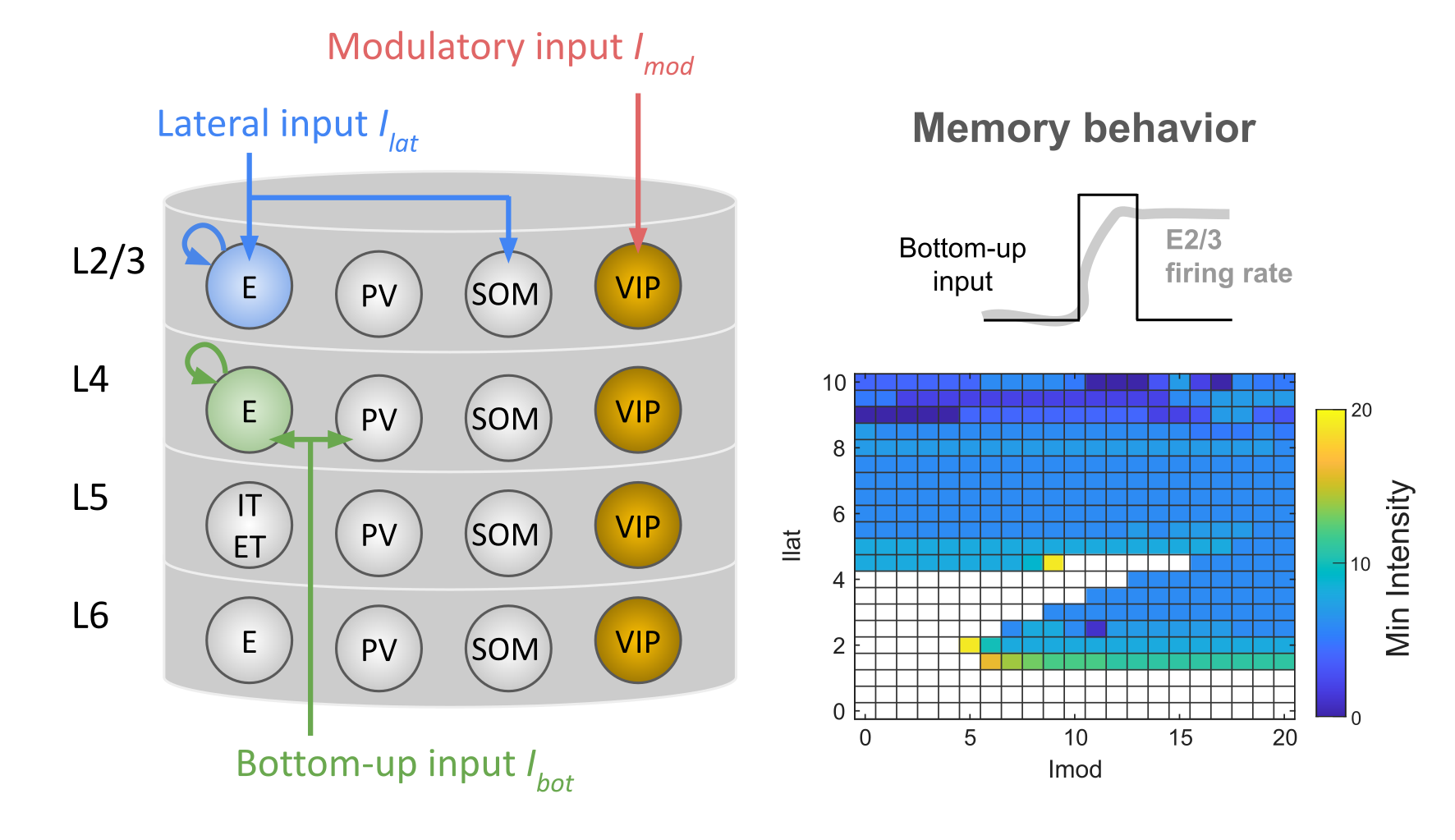 Figure 1. The cortical microcircuit model and its memory behavior. Key model parameters include VIP interneuron cell count (yellow), recurrent connectivity within the E2/3 population (blue), and recurrent connectivity within the E4 population (green). The minimum bottom-up input intensity for a memory behavior varies across different levels of lateral and modulatory inputs.
References1. Kamiński, J., & Rutishauser, U. (2020). Between persistently active and activity-silent frameworks: novel vistas on the cellular basis of working memory. Annals of the New York Academy of Sciences, 1464(1), 64-75.
https://doi.org/10.1111/nyas.142132. Gazzaley, A., & Nobre, A. C. (2012). Top-down modulation: bridging selective attention and working memory. Trends in cognitive sciences, 16(2), 129-135.
https://doi.org/10.1016/j.tics.2011.11.014 3. Chien, V. S., Jiříček, S., Knösche, T. R., Hlinka, J., & Schmidt, H. (2025). Long-Range Input to Cortical Microcircuits Shapes EEG-BOLD Correlation. bioRxiv, 2025-06.
https://doi.org/10.1101/2025.06.06.658058AcknowledgementThe work was supported by a Lumina-Quaeruntur fellowship (LQ100302301) by the Czech Academy of Sciences (awarded to HS) and ERDF-Project Brain Dynamics, No. CZ.02.01.01/00/22_008/0004643.