IntroductionSleep disturbance is a common consequence of neurotrauma, including traumatic brain injury (TBI) and spinal cord injury (SCI), yet objective biomarkers capable of distinguishing injury type remain limited. Wearable actigraphy generates high-dimensional physiological time-series data that may contain latent signatures of injury-related sleep disruption. Although sleep disturbances also occur following severe orthopedic injury (SOI), it remains unclear whether computational analysis of actigraphy-derived sleep architecture can detect injury-specific phenotypes. Here, we tested whether supervised machine learning models could classify injury type from wrist actigraphy-derived sleep signatures.
MethodsContinuous wrist actigraphy was collected from 61 inpatients (TBI n = 33, SCI n = 12, SOI n = 15). Raw actigraphy time-series were processed using a custom Python-based computational pipeline that performed automated preprocessing, circadian segmentation and high-throughput extraction of sleep–wake metrics. This workflow produced 24 features per observation, including sleep efficiency, fragmentation, and bout structure. Five engineered composite features capturing circadian disruption and sleep consolidation yielded a 31-feature representation of sleep dynamics. Seven supervised machine learning classifiers were evaluated using stratified five-fold cross-validation with performance assessed by AUC and average precision. (Fig. 1)
ResultsA stacking ensemble method achieved the strongest performance across both classification tasks. Discrimination was strong for TBI versus SOI (AUC=0.825±0.033; average precision=0.896) and SCI versus TBI (AUC=0.900±0.054; average precision=0.975). Nighttime sleep efficiency emerged as the most informative feature, suggesting that nocturnal sleep consolidation carries strong diagnostic value across injury groups.
DiscussionThese findings demonstrate injury-specific sleep signatures and show that actigraphy-derived sleep phenotyping can distinguish central nervous system injury from peripheral trauma using scalable, noninvasive monitoring. This computational framework may enable objective clinical stratification in neurotrauma and provides a foundation for future machine learning approaches to track recovery trajectories and identify sleep-based biomarkers of injury burden.
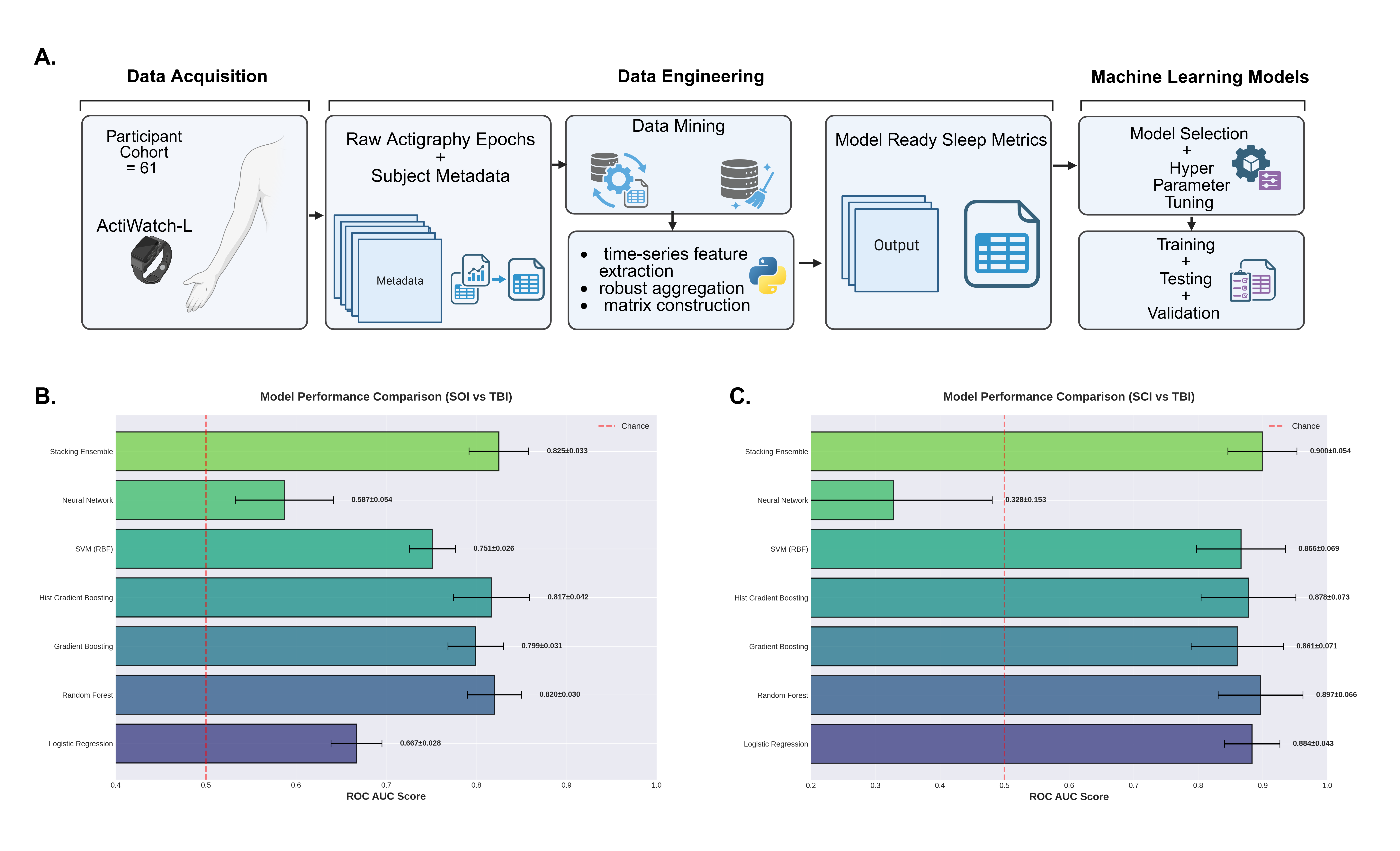 Figure 1. Actigraphy-based sleep feature pipeline and machine learning model performance for TBI classification.
References1. Courville, E., Kazim, S. F., Vellek, J., Tarawneh, O., Stack, J., Roster, K., Roy, J., Schmidt, M., & Bowers, C. (2023). Machine learning algorithms for predicting outcomes of traumatic brain injury: A systematic review and meta-analysis. Surgical Neurology International, 14, 262.
https://doi.org/10.25259/SNI_312_20232. Tunthanathip, T., & Oearsakul, T. (2021). Application of machine learning to predict the outcome of pediatric traumatic brain injury. Chinese Journal of Traumatology, 24(6), 350–355.
https://doi.org/10.1016/j.cjtee.2021.06.003 AcknowledgementAcknowledgements: A.L. was supported by the National Institutes of Health Training Program in Sleep and Circadian Biology (T32HL149646). Additional thanks to the Sleep, Inflammation, and Neuropathology Lab members for the support.