IntroductionBrain–computer interfaces (BCIs) decode brain signals into device commands [1]. Their performance is limited by a low signal-to-noise ratio, leading to a speed–accuracy trade-off: increasing accuracy through trial averaging requires more trials and reduces communication speed [2]. Existing metrics, such as the Information Transfer Rate (ITR) or BCI-Utility [3], obscure how accuracy depends on the number of trials — potentially introducing biases and limiting explainability. We propose a framework that separates and optimizes speed and accuracy, enabling explicit control of the trade-off and improving user- and experiment-specific adaptation.
MethodsThe framework quantifies BCI speed and accuracy through two measures:
Gain (relative speed improvement) and
Conservation (relative accuracy preservation), defined with respect to a baseline BCI. These are combined into a trade-off equation termed Gain–Cons Balance (GCB), αGain + (1 − α)Cons, where α controls the desired balance. The GCB specifies the target trade-off, while an early-stopping strategy adjusts the number of trials to satisfy the selected α. In this way, the early-stop implements the policy dictated by the GCB. The approach was validated on 63 subjects using two P300 paradigms, three classifiers, and three stopping criteria within a nested leave-one-session-out cross-validation procedure.
ResultsOptimization strategies produced distinct BCI behaviors (Fig. 1). The ITR behaved similarly to GCB(α = 0.75), favoring faster decisions with lower accuracies, whereas GCB(α = 0.25) prioritized accuracy at the cost of more trials. The balanced configuration (α = 0.5) achieved high accuracy with moderate speed. This trend was consistent across paradigms, subjects, sessions, classifiers, and early-stopping methods. These findings demonstrate that tuning α in the Gain–Cons Balance explicitly controls the speed–accuracy trade-off: selecting a desired accuracy determines the required number of trials, and vice versa.
DiscussionThe proposed Gain–Cons Balance framework enables explicit control of the speed–accuracy trade-off across Rapid Serial Visual Presentation and Row–Column Paradigm P300 datasets. By tuning the parameter α, the trade-off becomes a controllable design variable rather than an implicit constraint. The framework supports conditional analysis of expected accuracy or required trials, facilitates subject-level performance prediction, and reveals metric biases — particularly ITR’s preference for speed. Overall, the Gain–Cons Balance provides a general and interpretable tool to optimize and compare BCIs across paradigms, users, sessions, classifiers, and early-stopping strategies.
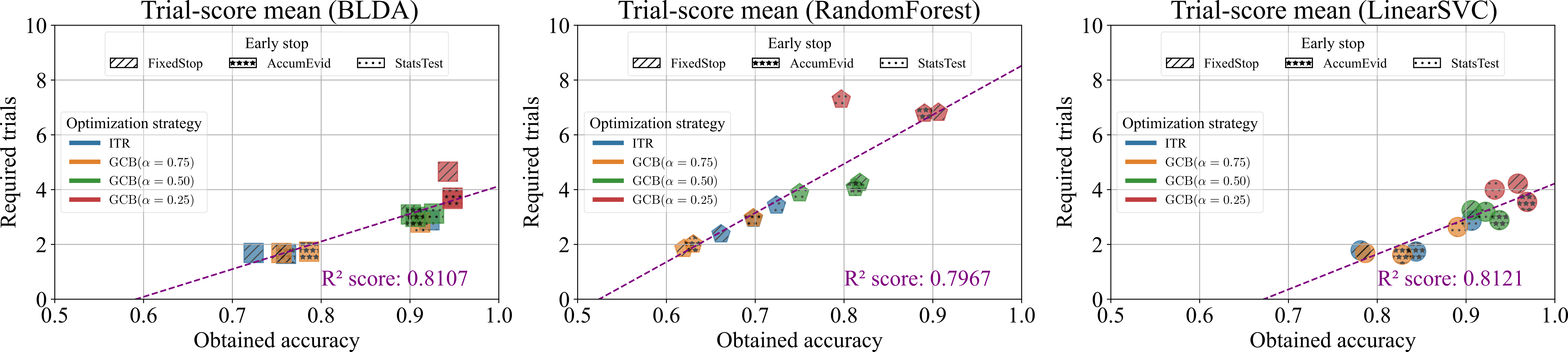 Figure 1. Required trials and obtained accuracies across classifiers, early-stopping strategies, and optimization methods for Hoffmann et. al. Rapid Serial Visual Presentation dataset [1]. Points show mean performance under leave-one-session-out validation. The fitted line illustrates the speed–accuracy trade-off.
References[1] Hoffmann,U., Vesin,J.-M., Ebrahimi,T., & Diserens,K.(2008).An efficient P300-based brain–computer interface for disabled subjects. Journal of Neuroscience Methods, 167(1):115–125, https://doi.org/10.1016/j.jneumeth.2007.03.005.
[2] Schreuder,M., Höhne,J., Blankertz,B., Haufe,S., Dickhaus,T., & Tangermann,M.(2013).Optimizing event-related potential based brain-computer interfaces: A systematic evaluation of dynamic stopping methods. Journal of Neural Engineering, 10(3):036025, https://doi.org/10.1088/1741-2560/10/3/036025.
[3] Yuan,P., Gao,X., Allison,B., Wang,Y., Bin,G., & Gao,S.(2013).A study of the existing problems of estimating the information transfer rate in online brain-computer interfaces. Journal of Neural Engineering, 10(2):026014, https://doi.org/10.1088/1741-2560/10/2/026014.
AcknowledgementThis work was supported by the Predoctoral Research Grants of the Universidad Autónoma de Madrid (FPI-UAM) and by PID2023-149669NB-I00 (MCIN/AEI and ERDF – “A way of making Europe”).