IntroductionGamma oscillations in cortical circuits are often modeled through excitatory-inhibitory (E-I) interactions underlying Pyramidal-Interneuron Network Gamma (PING) or through inhibitory interactions underlying Interneuron Network Gamma (ING). Quadratic integrate-and-fire (QIF) neuron models are widely used in modeling such dynamics because they support a direct correspondence between spiking-network simulations and tractable mean-field reductions. However, many QIF studies on PING oscillations mix current and conductance drive or use non-physiological reversal potentials, making it unclear whether conductance-based QIF E-I networks can generate biologically realistic gamma under physiological constraints.
MethodsWe studied an all-to-all conductance-based QIF E-I spiking network together with a corresponding mean-field firing-rate model. To isolate conductance-induced effects, we varied synaptic conductances and excitatory/inhibitory reversal potentials without additive direct current injection. Parameters were restricted to biologically realistic reversal-potential ranges. Because the resulting network dynamics are analytically difficult to interpret directly, we also analyzed single-neuron QIF responses under different conductance-based inputs and reversal potentials, using their analytical solutions to gain insight into how these parameters shape emergent network behavior.
ResultsThe conductance-based QIF E-I network exhibited gamma-range PING-like oscillations in some parameter regimes. As external drive to the excitatory population increased, the network exhibited a three-stage progression: a PING-like regime, a weak-ING-like intermediate regime marked by suppressed excitatory oscillations and persistent weak inhibitory oscillations, and population quenching at high drive (Fig.1). Under the same physiological constraints, both the spiking network and the mean-field model also displayed systematic non-biological features, including excitatory-cell doublets, weak inhibitory post-hyperpolarization currents, and overshooting inhibitory synaptic currents during depolarization.
DiscussionThese results reveal a three-stage dynamical progression in conductance-based QIF E-I networks under physiological synaptic constraints. This progression provides a compact description of how increasing drive reshapes network dynamics. At the same time, the observed anomalous firing patterns and synaptic-current dynamics reveal important limitations under biologically realistic synaptic constraints and suggest that intrinsic properties of the QIF formalism contribute substantially to these deviations, beyond generic E-I network mechanisms alone. Our results clarify when QIF models succeed or fail in capturing realistic gamma dynamics and motivate refinement of reduced spiking models for studying cortical oscillations.
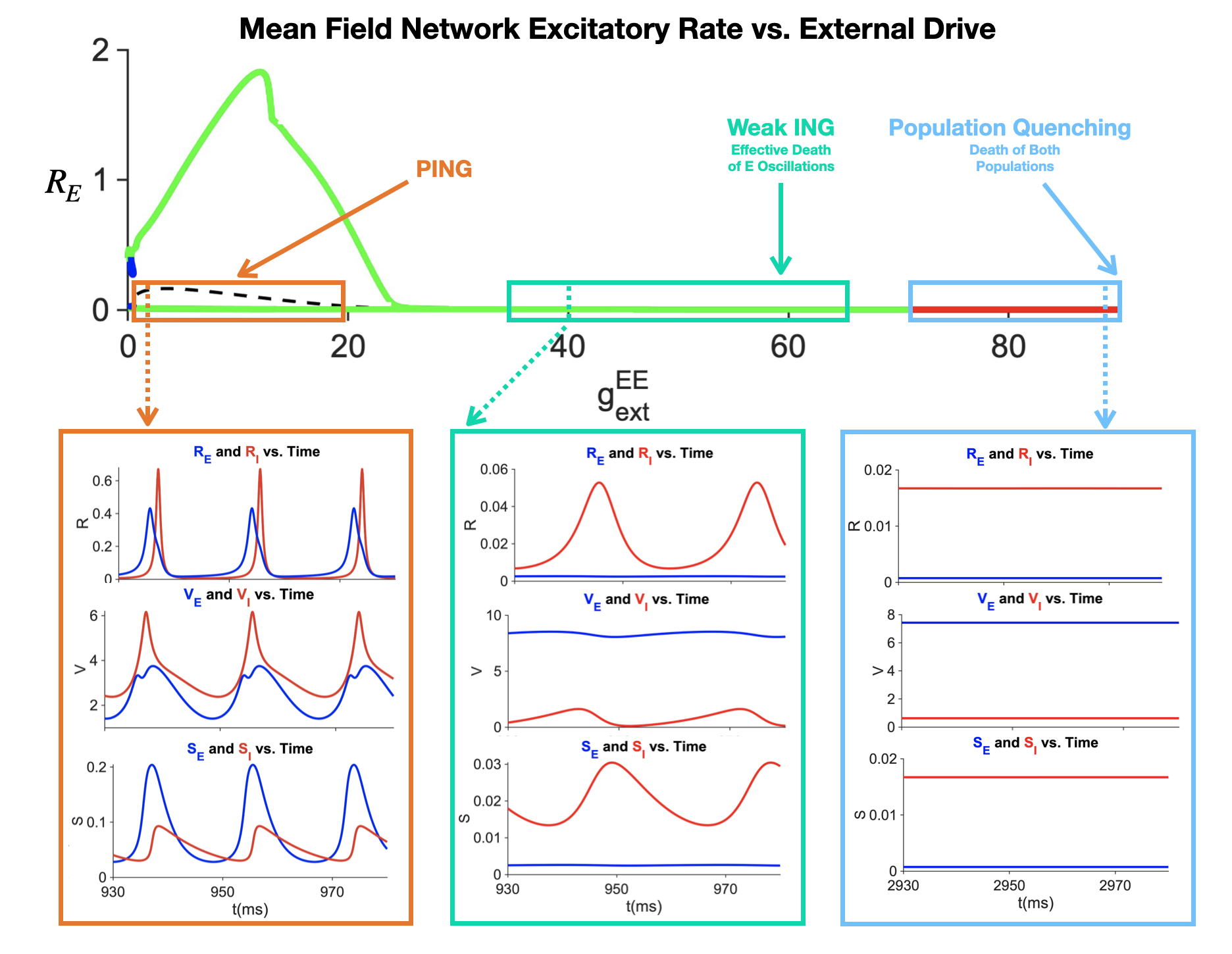 Figure 1. E-I Network dynamics as a function of external excitatory conductance drive in high input regime
References- Coombes, S., & Byrne, Á. (2019). Next generation neural mass models. In F. Corinto & A. Torcini (Eds.), Nonlinear Dynamics in Computational Neuroscience (pp. 1-16). Springer. https://doi.org/10.1007/978-3-319-71048-8_1
- Ermentrout, B. (1996). Type I membranes, phase resetting curves, and synchrony. Neural Computation, 8(5), 979-1001. https://doi.org/10.1162/neco.1996.8.5.979
- Keeley, S., Byrne, Á., Fenton, A., & Rinzel, J. (2019). Firing rate models for gamma oscillations. Journal of Neurophysiology, 121(6), 2181-2190. https://doi.org/10.1152/jn.00741.2018
- Montbrió, E., Pazó, D., & Roxin, A. (2015). Macroscopic description for networks of spiking neurons. Physical Review X, 5(2), 021028. https://doi.org/10.1103/PhysRevX.5.021028