IntroductionBridging the short-timescale of classic Hebbian learning and long-timescale of behavioral memory remains a challenge in the study of synaptic plasticity. The synaptic tag-and-capture theory proposes that activity-dependent molecular markers enable a state of synaptic stability [1], and it has been shown theoretically that multiple stability states enhance memory capacity [2]. Trafficking of the endoplasmic reticulum (ER) in and out of dendritic spines could viably serve as such a “tag” [3], but its effects on plasticity have yet to be studied in silico. We hypothesize that ER-mediated synaptic stabilization extends memory capacity and supports stable learning in neuronal microcircuits through activity-dependent modulation of plasticity.
MethodsWe model ER trafficking in dendritic spines using a piecewise deterministic Markov process with three synaptic states: ER−, ER+, and ER stable. Potentiation increases the probability of ER entry to a given synapse while depression promotes ER exit. Synaptic plasticity follows a calcium-based rule [4] where weight changes decay to baseline within minutes. However, ER+ synapses can transition to ER stable when activity elevates calcium above a threshold, resetting the baseline weight and enabling potentiation to persist over long timescales. The ER model is incorporated into recurrent networks of leaky integrate-and-fire neurons to test its impact on learning and memory through the lens of neuronal assemblies [5].
ResultsIn a single synapse subject to high-frequency stimulation, potentiation from the calcium-dependent plasticity rule will decay on the order of minutes without the presence of ER (Figure 1A). A second high-frequency stimulus first successfully draws the ER into the synapse and subsequently triggers ER stabilization, preserving synaptic potentiation over longer timescales (Figure 1B-C). We expect the differences in these timescales to play a significant role in learning and memory formation in in silico recurrent neuronal microcircuits.
DiscussionOur model of stochastic ER recruitment stabilizes the effects of potentiation in individual synapses in a biologically informed manner [3]. By extending the timescale of potentiation beyond that predicted by calcium-dependent plasticity alone, we expect to similarly affect the timescale of learning and memory in in silico microcircuits. Therefore, our model will generate experimentally testable predictions regarding the effects of ER-mediated stabilization on learning dynamics and long-term memory storage. These conclusions will be augmented by constraining the model parameters for ER visitation with experimentally measured dendritic ER distributions obtained from electron microscopy studies to make brain region specific predictions.
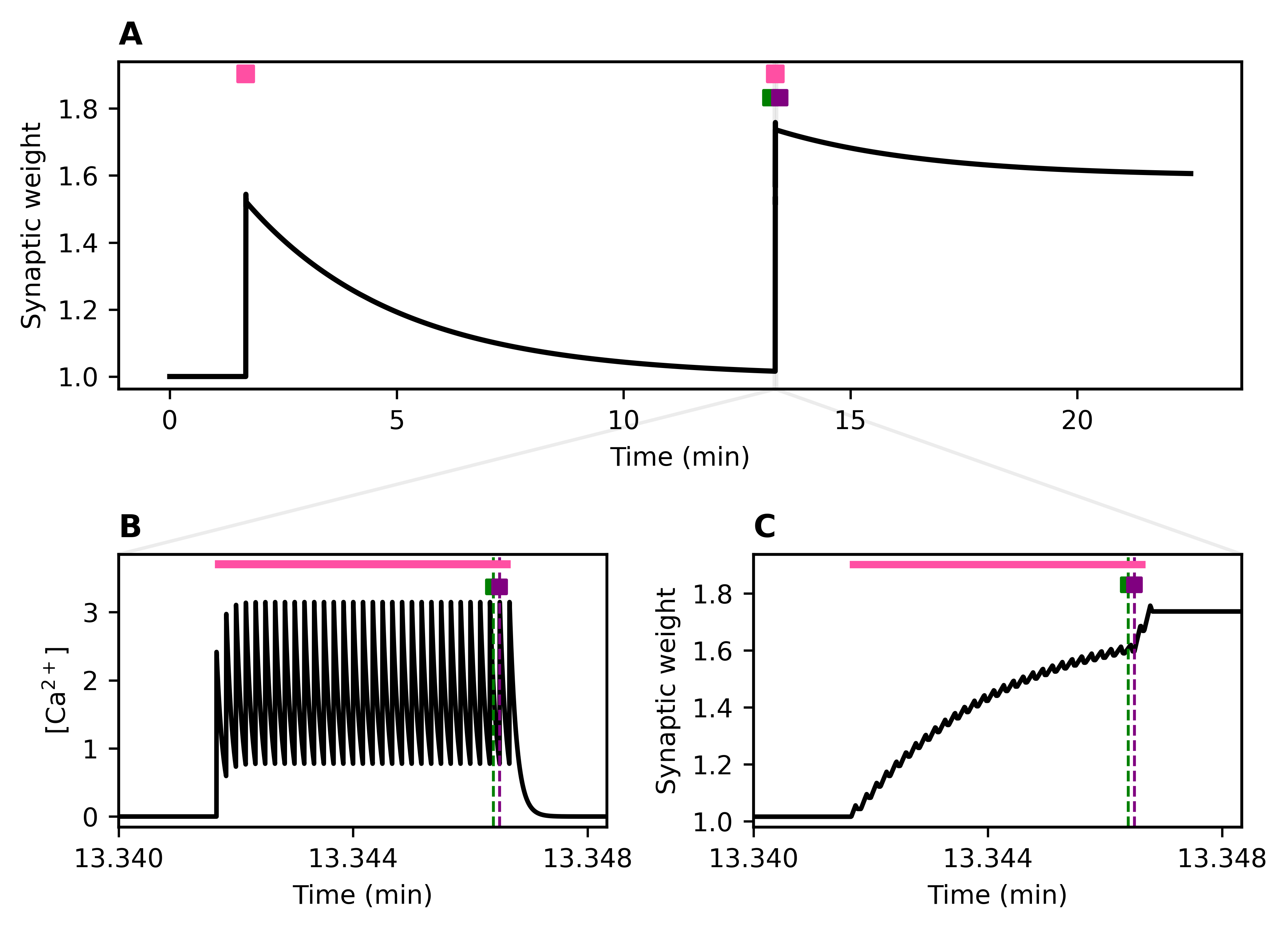 Figure 1. Stochastic activity-driven ER entry and stabilization preserve calcium-dependent plasticity over long timescales. (A) Identical high-frequency pre/post spike trains (pink) produce synaptic weight changes; the first stimulation fails to trigger ER entry, while the second induces ER entry (green) followed by stabilization (purple). (B–C) Insets show calcium (left) and weight (right) dynamics
References1. Redondo et al. (2011). Making memories last: the synaptic tagging and capture hypothesis. Nat Rev Neurosci 12, 17–30.
2. Fusi et al. (2005). Cascade models of synaptically stored memories. Neuron, 45(4), 599–611.
3. Dittmer et al. (2024). L-type Ca
2+ channel activation of STIM1-Orai1 signaling remodels the dendritic spine ER to maintain long-term structural plasticity. Proc Natl Acad Sci USA., 121(35), e2407324121.
4. Moldwin et al. (2025). A generalized mathematical framework for the calcium control hypothesis describes weight-dependent synaptic plasticity. J Comput Neurosci 53, 333–357.
5. Miehl et al. (2023). Formation and computational implications of assemblies in neural circuits. J physiol, 601(15), 3071–3090.
AcknowledgementNone.