IntroductionfMRI foundation models have grown rapidly in size [1-2], but scale may be suboptimal for neuroimaging given domain constraints and interpretability needs. BrainSymphony instead embeds neurobiological priors to build a lightweight, parameter-efficient, multimodal model capturing spatiotemporal BOLD dynamics and diffusion-MRI connectivity. We test out-of-distribution generalization on PsiConnect (62 participants; pre/post psilocybin; rest, meditation, music, movie) and relate model-derived dynamics to MEQ-30 mystical-type experience ratings. BrainSymphony reconstructs unseen fMRI time series with high fidelity and exposes fine-grained psychedelic network reorganization beyond classical functional connectivity.
MethodsBrainSymphony uses three fMRI encoders: an ROI-wise Spatial Transformer with mixed positional embeddings (including cortex-gradient priors), a Temporal Transformer with sinusoidal time embeddings, and a 1D convolutional stream for short-range transients. Encoder outputs are fused by a Perceiver module. We applied a frozen model pretrained on HCP/HCP-Aging to PsiConnect (baseline and psilocybin; rest, meditation, music, movie). Reconstruction was quantified by R², Pearson r, and MAE against ROI-shuffled controls. Directed influence matrices were computed from Perceiver attention (incoming/outgoing) and used to decode context and to characterize psilocybin–baseline reorganization, including modulation by experience intensity.
ResultsBrainSymphony reconstructed unseen psychedelic fMRI with high fidelity; R² and Pearson r exceeded shuffled controls (Fig. 1). Directed influence matrices decoded rest/meditation/music/movie at baseline (~0.64) and remained above chance under psilocybin (~0.46; chance 0.25), consistent with reduced modular boundaries and increased integration. Psilocybin increased outgoing influence in DMN, Control, and Visual networks, suggesting reduced DMN autonomy. Incoming influence highlighted Visual cortex as a dominant driver even in eyes-closed states, with limbic/salience drivers strongest in affective contexts. These effects scaled with Mystical Experience Questionnaire intensity with conventional functional connectivity failing to identify them.
DiscussionCompact, domain-informed foundation models can be predictive and mechanistically useful. BrainSymphony’s attention-derived directed influence reveals psilocybin-driven redistribution of large-scale communication that tracks behavioral context and subjective intensity of the experience. Visual territories emerge as consistent drivers even with closed eyes, aligning with internally generated imagery; limbic circuits amplify during emotionally rich contexts; DMN/Control/ systems show condition-specific increases in being influenced, reflecting decreased segregation and increased integration. BrainSymphony demonstrates that efficiency and interpretability can coexist with strong generalization.
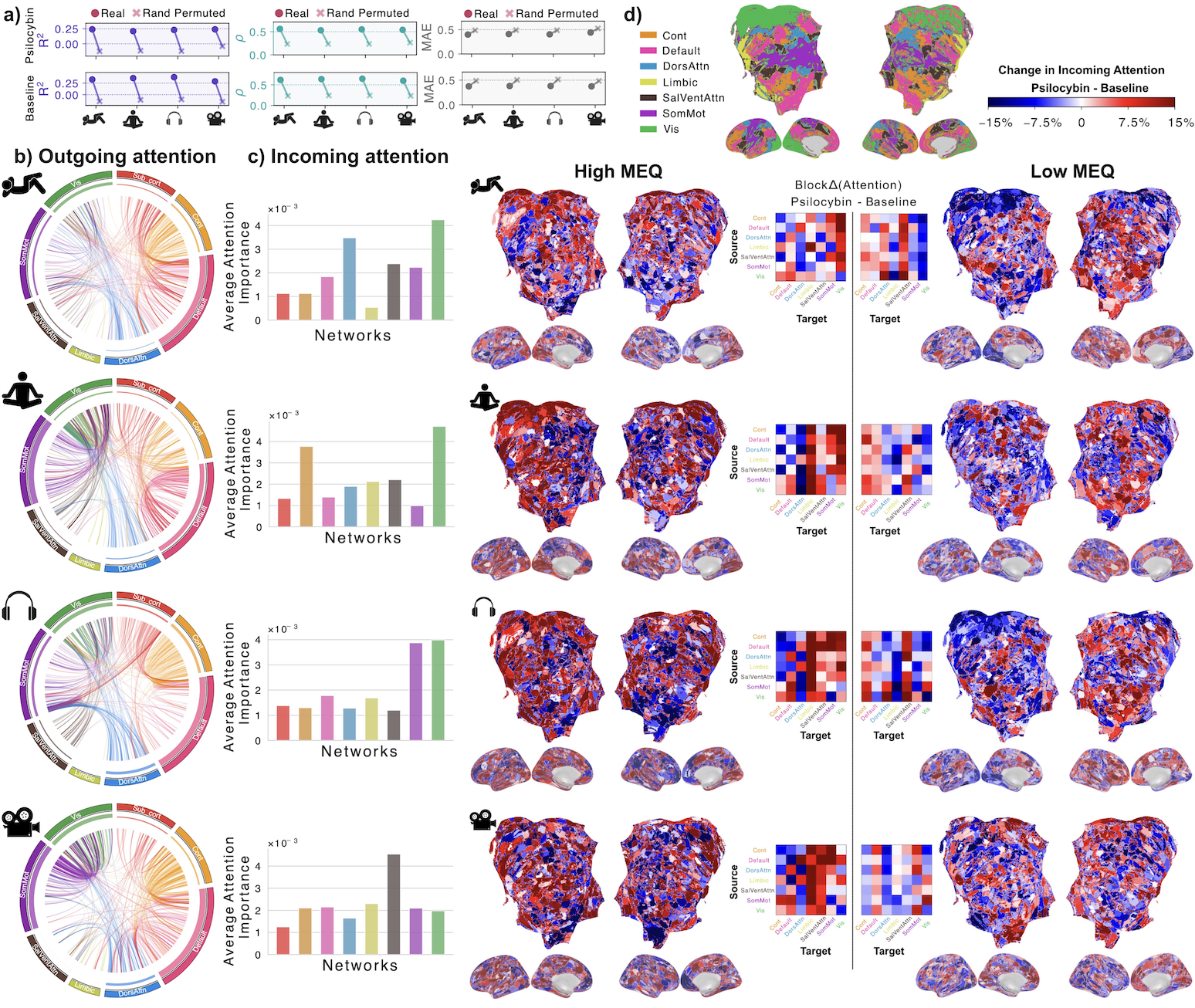 Figure 1. BrainSymphony reconstruction and attention-based reorganization. (a) Paired dots: real vs permuted ROI series across conditions; higher R²,r, lower MAE. (b) Circos: Admin–Baseline attention Δ (top 500 edges) colored by source network; inner track = total outgoing. (c) Network-mean incoming attention Δ. (d) High vs Low MEQ receptive-attention maps plus inter-network Δ matrices.
References1. Caro, J. O., Fonseca, A. H. D. O., Averill, C., Rizvi, S. A., Rosati, M., Cross, J. L., ... & van Dijk, D. (2023). BrainLM: A foundation model for brain activity recordings. BioRxiv, 2023-09.
2. Dong, Z., Li, R., Wu, Y., Nguyen, T. T., Chong, J., Ji, F., ... & Zhou, J. H. (2024). Brain-jepa: Brain dynamics foundation model with gradient positioning and spatiotemporal masking. Advances in Neural Information Processing Systems, 37, 86048-86073.
3. Stoliker, D., Novelli, L., Khajehnejad, M., Biabani, M., Barta, T., Greaves, M. D., ... & Razi, A. (2025). Psychedelics align brain activity with context. bioRxiv, 2025-03.
AcknowledgementA.R. is affiliated with The Wellcome Centre for Human Neuroimaging, supported by core funding from Wellcome [203147/Z/16/Z]. A.R. is a CIFAR Azrieli Global Scholar in the Brain, Mind & Consciousness Program.