IntroductionUnderstanding and developing computational models of neurons relies on complementary views, such as voltage traces, activity mapped onto morphology, and channel kinetics. Interactive adjustment of parameters can further expose how model mechanisms shape dynamics. Existing support spans simulator-native interfaces [1], model platforms [2,3], network builders [4], and model-tuning environments [5], but these often require working within a particular simulator, platform, or model representation. CompNeuroVis addresses the gap between general-purpose plotting and specialized tools by helping researchers assemble interactive applications around workflows they already use.
MethodsCompNeuroVis is a Python toolkit for building interactive applications around existing models and data. In a compositional style similar to common scientific plotting libraries, the user defines a source, such as a runnable simulation, Python model, or recorded data stream, then adds views and controls. The application is launched with a single call (Fig. 1). Views are extensible: current examples include trace plots, morphology views, and state diagrams, with raster and network views in progress. Controls adjust parameters and other settings live. Each composition reduces to a shared specification of data, views, controls, and synchronizing messages, allowing the same application to run across sources and within notebooks.
ResultsWe demonstrated the toolkit across several workflow classes. For a compartmental NEURON model with Hodgkin-Huxley dynamics, we built an interactive application with controls that modify parameters during execution and a morphology view that color-codes spatial variables while allowing compartments to be selected for plotting [1]. We reproduced these views for an equivalent Jaxley model, illustrating use across simulators. We also interfaced with user-defined models such as LIF neurons written in Python, embedded a live interface within a Jupyter notebook, and created state diagrams for Markov-based ion channel models and 3D surface plots for higher-dimensional data.
DiscussionCompNeuroVis complements existing computational neuroscience interfaces by emphasizing low-friction integration with the code, models, data, and simulators researchers already have. Rather than introducing a new simulator, platform, or model format, it provides reusable components for assembling individualized interactive applications. Because each application reduces to a shared specification, the same components can extend to networked interfaces and purpose-built tools, from model editors and teaching interfaces to remote simulator dashboards and multi-simulator comparison views. This supports model development, teaching, debugging, and exploratory analysis, all of which help researchers build intuition about neural mechanisms.
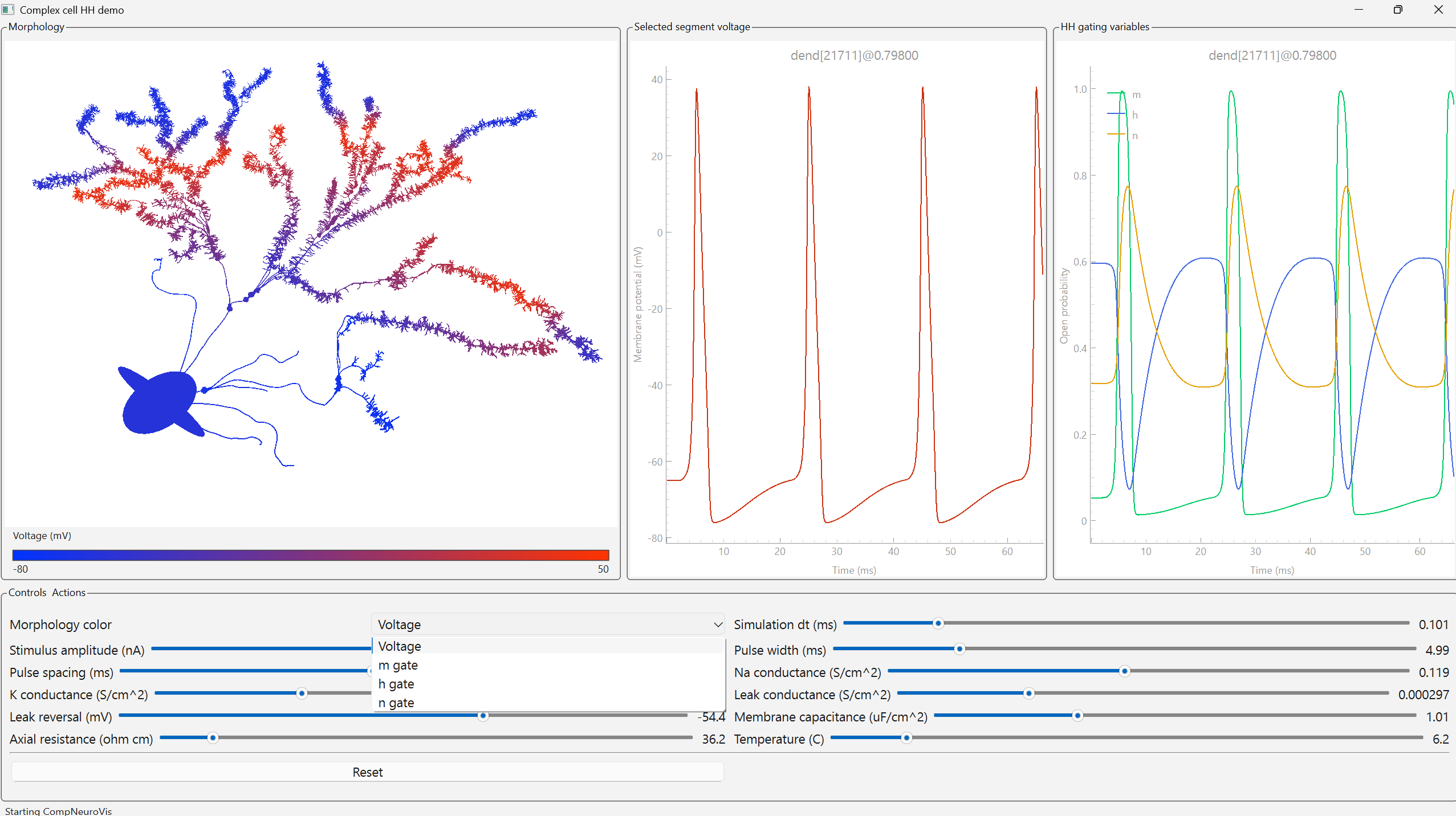 Figure 1. A CompNeuroVis application built around a compartmental NEURON model of a reconstructed cell with Hodgkin-Huxley dynamics. The morphology is color-coded by a selected variable, here membrane voltage. For a selected segment, linked plots show membrane voltage and the gating variables m, h, and n. A dropdown sets the mapped variable and sliders adjust stimulus and biophysical parameters.
References- Hines, M. L., & Carnevale, N. T. (1997). The NEURON simulation environment. Neural Computation, 9(6), 1179-1209. https://doi.org/10.1162/neco.1997.9.6.1179
- Gleeson, P., et al. (2019). Open Source Brain: A collaborative resource for standardized models. Neuron, 103(3), 395-411.e5.
- Cantarelli, M., et al. (2018). Geppetto: A reusable modular open platform for neuroscience data and models. Philosophical Transactions B, 373(1758), 20170380.
- Dura-Bernal, S., et al. (2019). NetPyNE, a tool for data-driven multiscale modeling of brain circuits. eLife, 8, e44494.
- Makarov, R., Chavlis, S., & Poirazi, P. (2025). DendroTweaks: An interactive approach for unraveling dendritic dynamics. eLife, 13, RP103324.
AcknowledgementI thank Ethan Irby (Research Assistant, Nathan Kline Institute) for ideas on use cases and capability requirements, and the open-source computational neuroscience community and simulator developers whose tools and discussions informed this work.