IntroductionThe auditory periphery efficiently transmits sparsely encoded information to cochlear nuclei and higher centers while preserving acoustic features. Lateral inhibition among cochlear hair cells and cochlear nucleus neurons increases sparsity, improves frequency selectivity and resolution. Outer hair cells (OHC) dynamically modulate cochlear responses through stiffness changes, hypothesized to refine frequency tuning and receptive fields of inner hair cells (IHC).
Inspired by these mechanisms, we implement a sparse coding approach using a lateral inhibitory neuromorphic network. We propose the Adaptive Central Frequencies Locally Competitive Algorithm (ALCA-CF), which adapts neuronal parameters to optimize acoustic signal representation [1].
MethodsALCA-CF optimizes offline the IHC gammachirp models by adapting receptive field sensitivity to the acoustic environment. This partially mimics the online adaptability of OHC, where stiffness changes affect IHC responses. Additionally, lateral inhibition in ALCA-CF enhances frequency resolution while maintaining sparse coding, like mechanisms in the cochlear system (see Fig. 1). By separately analyzing the impact of bandwidth, central frequency changes, and sparsity of the IHC models, we quantify their influence on signal quality and recognition. We also show that this processing produces state-of-the-art (SOTA) speech representations enabling SOTA classification with much smaller and simpler spiking neural networks.
Results
ALCA-CF improves reconstruction quality and sparsity over fixed Gammatone filter bank. On Heidelberg Digits, ALCA-CF achieves an SNR of 15.35 dB (+5.52 dB vs. fixed filters) and reduces sparsity by 17.53%. Similar gains are observed on Google Speech Commands (SNR: 23.04 dB). ALCA-CF learns a non-linear frequency resolution, removing information in irrelevant frequency intervals while concentrating coefficients in relevant ones, yielding sparser and more efficient speech representations. On Intel's Loihi 2 [2], a neuromorphic chip, ALCA-CF reaches 94.88% speech classification accuracy at 0.004 W, a 5.25× reduction vs. fixed filters (0.021 W) and 3.75× vs. LAUSCHER silicon cochlea [3] SHD (0.015 W), which achieved a lower accuracy of 83.77%.DiscussionALCA-CF provides an adaptive front-end trained independently of any target application, distinguishing it from supervised approaches where the front-end is optimized for a specific task. This independence makes it highly versatile, as the same method has the potential to adapt to acoustic signals of varying nature, including speech, environmental sounds, and music. Furthermore, ALCA-CF offers the ability to modulate the number of active filters based on data complexity and signal nature, enabling a flexible trade-off between representation accuracy and computational efficiency. This flexibility is particularly advantageous for embedded neuromorphic systems, where energy constraints demand sparse and content-adaptive representations.
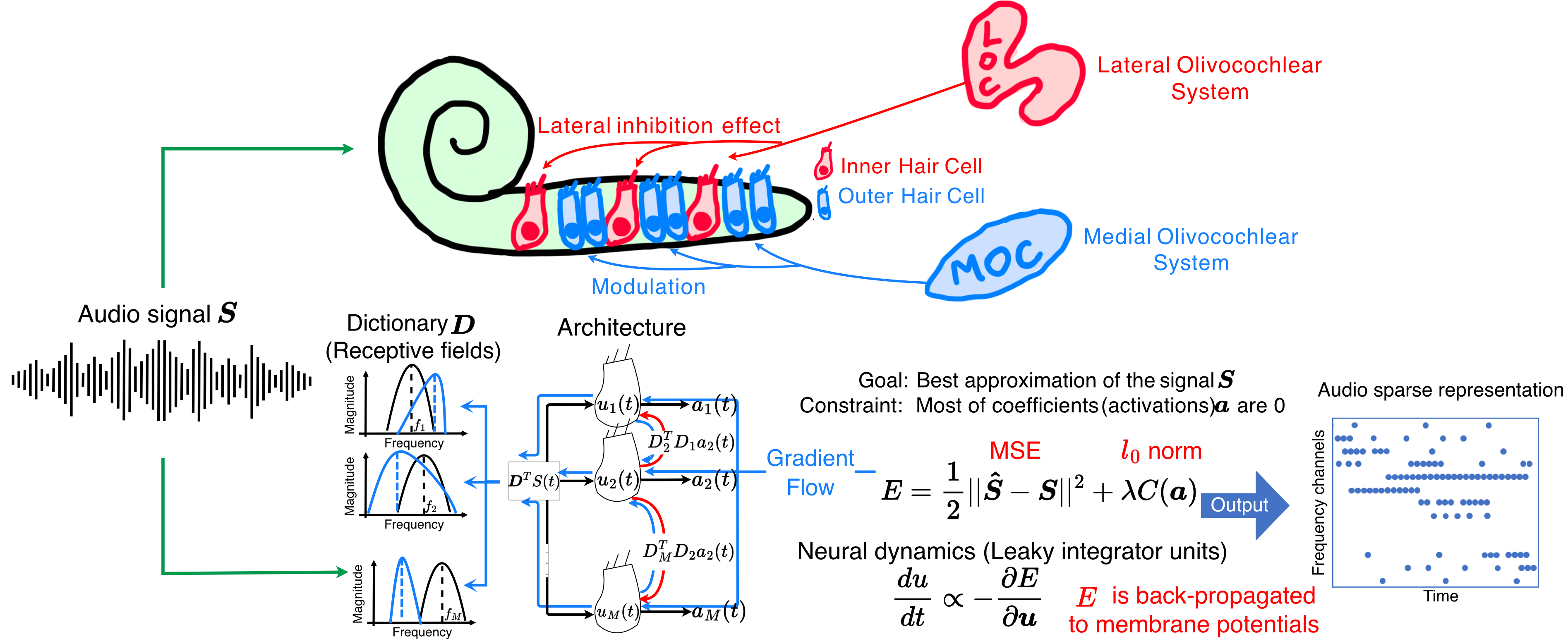 Figure 1. Overview of the ALCA-CF front-end. Each filter is represented by a neuron with a receptive field. Red arrows are lateral inhibition synapses and blue arrows are the feedback that adapts each neuron's receptive field. Lateral inhibition weights are the correlation between pre- and post-synaptic neuron receptive fields. Neuron activations ai are represented by blue dots in the time-frequency output.
References[1] Bahadi, S., Plourde, E., & Rouat, J. (2025, April). Adaptive Central Frequencies Locally Competitive Algorithm for Speech. In ICASSP 2025-2025 IEEE International Conference on Acoustics, Speech and Signal Processing (ICASSP) (pp. 1-5). IEEE. https://doi.org/10.1109/ICASSP49660.2025.10887648
[2] Orchard, G., et al. (2021, October). Efficient neuromorphic signal processing with loihi 2. In 2021 IEEE workshop on signal processing systems (SiPS) (pp. 254-259). IEEE. https://doi.org/10.1109/SiPS52927.2021.00053
[3] Cramer, B., et al. (2020). The heidelberg spiking data sets for the systematic evaluation of spiking neural networks. IEEE Transactions on Neural Networks and Learning Systems, 33(7), 2744-2757. https://doi.org/10.1109/TNNLS.2020.3044364
AcknowledgementThank the ”Fonds de recherche du Québec - Nature et technologies” and ”Natural Sciences and Engineering Research Council of Canada” for funding this research. We extend our appreciation to NVIDIA for donating the GTX1080 and Titan Xp GPUs. We thank Intel for giving us access to Loihi 2 and Andreas Wild for his insights on the power/energy benchmark.