IntroductionFor 15 million patients worldwide with drug-resistant epilepsy, neurostimulation is a promising solution to counteract seizure activity [1]. However, current neurostimulation devices are unable to provide personalized or adaptive care due to their over reliance on pre-programmed responses that use fixed stimulation parameters [2]. A new framework for characterizing seizure dynamics is needed to design effective stimulation. Fractional-order dynamical networks accurately capture multi-scale neural dynamics and the spatial relationship between brain regions [3]. Here, we provide a stabilizing fractional-order dynamical framework to characterize seizure dynamics across epileptic states and effectively suppress epileptic activity.
MethodsUsing intracranial EEG data recorded from 10 focal epilepsy patients, we explicitly model the multi-scale temporal structure (captured by fractional-order exponents) and stability properties (captured by eigenvalues of fractional-order systems) across interictal, pre-ictal, ictal, and post-ictal brain states. We apply the Kolmogorov-Smirnov 2-sample statistical test to fractional-order exponents and eigenvalues during different brain states to understand the evolution of brain dynamics across patients. We apply a novel stabilizing control framework to 35 seizure snapshots. We simulate the controlled signals and compute their difference in energy with uncontrolled epileptic data to assess effective suppression.
ResultsOur results show that our framework can capture consistent and distinct patterns over all epileptic brain states in multi-scale and stability properties across most patients. Median fractional-order exponents decreased from interictal (0.75) to pre-ictal (0.68) and ictal (0.63) and then increased during post-ictal (0.78). Eigenvalues followed a similar trend as fractional-order exponents. We observed increased variance of eigenvalues during post-ictal. Our stabilizing control framework achieved seizure suppression in 34/35 seizures, successfully stabilizing 77% of initially unstable seizures and reducing seizure amplitude by approximately 49% across all electrodes.
DiscussionThe decrease in fractional-order exponent values during interictal to ictal indicates a progressive strengthening of long-range temporal memory as the seizure approaches, which is consistent with critical slowing [4]. Furthermore, the wide spread in fractional-order exponents during post-ictal likely suggests variable long range temporal memory properties post-seizure, without returning to baseline interictal levels. Tracking fractional-order exponents may be useful for seizure prediction in future studies. In this work, we demonstrate the capability of our state-of-the-art stabilizing state feedback control scheme to effectively suppress epileptic activity in a computationally tractable control manner that is straightforward to implement.
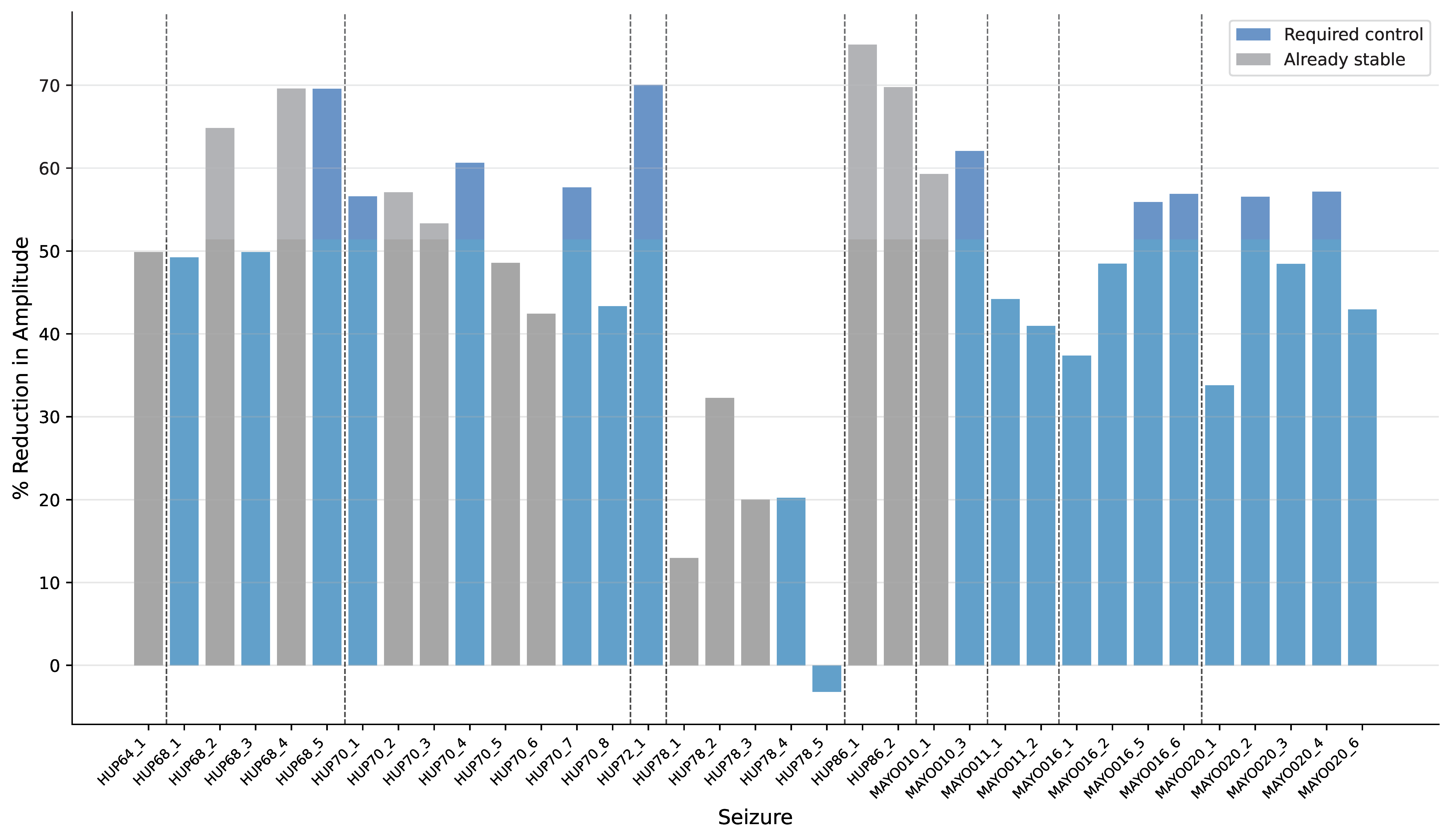 Figure 1. Percentage amplitude reduction for each seizure. Gray bars represent seizures that are already stable (maximum eigenvalues < 1), while blue bars indicate seizures that require stabilization. Vertical dashed lines separate patients. Only 1 seizure increased in amplitude after control. Control reduced amplitude by an average of 48.96% + 16.94%.
References[1] Edwards, C. A., Kouzani, A., Lee, K. H. & Ross, E. K. Neurostimulation devices for the treatment of neurologic disorders. In Mayo Clinic Proceedings, vol. 92, 1427–1444 (Elsevier, 2017).
[2] Morrell, M. J. Responsive cortical stimulation for the treatment of medically intractable partial epilepsy. Neurology 77, 1295–1304 (2011).
[3] Reed, E., Chatterjee, S., Ramos, G., Bogdan, P. & Pequito, S. Fractional cyber-neural systems—a brief survey. Annual Reviews in Control 54, 386–408 (2022).
[4] Maturana, M. I. et al. Critical slowing down as a biomarker for seizure susceptibility. Nature communications 11, 2172 (2020).
AcknowledgementEP gratefully acknowledges the support of Texas Tech University. GR is funded by national funds through FCT – Fundação para a Ciência e a Tecnologia, I.P., and, when eligible, co-funded by EU funds under project/support UID/50008/2025 – Instituto de Telecomunicações, with DOI identifier
https://doi.org/10.54499/UID/50008/2025.