IntroductionFocal task-specific dystonia (FTSD) is an isolated dystonia in which abnormal contractions emerge during a particular motor activity or task while other movements remain relatively spared [1]. We propose that FTSD arises when a task-specific motor synergy (TSMS) in primary motor cortex (M1) develops excitatory synapses that outpace parvalbumin (PV)-mediated inhibitory synapses, a mechanism consistent with reduced motor cortical inhibition reported in FTSD [2,3]. This imbalance gives rise to a symptom-threshold: motor output remains normal at or below a critical task intensity, whereas the dystonic synergy is recruited once that threshold is exceeded.
MethodsUsing a single-case clinical chronology as motivation, we built a proof-of-concept spiking neural network with leaky integrate-and-fire excitatory and inhibitory populations, conductance-based synapses, probabilistic E-to-I and I-to-E connectivity, and Poisson external drive. Input amplitude was varied as a proxy for movement intensity. We modeled two TSMS states: a functional synergy with matched excitatory and inhibitory drive and a dystonic synergy with elevated excitatory strength without proportional inhibitory strengthening. Network output was quantified as population-averaged firing rate across input amplitudes.
ResultsBalanced networks produced regular raster activity and firing rates that scaled with input, while inhibitory-cell activity rose in parallel (Fig. 1). In alternative E/I parameter regimes, stronger input recruited sufficient inhibitory feedback to stabilize or reduce firing after an initial rise. When functional and dystonic synergies coexisted, dystonic firing remained low at weak inputs but surpassed functional-synergy firing after a discrete input threshold. Thus, E/I imbalance generated an intensity-dependent switch from controlled output to hyperexcitable, dystonic-dominant activity.
DiscussionThese results support a TSMS account in which FTSD reflects a local M1 synergy whose excitatory circuit is selectively strengthened by repeated above-capacity practice (overreaching) while its PV-mediated inhibitory circuit fails to strengthen proportionally, rather than a solely global basal ganglia or cerebellar disorder. The threshold behavior explains why symptoms can be task- and intensity-specific. We further propose below- or at-threshold retraining (BATR), a non-invasive motor-retraining protocol conceptually related to slow-down exercise [4], in which practice is constrained to at or below the symptom-threshold to strengthen PV-mediated inhibition and restore E/I balance without further potentiating dystonic excitation.
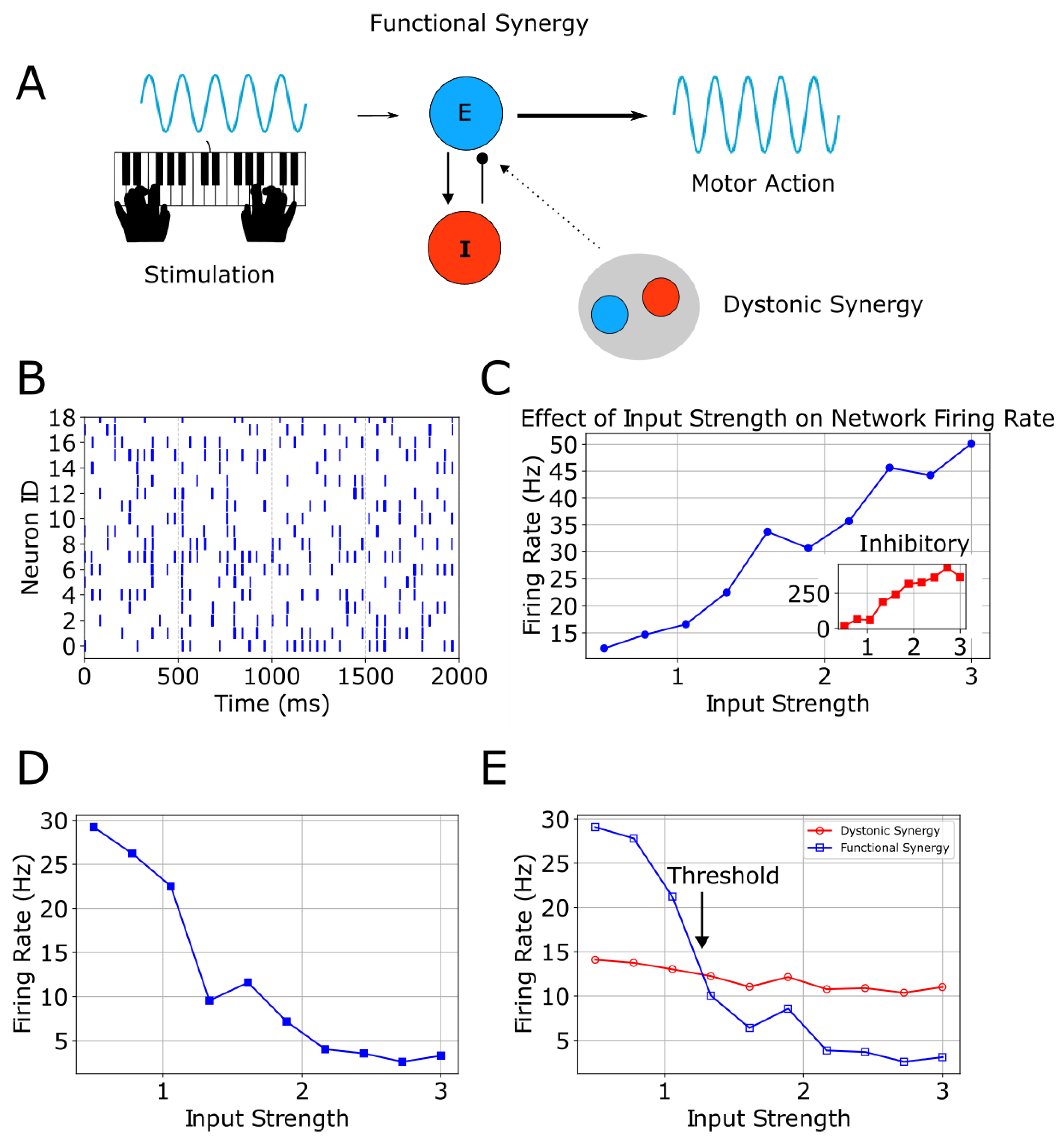 Figure 1. A, stimulation evokes motor action via functional excitatory/inhibitory synergy, with optional overlapping dystonic synergy. B, healthy-state raster shows regular spikes across neurons. C, firing rate increases with input strength; inset shows inhibitory activity. D, altered E/I balance produces a decreasing response. E, dystonic and functional firing diverge at a threshold across input levels.
References1. Albanese, A., et al. (2025). Definition and classification of dystonia. Movement Disorders, 40(7), 1248–1259.
2. Stahl, C. M., & Frucht, S. J. (2017). Focal task-specific dystonia: A review and update. Journal of Neurology, 264(7), 1536–1541.
3. Ridding, M. C., et al. (1995). Changes in the balance between motor cortical excitation and inhibition in focal, task-specific dystonia. Journal of Neurology, Neurosurgery & Psychiatry, 59(5), 493–498.
4. Yoshie, M., et al. (2015). Slow-down exercise reverses sensorimotor reorganization in focal hand dystonia: A case study of a pianist. International Journal of Neurorehabilitation, 2(2), 2376–0281.
AcknowledgementThe authors thank colleagues who provided helpful informal feedback on earlier versions of this work.