IntroductionDopamine-modulated STDP is a key implementation of the three-factor learning rule, in which synaptic changes depend on pre- and postsynaptic activity and a modulatory signal. Izhikevich's model introduced an eligibility trace that enables delayed dopaminergic rewards to reinforce earlier neural activity, supporting reward-based learning in recurrent spiking neural networks [1]. Previous studies showed that this framework promotes feedforward organization and spatiotemporal sequence encoding [2,3]. However, dopamine acts only as a gain factor, without altering the STDP function shape. Here, we introduce a modified rule that incorporates dopamine-dependent changes in the STDP window [4], yielding more biologically realistic learning behavior.
MethodsA recurrent spiking neural network of 2,000 Izhikevich neurons (1,600 excitatory, 400 inhibitory) was organized into 100 overlapping stimulus subgroups. Synaptic connectivity was random (p = 0.1). Dopamine-modulated STDP was implemented using either the original Izhikevich rule or a modified rule with separate pre–post and post–pre eligibility traces and a saturating dopamine function. During 7,000 s of training, randomly selected subgroups received stimuli at random intervals, while activation of subgroup S1 triggered delayed dopamine rewards. Learning was evaluated during a 200-s reward-free test phase using spike density function peaks and AUC-based stimulus discriminability.
ResultsIn the original Izhikevich model, reward-based learning remained robust across a broad range of dopamine concentrations, with selective responses (AUC ≥ 0.9) maintained even at unrealistically high levels. In contrast, the modified model exhibited an inverted-U dependence on dopamine concentration (Fig. 1). Learning emerged at low dopamine levels, peaked at intermediate concentrations, and deteriorated above ~2 μM, where responses to rewarded and non-rewarded stimuli became indistinguishable. A narrow intermediate range (0.8–1.2 μM) displayed bistability-like behavior, with identical dopamine levels producing either high- or low-performance states depending on network history and stochastic training dynamics.
DiscussionUnlike the original Izhikevich model, in which dopamine only scales synaptic plasticity, the modified STDP rule allows dopamine to reshape the plasticity window. This produced an inverted-U relationship between dopamine concentration and learning performance, restricting successful conditioning to a biologically plausible range. The model also exhibited a bistability-like regime, where identical dopamine levels yielded different learning outcomes depending on network history. High dopamine concentrations impaired learning, likely through excessive potentiation that disrupted feedforward organization. These findings provide a more biologically realistic framework for dopamine-dependent learning.
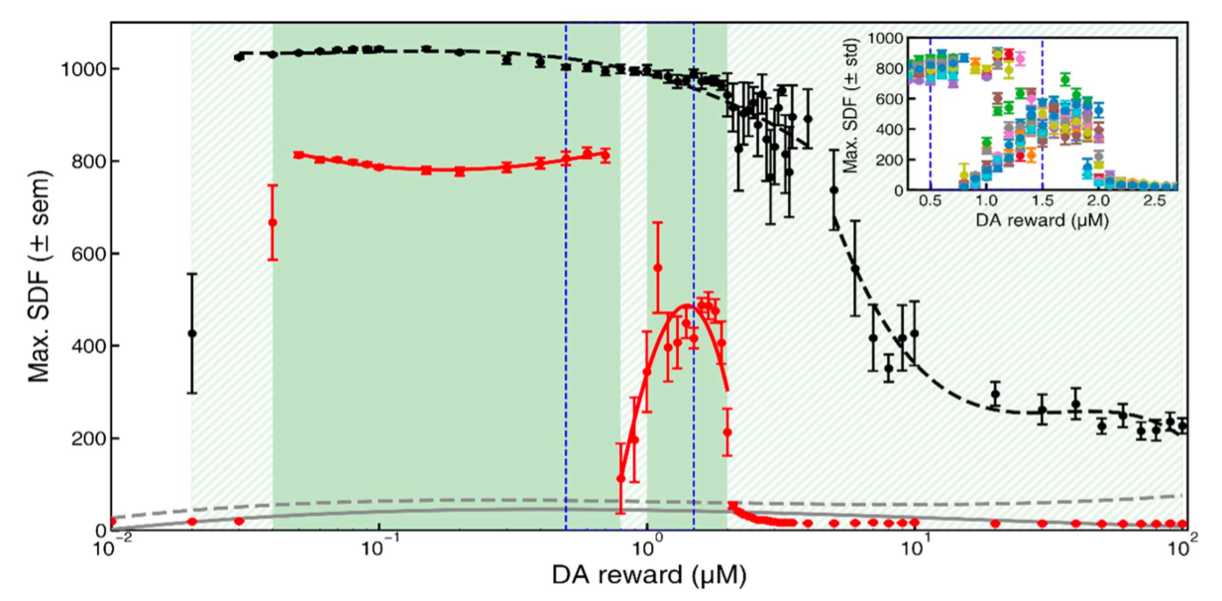 Figure 1. Learning performance as a function of dopamine reward concentration. Mean SDF peak responses during post-training testing are shown for the original Izhikevich model (black dashed line) and the modified model (red solid line), averaged over (N = 11) simulations; error bars indicate SEM. Gray curves represent responses to non-rewarded stimuli. Green shading marks regions with AUC ≥ 0.9.
References- Izhikevich, E. M. (2007). Solving the distal reward problem through linkage of STDP and dopamine signaling. Cerebral Cortex, 17(10), 2443–2452.
- Jeong, I. H. & Lee, K. J. Bursting dynamics and network structural changes towards and away from a pavlovian-conditioned neural network. PLOS Complex Systems 2, e0000035 (2025).
- Park, W., Kim, J., Jeong, I., & Lee, K. J. (2025). Temporal Pavlovian conditioning of a model spiking neural network for discrimination sequences of short time intervals. Journal of Computational Neuroscience, 53(1), 163–179.
- Zhang, J. C., Lau, P. M., & Bi, G. Q. (2009). Gain in sensitivity and loss in temporal contrast of STDP by dopaminergic modulation at hippocampal synapses. Proceedings of the National Academy of Sciences, 106(31), 13028–13033.
AcknowledgementThis work was supported by the National Research Foundation of Korea (NRF) grant funded by the Korea government (MSIT) (No. RS-2024-00335928).