IntroductionThe crystalline lens or eyeglasses induce spatial distortion of images on the retina, and the nervous system itself can introduce perceptual distortion. A previous study showed a correlation between perceptual distortion and the curvature of hand trajectories during reaching movements [1]. This suggests that perceptual distortion affects motor planning. On the other hand, adaptation to image skew changes the perception of unskewed geometrical patterns [2]. Similarly, barrel distortion, a type of lens distortion, might change the internal representation to perceive external straight lines as straight. We tested whether this distortion changes line perception and whether the internal representation affects motor planning of hand trajectories.
MethodsSeven participants performed an adaptation task in which an image of a grid with barrel distortion was displayed on a head-mounted display. During the task, participants were required to move their heads and gaze in multiple directions. Pre- and post-adaptation changes were evaluated using two tasks: (1) a curvature discrimination task to measure the point of subjective equality (PSE) by having participants judge the convexity (upward or downward) of lines presented in the upper or lower visual field, and (2) a reaching task measuring hand trajectory curvature during straight hand movements toward targets in either visual field. The study protocol was approved by the Institutional Review Board at Yamaguchi University.
ResultsCompared with the pre-adaptation test, the mean PSE in the post-adaptation test shifted in a direction consistent with the hypothesis that adaptation to barrel distortion leads to the perception of more outwardly curved lines as straight, in both the upper and lower visual fields. This shift was statistically significant in the upper visual field (t(X) = −2.99, p = 0.024, Fig. 1), and below the significance level in the lower visual field (t(X) = 0.59, p = 0.58). Regarding the reaching task, the initial movement direction did not change significantly across any conditions, regardless of the movement direction (leftward or rightward) or visual field (upper or lower).
DiscussionThe PSE shift supports the hypothesis that the internal representation of line is acquired through perceptual learning. This implies that the concept of a straight lines might also be acquired as the brain constructs a consistent representation from images that appear in various shapes depending on their retinal positions.
No observed change in the initial hand direction in reaching movements indicates that the internal spatial representation based on visual stimuli does not directly affect motor control, implying that perceptual spatial representations differ from those used in motor planning of hand trajectories.
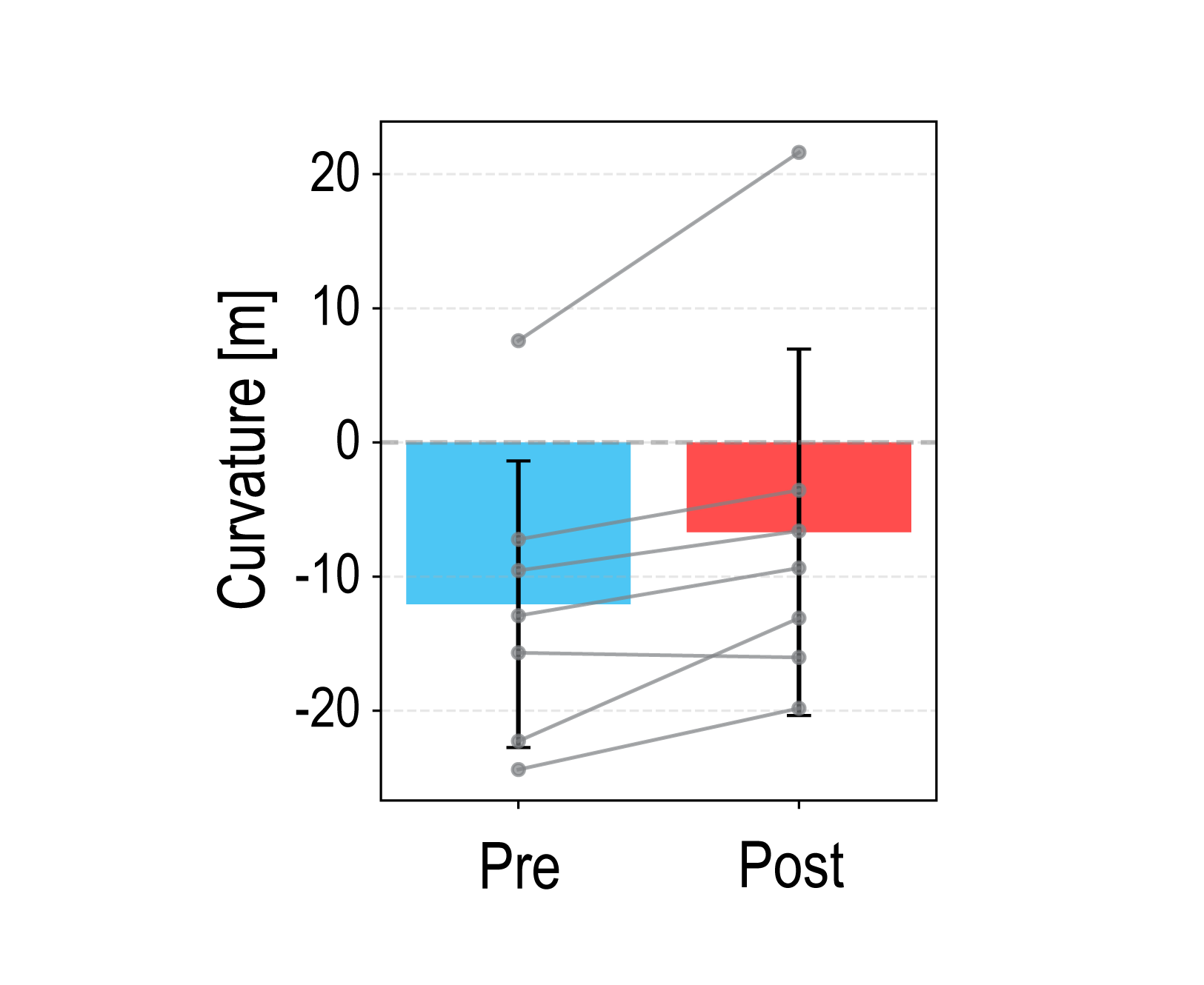 Figure 1. Mean PSE curvature across participants in pre- and post-adaptation curvature discrimination tests. Error bars represent the standard deviation. Positive and negative values indicate an upward- and downward-convex curves, respectively. Gray dots represent individual participant data.References
- Wolpert, D. M., Ghahramani, Z., & Jordan, M. I. (1995). Are arm trajectories planned in kinematic or dynamic coordinates? An adaptation study. Experimental brain research, 103(3), 460-470. https://doi.org/10.1007/BF00241505
- Habtegiorgis, S. W., Rifai, K., Lappe, M., & Wahl, S. (2017). Adaptation to skew distortions of natural scenes and retinal specificity of its aftereffects. Frontiers in Psychology, 8, 1158. https://doi.org/10.3389/fpsyg.2017.01158
AcknowledgementThis work was supported by the Sasakawa Scientific Research Grant from The Japan Science Society and by AMED under Grant Number JP26wm0625418h0002.