IntroductionWhole-brain maps of structural and functional features provide complementary views of cortical organization [1]. Despite their diversity, these maps exhibit structured spatial patterns, suggesting that common organizing principles shape the topographic distribution of biological features across the cortex. To better understand the underlying forces shaping brain organization, we quantified the homophily - the propensity for brain regions proximal in physical, connectivity, or biological spaces to exhibit similar properties – of 43 brain maps [2], introduce a generative framework that preserves empirical homophilic structures, then use it to identify patterns of unexplained variation and build biologically rich null models.
MethodsHomophily was quantified using Moran’s I [3], with respect to six inter-regional relationship matrices capturing geodesic proximity, structural and functional connectivity, as well as laminar, receptor, and genetic similarity. We then developed a generative model preserving the multimodal homophilic structure of empirical maps. Starting from random initial conditions, simulated annealing iteratively permuted regional values to minimize differences in Moran’s I across all modalities simultaneously (Fig. 1a). We generated 500 surrogate maps for each empirical map to quantify reconstruction accuracy and estimate the unique contribution of each modality. Residuals were also analyzed to identify patterns of unexplained variation.
ResultsHomophily varied markedly across brain maps. Most maps were more strongly aligned with receptor and transcriptomic similarity than with geodesic proximity. Surrogate maps generated by preserving multimodal homophily accurately reproduced empirical topographies (Fig. 1b), with reconstruction accuracy strongly related to overall homophily (r=0.94). Leave-one-out analyses identified receptor similarity as the largest unique contributor, followed by gene similarity and functional connectivity. Residual analyses revealed four reproducible axes of unexplained variation, suggesting the existence of additional biological and methodological influences not captured by the modeled constraints.
DiscussionWe show that homophily provides a unifying framework for understanding whole-brain topographies. Brain maps were more strongly aligned with receptor and transcriptomic similarity than with geodesic proximity, indicating that biological similarity capture aspects of cortical organization that cannot be accounted for by geometry alone. By preserving multimodal homophilic structures, our generative model accurately reconstructed empirical maps and exposed reproducible residual patterns that may reflect additional organizational principles or methodological influences. More broadly, this framework enables the creation of biologically-informed surrogate models, providing a powerful tool for hypothesis testing in neuroscience.
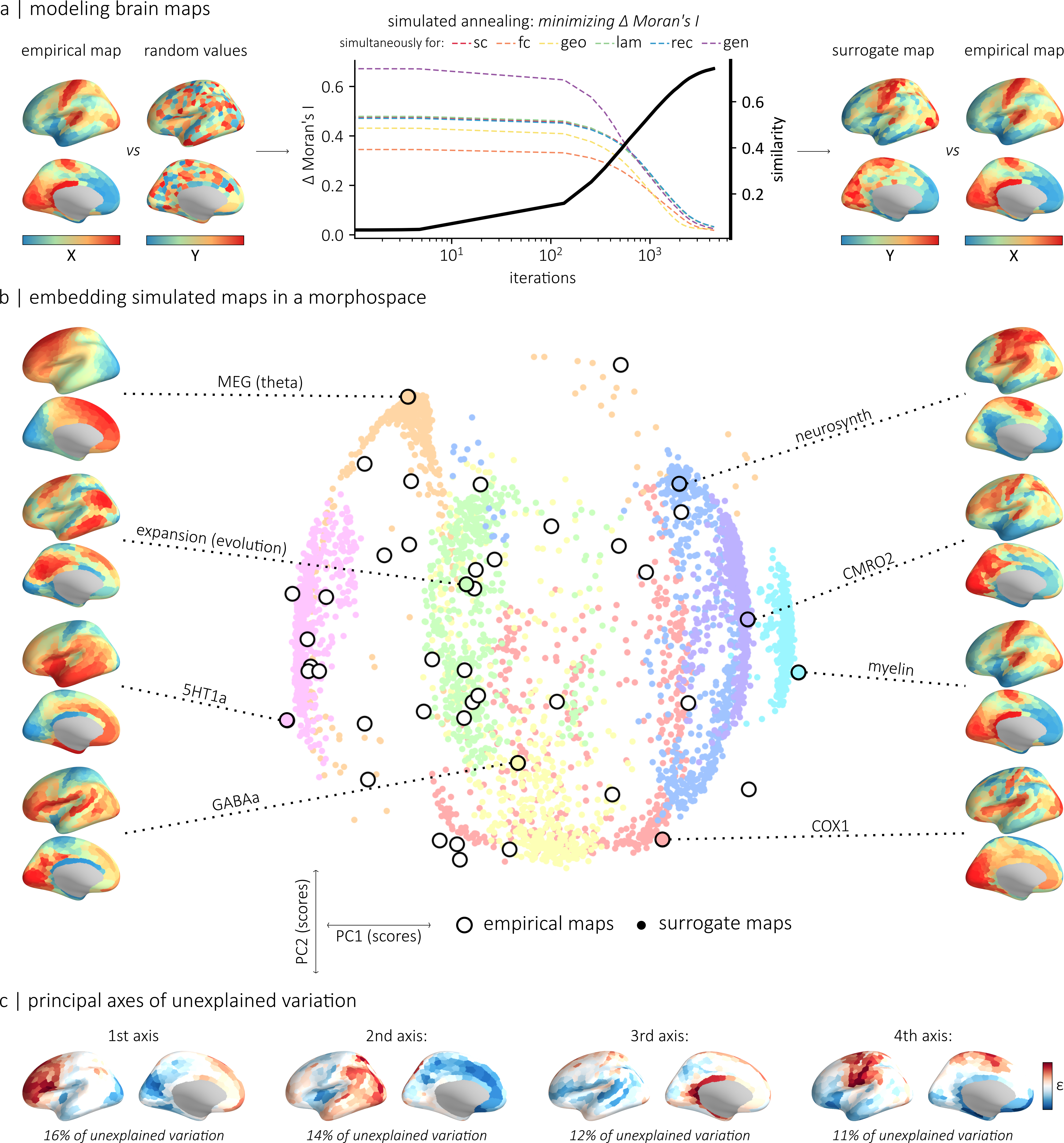 Figure 1. (a) The generative model relies on simulated annealing to randomly permute values while minimizing the difference in autocorrelation between empirical and simulated maps. (b) Morphospace summarizing the topographic properties of the empirical and simulated maps. (c) We identified the four main axes of variance in a matrix of regional difference between simulated and empirical values.
References[1] Hansen, J. Y., & Misic, B. (2025). Integrating and interpreting brain maps. Trends in Neurosciences,
48 (8): 594–607.
[2] Markello, R. D., Hansen, J. Y., Liu, Z.-Q., Bazinet, V., Shafiei, G., Suárez, L. E., Blostein, N., Seidlitz, J., Baillet, S., Satterthwaite, T. D., Chakravarty, M. M., Raznahan, A., & Misic, B. (2022). neuromaps: structural and functional interpretation of brain maps. Nature Methods,
19 (11): 1472–1479.
[3] Moran, P. A. P. (1950). Notes on Continuous Stochastic Phenomena. Biometrika. 37 (1): 17–23.
AcknowledgementWe thank Justine Y. Hansen, Eric. G. Ceballos, Yigu Zhou, Asa Farahani, Tahmineh Taheri and Moohebat Pourmajidian for their comments and suggestions.