IntroductionThe BiLex model simulates the bilingual language system: two phonetic self-organizing maps (SOMs) represent English and Spanish words, linked to a shared semantic map via bidirectional associative connections (Fig.1a) [1]. Traditional SOMs use neighborhood activations; the laterally-connected BiLex uses short-range excitation and long-range inhibition, enabling mechanistic examination of within- and between-map lexical-semantic interactions. Semantic effects — familiarity, typicality, and specificity — can emerge from lateral interactions. Lateral excitation-inhibition focuses activation over settling steps, providing a novel response time measure. Naming accuracy and response time were examined in English and Spanish.
MethodsPhonetic representations used IPA-based feature encodings. Semantic representations, superordinate membership, and typicality were defined using GPT-4o [2] (>90% MTurk agreement): feature semantics and superordinate-subordinate pairs (yes/no word-feature queries e.g., "is apple a fruit?"; typicality as a 0-1 category-membership rating. SOMs were trained by word-frequency sampling (a familiarity proxy), learning boosted or penalized based on expected representation. Learned connections linked all maps, superordinates on the phonetic map via subordinates. Naming was simulated by presenting a word to the semantic map, driving lateral interactions within and between maps until activation settled; response time was settling steps to certainty.
ResultsOverall accuracy was 73.6% (English) and 70.5% (Spanish), within the range for healthy bilingual adults on naming tasks [3]. Most errors were semantically related (49.1%), superordinate responses (28.0%), or phonological (9.2%); 8.6% were unrelated and 3.0% failed to converge. Typicality and word frequency were positively correlated, r
s(664) = .115, p = .003. Higher frequency was correlated with faster (English r
s(664) = −.261, Spanish r
s = −.180) and more accurate naming (English rs(664) = .157, Spanish r
s(664) = .225; all p < 0.001). See Fig. 1b, c. Excitation-inhibition dynamics enabled response time measurements via map activation settling steps. The laterally-connected BiLex model successfully simulated naming in both languages.
DiscussionA biologically plausible model should produce human-like errors rather than random failures. Error types matched those documented in the naming literature on semantic cognition and lexical access [4]: within-category coordinate errors, phonological similarity errors, or superordinate responses to subordinate category members. A positive correlation between typicality and word frequency suggested that higher-frequency words tend to be more typical category members, and atypicality in low-frequency words may contribute to naming difficulty. Structured errors validate the model and provided insight into underlying semantic and lexical mechanisms. Future work will examine lexical-semantic impairments and potential treatments.
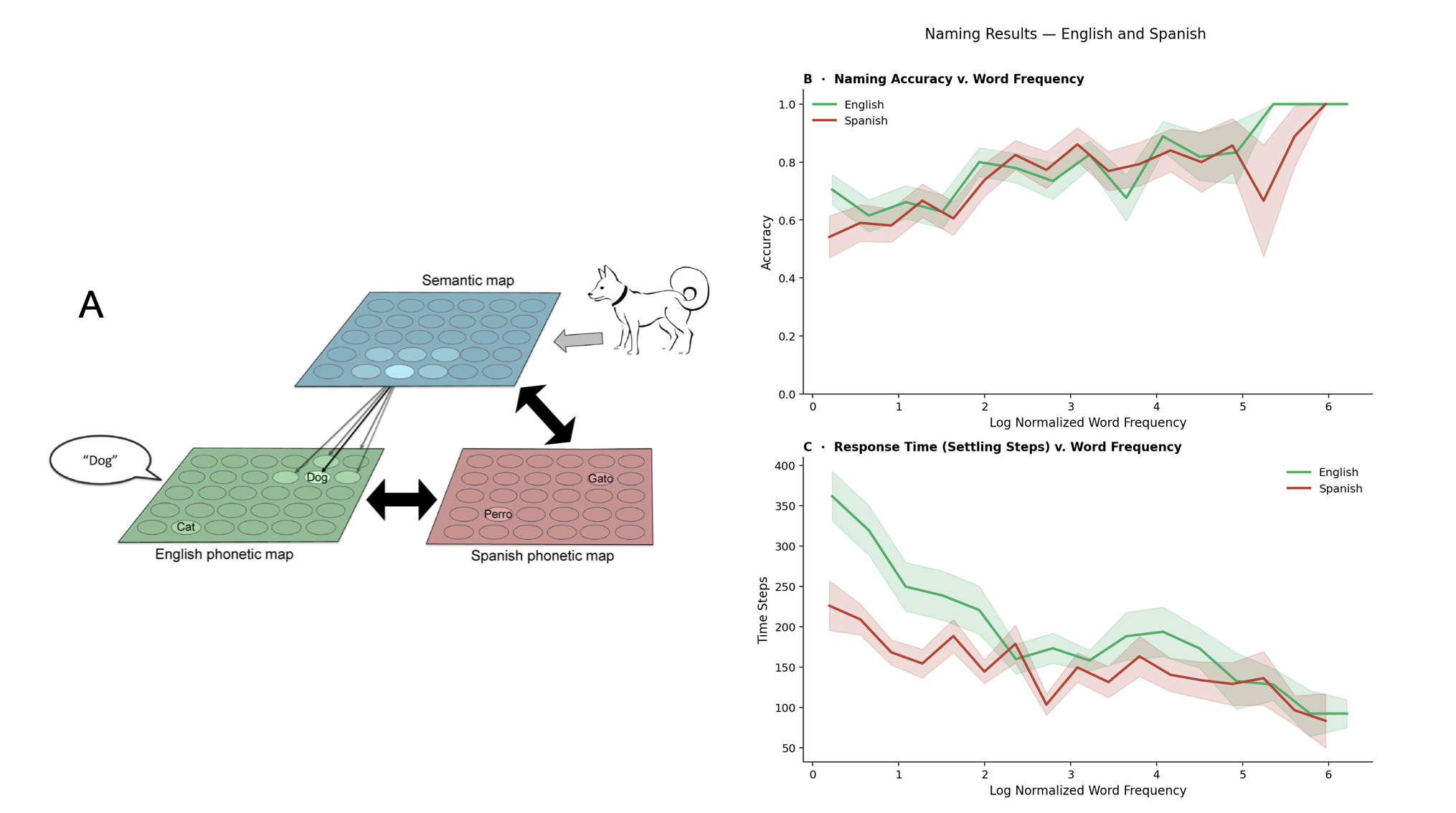 Figure 1. Left: BiLex model with lateral connections, adapted from [1]. Naming is simulated by presenting an input to the semantic map, propagating activation through bidirectional associative connections, and producing a response from a phonetic map, in English and Spanish. Right: accuracy significantly increased with word frequency (p < 0.001) while response times were significantly faster (p < 0.001).References
[1] Peñaloza, C., et al. (2019). BiLex: A computational approach to the effects of age of acquisition and language exposure on bilingual lexical access. Brain and Language, 195, Article 104643. https://doi.org/10.1016/j.bandl.2019.104643
[2] OpenAI. (2024). Hello GPT-4o. https://openai.com/index/hello-gpt-4o/
[3] Kohnert, K. J., Hernandez, A. E., & Bates, E. (1998). Bilingual performance on the Boston Naming Test: Preliminary norms in Spanish and English. Brain and Language, 65(3), 422–440. https://doi.org/10.1006/brln.1998.2001
[4] Rogers, T. T., et al. (2015). Disorders of representation and control in semantic cognition: Effects of familiarity, typicality, and specificity. Neuropsychologia, 76, 220–239. https://doi.org/10.1016/j.neuropsychologia.2015.04.015
AcknowledgementThis research was supported through the NIH under grant 5R01DC020653-02.