IntroductionNeurons encode, compute, and transmit information through spikes, yet the functional meaning of a spike depends on how reliably it reflects the recent synaptic events that generated it. In many neural circuits, excitation and inhibition are co-active and approximately balanced, placing neurons in a conductance-driven regime where spike timing emerges from the interaction between fast excitatory–inhibitory (E–I) competition and intrinsic membrane nonlinearities such as thresholding, refractoriness, and adaptation. Here we ask how the predictability of near-future spiking from recent local E–I history depends on the magnitude and statistics of balanced synaptic drive.
MethodsWe simulated a biophysical neuron receiving balanced excitatory and inhibitory synaptic inputs. Three parameters were systematically varied: (i) balanced synaptic gain, implemented by increasing excitatory and inhibitory conductance per event together in matched proportion; (ii) presynaptic input rate, shaping the temporal statistics of synaptic events; and (iii) the balance point of mean drive (balanced voltage). For each condition, we evaluated how well recent E–I history predicted imminent spikes. Predictability was quantified using two decoders: a linear generalized linear model (GLM) and a nonlinear multilayer perceptron (MLP). (Fig. 1). Model performance was evaluated using precision–recall area under the curve (PR-AUC).
ResultsPredictability increased steeply with balanced E–I gain across the explored parameter space. Standardized regression analysis showed that balanced synaptic gain was the dominant determinant of PR-AUC, exerting a substantially larger effect than other parameters. Firing rate provided the second strongest contribution, whereas variations in presynaptic input frequency and balanced mean voltage produced comparatively minor effects. Increasing input frequency modestly improved predictability at low firing regimes but showed rapid saturation once firing rates plateaued. Across all parameter regimes, the MLP decoder consistently outperformed the GLM decoder.
DiscussionThese findings reveal a regime-dependent predictability landscape: Strengthening excitation and inhibition together increases the reliability with which recent local synaptic competition can be decoded from spikes. In contrast, input frequency and mean voltage balance exert limited direct influence. Together, these findings indicate that synaptic gain modulation can tune neuronal computation between stochastic spiking and history-dependent gating without requiring shifts in E–I ratio or intrinsic neuronal properties.
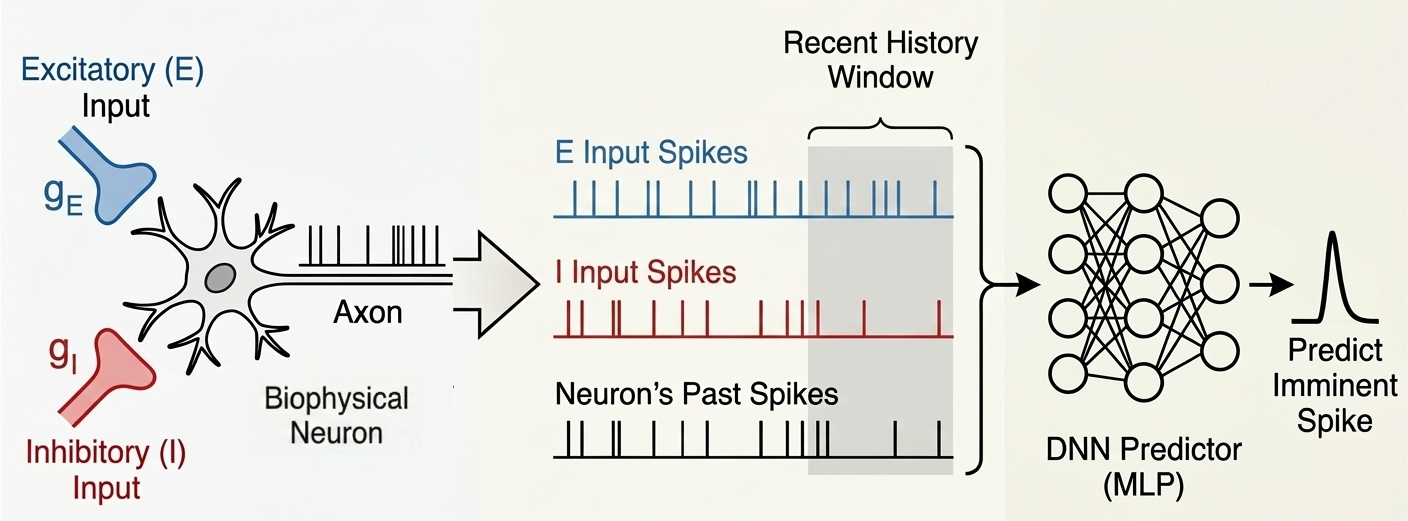 Figure 1. Schematic overview of the spike prediction pipeline. A biophysical neuron model receives balanced excitatory and inhibitory synaptic inputs. The recent temporal history of these inputs, along with the neuron’s own past output spikes, is extracted and fed into a deep neural network (DNN) to predict imminent spikes.
AcknowledgementWork supported in part by graduate summer funding to HL from the Program in Computational Biology and Biomedical Informatics, and by NIH R01 NS011613 to RAM. The content is solely the responsibility of the authors and does not necessarily represent the official views of the National Institutes of Health.