IntroductionLarge-scale brain activity shows complex dynamics that can be better interpreted through mathematical modeling. The very nature of neural activity - multi-scale, noisy, nonstationary, and highly variable across space and subjects - makes it difficult to define a model that is both computationally feasible and biologically meaningful. Here, we focus on the oscillatory components of this activity and propose a model of cross-frequency band interactions. Couplings between these bands can facilitate network communications and modulate information transfer [1]. We develop a prediction-based linear model estimating effective connectivity and characterize such couplings in cortical recordings of mice under anesthesia.
MethodsIn terms of data processing, we extracted time-resolved band power using a continuous Morlet wavelet filter bank, downsampled, applied log-amplitude scaling, and performed per-band, per-channel z-score normalization.
We then modeled effective connectivity with a linear time-delayed model to track how band power evolves across channels over time. The model is estimated by minimizing a cost function combining the sum of squared residuals between predicted and observed states with an L1 penalty on the transition matrix [2], which promotes sparsity by shrinking weak connections toward zero, improving generalization and interpretability. A regularization parameter controls the trade-off between data fit and sparsity.
ResultsWe evaluated our model on ECoG data from a 32-electrode array evenly covering a large portion of the cortical dorsal surface (Fig.1 E) in anesthetized mice [3]. From channel-wise Morlet wavelets, we defined physiologically relevant bands (delta, theta, spindles, low gamma) and used the model to predict band-power dynamics from cross-frequency and cross-channel couplings. Preliminary results from this approach revealed key properties of cortical activity: certain frequency bands, such as delta and low gamma, show more predictive influence than others on the evolution of the cortical network (Fig.1 D). We also identified cross-channel and cross-frequency interactions, as well as the predictive influence of each band per channel (Fig.1 A-C).
DiscussionThis framework captures how neural activity spreads across cortical regions and frequency bands. In this formulation, effective connectivity describes how activity in one frequency band shapes future activity in another by including past temporal information in the model formulation. By representing each frequency’s power as a separate state, the model naturally integrates these influences, allowing it to capture both cross-channel and cross-frequency interactions, as seen in Fig.1 A-B, respectively. Thus, preliminary results highlight the model’s promise for describing complex multi-scale brain dynamics.
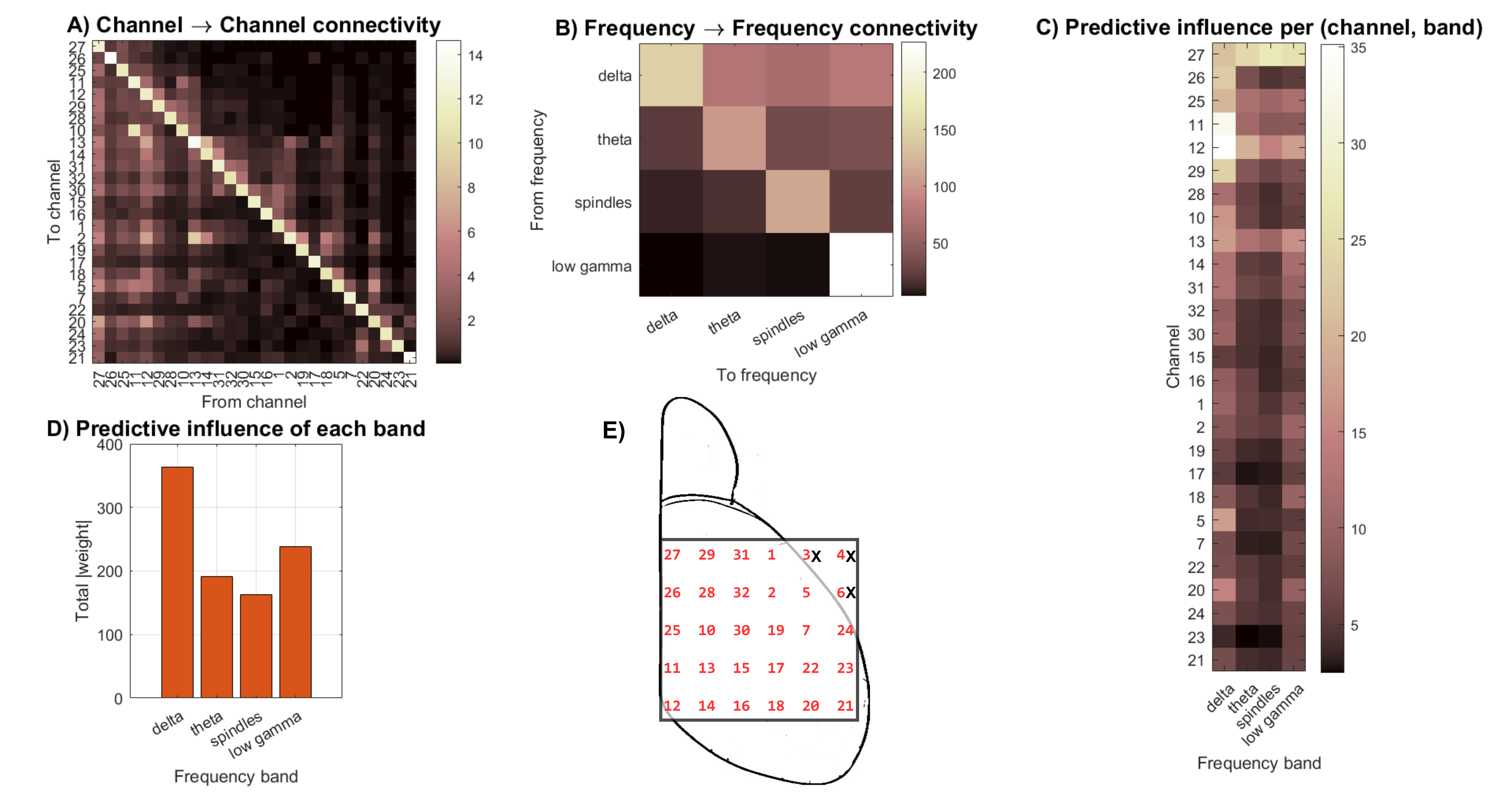 Figure 1. A) Cross-channel interactions summed over all frequency bands. B) Cross-frequency interactions summed over all channels. C) Summed band activation per channel. D) Frequency band predictive influence in future states. E) Illustration of the mouse dorsal portion of the cortex with the 32-electrode ECoG grid.
References1. Canolty, R. T., & Knight, R. T. (2010). The functional role of cross-frequency coupling. Trends in cognitive sciences, 14(11), 506–515.
https://doi.org/10.1016/j.tics.2010.09.0012. Tibshirani, R. (1996). Regression shrinkage and selection via the lasso. Journal of the Royal Statistical Society Series B: Statistical Methodology, 58(1), 267–288.
https://doi.org/10.1111/j.2517-6161.1996.tb02080.x3. Pedrosa, R., Nazari, M., Mohajerani, M. H., Knöpfel, T., Stella, F., & Battaglia, F. P. (2022). Hippocampal gamma and sharp wave/ripples mediate bidirectional interactions with cortical networks during sleep. Proceedings of the National Academy of Sciences, 119(44), e2204959119.
https://doi.org/10.1073/pnas.2204959119AcknowledgementThe authors thank Rafael Pedrosa for the dataset. This work is supported by the Project Dutch Brain Interface Initiative (DBI2) with Project number 024.005.022 of the Research Programme Gravitation, which is financed by the Dutch Ministry of Education, Culture and Science (OCW) via the Dutch Research Council (NWO). The authors declare no conflict of interest.