IntroductionThe layer 5B pyramidal neurons (PT5B) are the final output of the primary motor cortex (M1). They suffer from reduced intrinsic excitability in a Parkinsonian mouse model[1]. There is considerable heterogeneity within the population, with evidence from both electrophysiology and single-cell RNA sequencing[2]. We also suspect there is considerable degeneracy, where multiple configurations of ion channels can produce similar responses. Here, we used data-driven multicompartment models to explore the variability and degeneracy of the PT5B neurons.
MethodsWe used BluePyOp to optimize parameters of conductance-based multicompartment neuron models for individual fits to in vitro somatic current clamp data from 133 PT5B healthy control neurons. To explore potential degeneracy, we optimized parameters independently 20 times for the same experimental response to produce an ensemble of neuron models. As perturbations can reveal the underlying differences, we modeled the effects of low dose (20nM) tetrodotoxin (TTX), which inhibits the persistent sodium channel (NaP).
ResultsThere was substantial variability within electrophysiology (Fig. 1A). Simulations reproduced many features of the voltage traces (Fig. 1B), capturing the excitability of individual neurons and the population, e.g., maximum frequency range in experiments 20.5 – 80.4Hz, and simulation 20.0 – 94.4Hz. Similar voltage traces could be produced with a wide variety of model parameters, with substantial variability in the contribution of calcium and dendritic currents. Simulations of low-dose TTX reductions in NaP conductance revealed a subpopulation of neurons where there was little or no change in excitability, with similar maximum frequencies (33% with less than 1% decrease), and no change in rheobase (77% of models).
DiscussionThere was substantial variability in the electrophysiology of PT5B neurons, which can be captured by computational models. The diversity of ion channel genes in single-cell RNA counts suggests the degeneracy seen in computational models is not only the result of the ill-posed inverse problem, but also a biologically relevant feature of the neurons. Degeneracy has been shown to play a role in the survival of invertebrates[3] and may be relevant to varying resistance to Parkinsonism.
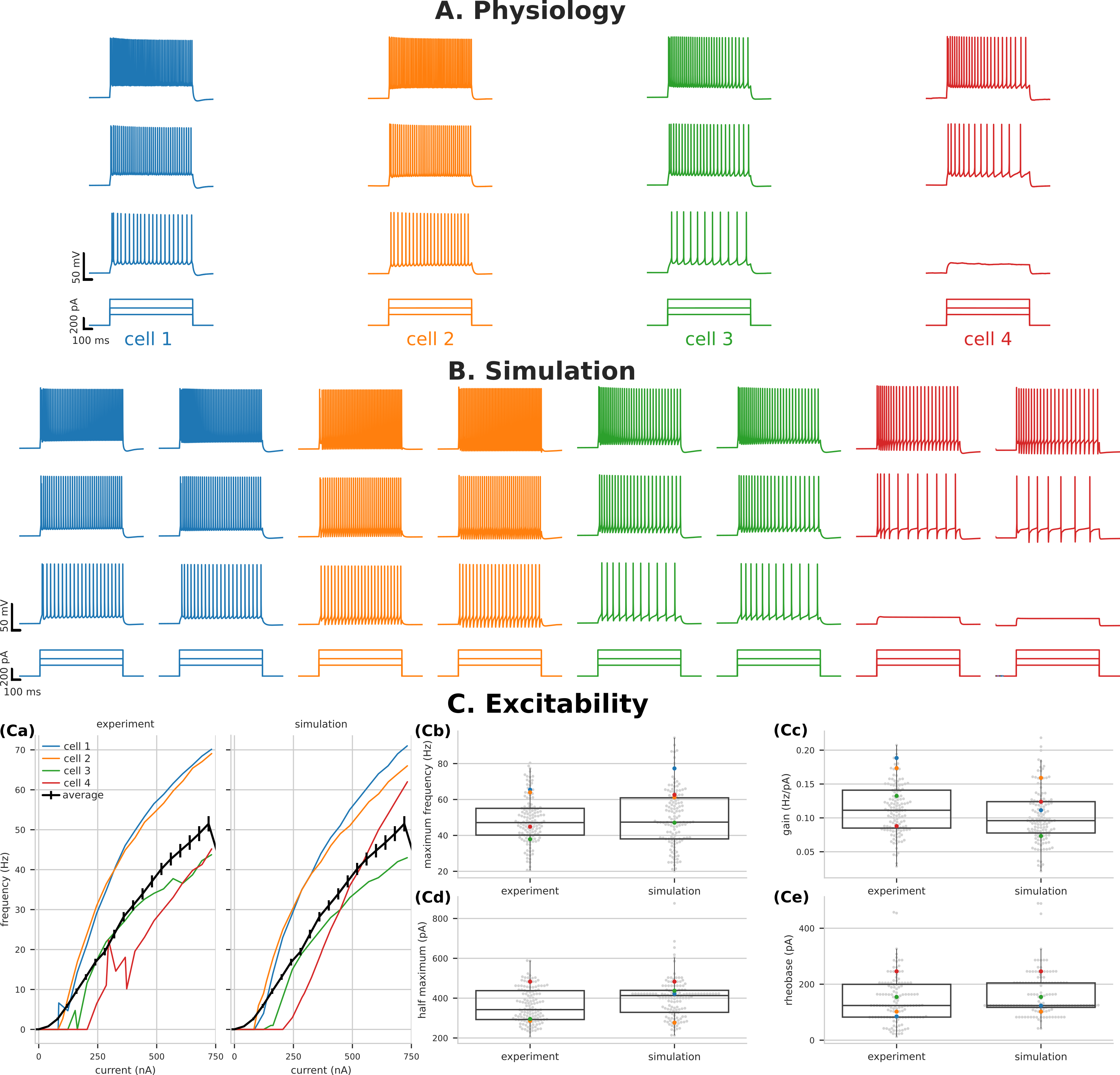 Figure 1. Variability of PT5B excitability captured by parameter optimization. Voltage traces of PT5B neurons to current clamp at (160 pA, 320 pA, and 480 pA) (A) Experiments, (B) Simulation. (C) Excitability measures demonstrate the variability seen between cells and the ability of parameter optimization to capture both individual responses (highlighted) and the population distribution.
References1. Chen, L., Daniels, S., Kim, Y., & Chu, H.-Y. (2021). Cell Type-Specific Decrease of the Intrinsic Excitability of Motor Cortical Pyramidal Neurons in Parkinsonism. The Journal of Neuroscience 41(25), 5553–5565.
2. Yao, Z., Liu, H., Xie, F., Fischer, S., Adkins, R. S., Aldridge, A. I., Ament, S. A., Bartlett, A., Behrens, M. M., Van den Berge, K., Bertagnolli, D., de Bézieux, H. R., Biancalani, T., Booeshaghi, A. S., Bravo, H. C., Casper, T., Colantuoni, C., Crabtree, J., Creasy, H., … Mukamel, E. A. (2021). A transcriptomic and epigenomic cell atlas of the mouse primary motor cortex. Nature, 598(7879), 103–110.
3. Goaillard, J.-M., & Marder, E. (2021). Ion channel degeneracy, variability, and covariation in neuron and circuit resilience. Annual Review of Neuroscience, 44(1), 335–357.