IntroductionConduction delays between brain regions play a central role in regulating largescale neural dynamics. Plastic changes in white matter modify said delays, altering network stability, synchronization and gain in nonlinear neural systems [1, 2, 3]. However, most theoretical studies assume either simplified or fixed delay structures, while experimentally measured delay statistics remain difficult to estimate from neural recordings. In this present work, we combine theoretical analysis to study the influence of distributed delays on the dynamics of delayed nonlinear neural networks (DNLNNs), and machine learning to infer delay structure directly from neural time-series data.
MethodsWe study DNLNNs using two complementary approaches. First, linear stability analysis and random matrix theory are used to characterize how delay statistics influence a DNLNN’s eigenspectrum [4, 5], from which we can infer the network stability. Second, we develop artificial neural network models capable of learning effective delay distributions from neural activity data. Spiking neural networks (SNNs) [6, 7] are trained to infer pairwise delay matrices from multivariate neuronal time series, which are incorporated in simulations of delayed nonlinear networks in order to reproduce the observed dynamics. The full pipeline is illustrated in Figure 1.
ResultsThe linear stability analysis shows how delay statistics modify the eigenspectra and thus the stability boundaries of delayed nonlinear neural networks, linking the mean and variance of conduction delays to dynamical transitions of the system. In parallel, the machine learning framework successfully recovers structured delay distributions from simulated neural data and accurately reproduces the resulting network dynamics when incorporated into delayed network simulations.
DiscussionThe obtained results suggest that combining theoretical analysis with datacentered inference provides a promising approach for studying delayed neural systems. Learning delay distributions directly from neural recordings can help bridge the gap between experimentally measured neuronal activity and mathematical models of large-scale brain dynamics, offering new tools to investigate the influence of conduction delays on the stability and collective dynamics of
neural networks.
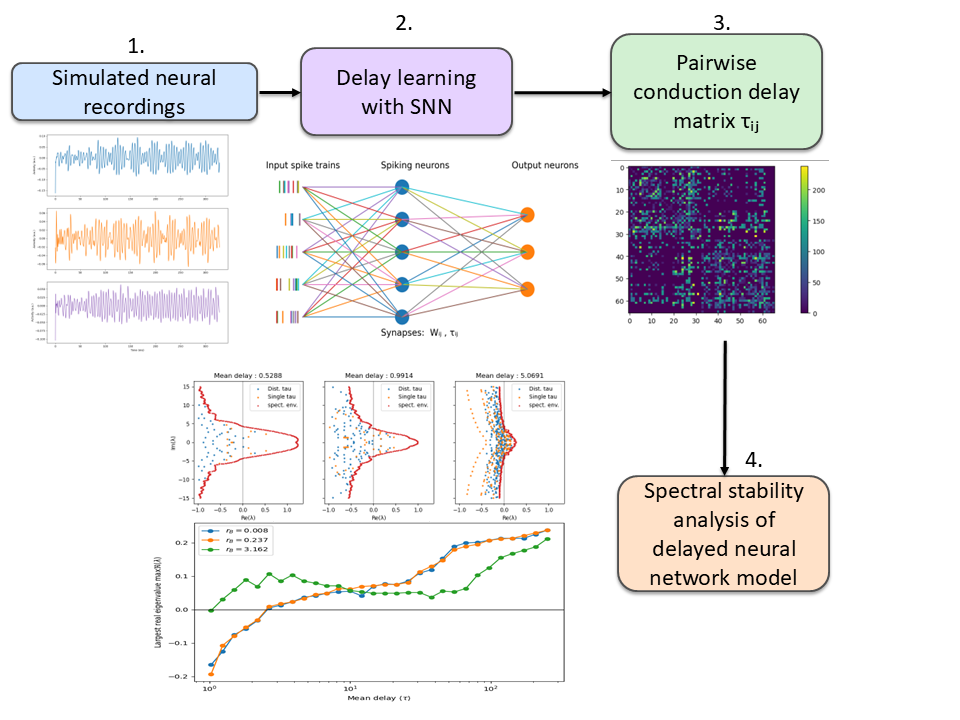 Figure 1. Pipeline for data-driven inference of conduction delays and stability analysis of delayed neural networks. Simulated neural recordings are used to train a spiking neural network that infers a pairwise delay matrix τ. The learned delays are incorporated into delayed neural network models whose spectral properties and stability are analyzed.References
[1] Lefebvre, J
et. al, Myelin-induced gain control in nonlinear neural networks. Commun Phys (2025)
[2] Sampaio-Baptista, C. & Johansen-Berg, H. White Matter Plasticity in the Adult Brain. Neuron (2017)
[3] Scholz et. al Training induces changes in white-matter architecture. Nat Neurosci (2009)
[4] Pigani, E. et. al, Delay effects on the stability of large ecosystems. PNAS, (2022).
[5] Leishman, Q. & Webb, B. A New Approach to Stability of Delay Differential Equations with Time-Varying Delays via Isospectral Reduction (2025).
[6] Sun, P., Wu, J., Zhang, M., Devos, P. & Botteldooren, D. Delay learning based on temporal coding in spiking neural
networks (2024)
[7] Nicola, W. & Clopath, C. Supervised learning in spiking neural networks with FORCE training. Nat Commun (2017)
AcknowledgementThe authors thank members of the Neurophysics and Nonlinear Dynamics group at the University of Ottawa for helpful discussions.