IntroductionWhile human brain mapping characterizes these relationships at the macroscale, advancements in Synthetic Biological Intelligence (SBI) now allow us to investigate them in controllable, human iPSC-derived neural systems [1]. To systematically probe these mesoscale dynamics, we utilized the CL1 platform, which facilitates high-level programmability of in vitro networks, allowing for precise spatiotemporal electrical stimulation and real-time functional readouts. Treating cultures as physical reservoirs, we ask whether enforcing modular connectivity (segregation + integration) enhances separability of neural state trajectories compared with unstructured 2D monolayers, across spatial, temporal, and spatio-temporal classification benchmarks.
MethodsIn this work, human iPSC-derived cortical and hippocampal neurons were cultured as 2D monolayers or in 60-module PDMS microfluidic devices enforcing modular connectivity) coupled by a peripheral loop enabling re-entrant paths. Spikes were recorded on CL1 at 25 kHz; stimulation/noise artifacts were removed via waveform PCA + GMM clustering. We tested reservoir encoding with spatial source discrimination, Morse ‘S’ vs ‘O’ sequence decoding, and MNIST driven as 16-channel, 5-step spiking tensors. Spike counts were binned to form state vectors x(t) and decoded by logistic regression with 5-fold CV, against shuffled and test-chip controls.
ResultsAll biological cultures supported above-chance spatial decoding, but modular devices improved fidelity, with mixed cortical–hippocampal modular networks reaching ~96% median accuracy (Fig.1). Temporal Morse decoding depended on network dynamics: only highly active modular cultures outperformed shuffled controls, while hippocampal monolayers were near chance. For MNIST, monolayers performed poorly, whereas high-activity modular cultures achieved 69–75% median (max 82–88%) accuracy; shuffled and test-chip controls stayed at chance. PCA of reservoir states revealed class-separable manifolds only in real modular data.
DiscussionWhile physical Reservoir Computing has been demonstrated in non-biological substrates, its validation in human iPSC-derived neural networks remained limited [2]. In this work, we show that human iPSC neuronal cultures can act as robust biological reservoirs, and enforced modular topology functions as a computational regularizer that expands functional dimensionality and supports fading memory for complex spatio-temporal separation. The synergy of biological identity (hippocampal + cortical) and engineered modular connectivity suggests a programmable route to test how structural constraints enable—or impair—computation, with implications for both SBI applications and mechanistic models of dysconnectivity in brain disorders.
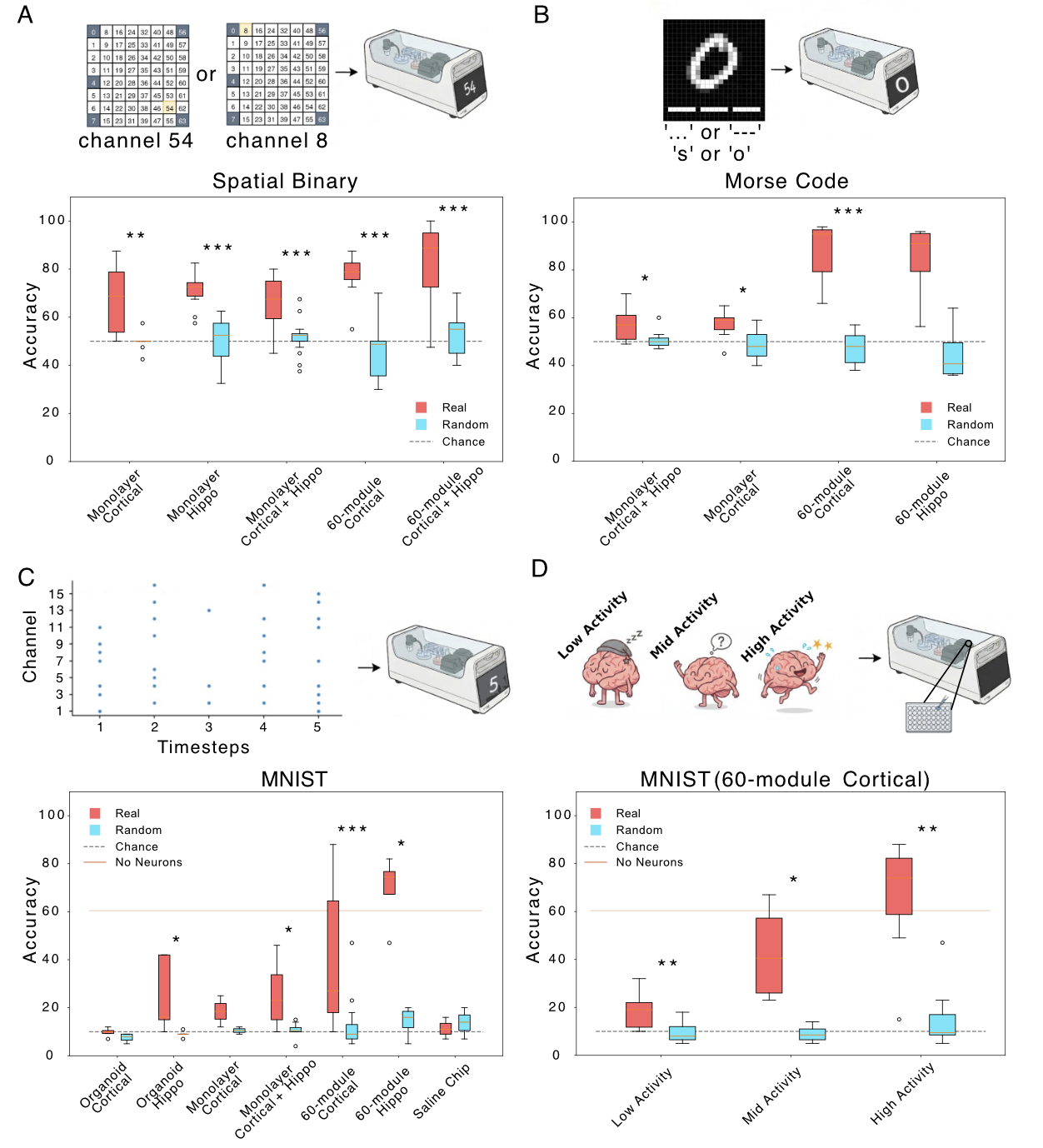 Figure 1. Binary classification (all distances). Red: neuronal cultures; cyan: shuffled controls. (B) Morse code: accuracy for letter prediction; X-axis cell type/activity; dark green real, light green shuffled. (C) MNIST: digit-prediction accuracy; same axes/colors; dashed line chance. (D) Cortical 60-module MNIST accuracy vs activity (low/med/high). *p<0.05, **p<0.01, ***p<0.001.
References1. Kagan, B. J., Kitchen, A. C., Tran, N. T., Habibollahi, F., Khajehnejad, M., Parker, B. J., ... & Friston, K. J. (2022). In vitro neurons learn and exhibit sentience when embodied in a simulated game-world. Neuron, 110(23), 3952-3969.
2. Cai, H., Ao, Z., Tian, C., Wu, Z., Liu, H., Tchieu, J., ... & Guo, F. (2023). Brain organoid reservoir computing for artificial intelligence. Nature Electronics, 6(12), 1032-1039.
AcknowledgementThis work was funded by Cortical Labs Pty Ltd.