IntroductionStability, the ability of a system to return to a steady state after perturbation, is a fundamental property of dynamics on networks, critical in brain networks with regards to epilepsy for example, and in other contexts ranging from ecological networks to power grids. Despite its importance, existing approaches to stability assessment, such as linear stability analysis based on the dominant eigenvalue of the Jacobian matrix, offer only heuristic insights since they ignore the remainder of the eigenspectrum and do not directly quantify deviation from stability. Moreover, current approaches do not give a full interpretation of how individual nodes or motifs of the network structure contribute to the stability (or lack thereof) of the system.
MethodsHere, we introduce a novel technique for directly quantifying the expected deviation from stability of the network dynamics x(t) as a function of the directed network structure C (with C
ji, the connection weight from node j to i) assuming linear dynamics around a fixed point: dx(t) = (I − C)x(t)θ dt + ζ dw(t). Here, the process has reversion rate θ>0, and is driven by uncorrelated noise terms with strength ζ
2 (for a multivariate Wiener process w(t)).
Our measure for the deviation from stability, D
st, is computed analytically via a power series expansion of network's weighted, directed connectivity matrix C (building on formulations of the network covariance matrix in this fashion [1,2,3]).
ResultsWe demonstrate that the deviation from stability D
st directly corresponds to a weighted sum of convergent paired walks on the network (Fig. 1). Our measure explains how dynamics become more stable through small-world transitions to random networks dynamics, which dominant eigenvalues can remain blind to.
Moreover, we introduce novel centrality measures capturing how individual nodes contribute to the network’s deviation from stability as sources and targets, respectively, of the convergent walks in (Fig. 1).
We apply the measure to the Epileptor model [4], efficiently distinguishing spreading and non-spreading seizures, and successfully identifying the susceptibility of nodes to seizure dynamics in terms of their embedding in the network.
DiscussionOur method provides the first full characterisation of how stability in dynamics relates to underlying network structure. This is more complete than heuristics focused on only dominant eigenvalues, and provides the interpretation that stability depends solely on convergent walks in the network. The contribution of individual nodes can also be assessed, as novel meaningful centrality measures.
This approach holds much promise for the study of epilepsy, as demonstrated in early application to the Epileptor model where the required change in excitability of a node to cause seizures was found to be directly related to its contribution to network deviation from stability in our framework, providing a network-based explanation of this sensitivity.
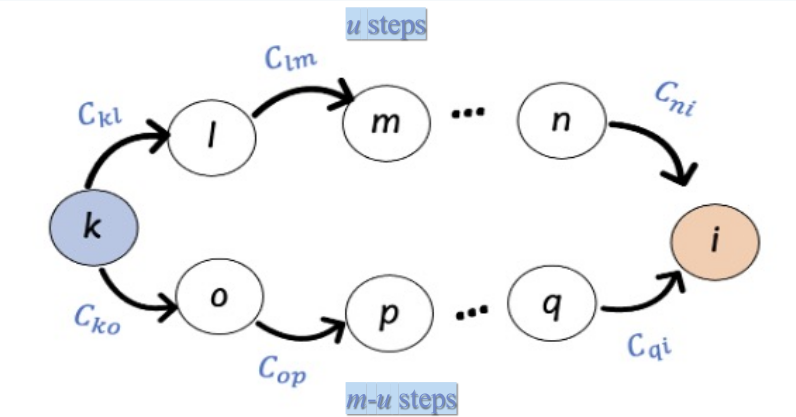 Figure 1. Deviation from stability D_st corresponds to a weighted count of convergent walks on the network CReferences
[1] Schwarze, A. C., & Porter, M. A. (2021). Motifs for processes on networks. SIAM Journal on Applied Dynamical Systems, 20(4), 2516–2557.
[2] Barnett, L., Buckley, C. L., & Bullock, S. (2009). Neural complexity and structural connectivity. Physical Review E, 79(5), 051914.
[3] Lizier, J. T., Bauer, F.M., Atay, F., & Jost, J. (2023). Analytic relationship of relative synchronizability to network structure and motifs. Proceedings of the National Academy of Sciences, 120(37), e2303332120.
[4] Proix, T., Bartolomei, F., Chauvel, P., Bernard, C., & Jirsa, V. K. (2014). Permittivity coupling across brain regions determines seizure recruitment in partial epilepsy. Journal of Neuroscience, 34(45), 15009–15021.
AcknowledgementWe acknowledge the use of The University of Sydney’s high-performance computing cluster Artemis and National Computational Infrastructure in generating results.