IntroductionAction selection in the basal ganglia (BG) is often inferred from the mean firing rate (MFR) of the output nucleus, substantia nigra pars reticulata (SNr). Because SNr MFR is ultimately driven by its synaptic inputs, we introduce the competition degree
Cd, an input-side indicator that directly quantifies how Direct Pathway (DP) and Indirect Pathway (IP) inputs determine selection among competing channels in a spiking neural network (SNN) (see Figure 1).
MethodsFor each channel,
Cd =
SDP/SIP, where
SDP and
SIP denote the presynaptic current strengths via DP and IP arriving at SNr, respectively (Ref. [1]). The selected action corresponds to the channel with the largest
Cd, providing a cause-and-effect mapping from input-side competition to output-side selection, without relying on SNr MFR readout.
ResultsTo our knowledge, this is the first quantitative formulation of action selection based on input-side DP/IP competition in a multi-channel BG SNN. Our results further show that shifts in
Cd predict channel switching when cortical inputs change, indicating that input-side DP/IP competition mechanistically determines selection and switching in BG.
DiscussionThese findings identify the competition degree
Cd as a quantitative substrate for linking DP/IP competition to selection and switching in BG. Thus,
Cd offers a mechanistic predictor of channel dominance: the selection outcome is not merely read out at SNr, but is determined presynaptically by DP/IP competition upstream of SNr output.
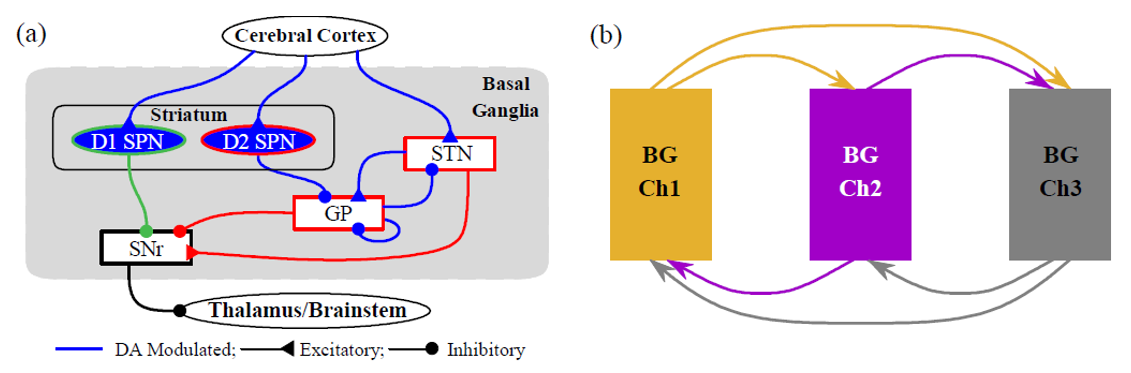 Figure 1. (a) Single-channel BG circuit. Green and red lines represent direct pathway (DP) and indirect pathway (IP) to the output nucleus, SNr, respectively. (b) Three-channel BG SNN. Channels 1-3 represent actions and are shown in orange, purple, and gray, respectively.
References[1] Kim, S.-Y., & Lim, W. (2024) Quantifying harmony between direct and indirect pathways in the basal ganglia; healthy and Parkinsonian states.
Cognitive Neurodynamics 18, 2809-2829.