IntroductionWe investigate robustness to structural sparsity in a hippocampus-inspired artificial neural network (OurANN) for image classification. OurANN is composed of functional modules—dentate gyrus (DG), CA3, and CA1—rather than conventional hidden layers (see Figure 1). DG enforces sparse competitive representations, CA3 provides recurrent stabilization, CA1 integrates stabilized activity for readout, and shortcut connections (EC→CA3 and EC→CA1) preserve signal flow under sparse connectivity.
MethodsAs a baseline, we use a conventional multilayer perceptron (CANN) with three feedforward hidden layers whose numbers of units match those of DG, CA3, and CA1. OurANN classifier is trained using standard backpropagation (Ref. [1]), ensuring direct comparability with the CANN baseline. Using the MNIST dataset as a controlled benchmark, we sweep the inter-layer connection probability
pc from 1.0 down to 0.01 and evaluate robustness using global degradation rates and robustness indices, together with local performance metrics.
ResultsIn the dense and moderate regimes (
pc=1.0 ~ 0.1), OurANN and CANN exhibit nearly identical performance, indicating no intrinsic advantage under weak sparsity. Differences begin to emerge in the sparse regime (
pc = 0.1 ~ 0.05), where OurANN shows slower performance degradation, in contrast to the CANN. In the extremely sparse regime (
pc = 0.05 ~ 0.01), OurANN exhibits clear and persistent robustness, while CANN performance rapidly collapses.
DiscussionAlthough CANN robustness can be partially recovered through brute-force scaling of layer size, achieving robustness comparable to OurANN requires substantially increased parameter redundancy. These results distinguish structural robustness in OurANN, arising from hippocampus-inspired architectural organization, from brute-force scaling robustness in CANN, achieved through parameter expansion.
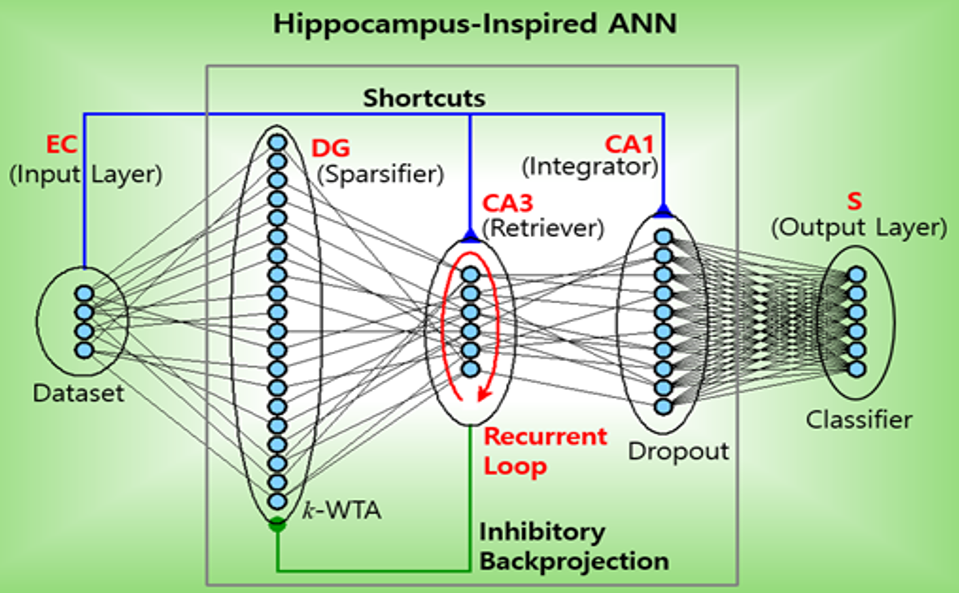 Figure 1. Hippocampus-inspired artificial neural network (ANN). Feedforward: EC (entorhinal cortex) → DG (dentate gyrus) → CA3 and Shortcuts (SCs): EC → CA3 and EC → CA1 and inhibitory backprojection: CA3 → DG. S: subiculum.
References[1] Rumelhart, D. E., Hinton, G. E., & Williams, R. J (1986) Learning representations by back-propagating errors. Nature, 323, 533-536.