IntroductionElectrical stimulation has been used as a treatment of a variety of neurological disorders, including Parkinson’s Disease (PD) [1]. Despite its efficacy, its mechanism of action on the modulation of network-level dynamics to alleviate symptoms is not fully understood. Previous computational work has addressed stimulation effects at the cellular and synaptic level, but the underlying collective dynamics and their functional roles remain relatively unexplored [2]. This requires clinicians to rely on manual programming to determine the therapeutic effect [3]. A mechanistic understanding of stimulation effects on the neuronal circuitry is necessary for the development of closed-loop stimulation techniques that could improve patient outcomes.
MethodsUsing a sparse, recurrently connected excitatory-inhibitory (E-I) network of leaky integrate-and-fire neurons, we extend the Brunel architecture [4] with short-term synaptic plasticity (STP) [5] and characterise its effects on the original network and changes in the canonical activity states (Fig 1A).
Using an implementation of deep brain stimulation (DBS) that aligns with experimental observations like axonal depolarisation [6], somatic suppression [7], and efferent activation [8] (Fig 1B), we examine the effects of stimulation across the parameter space of E-I balance and external drive. We capture the effect of stimulation on individual neurons and the population-level activity through metrics such as desynchronisation and regularisation.
ResultsA known biomarker for PD is the presence of abnormally strong oscillations in the beta band (13-30 Hz) [9]. To model the effects of stimulation on PD treatment, we measured the reduction of the beta-band oscillatory activity, correlated with alleviation of PD-associated motor symptoms [10]. High-frequency stimulation has a strong effect on suppressing strong beta-oscillations in networks receiving low external drive and having a high level of inhibition (Fig 1C, D). Using measures of criticality, we show that the presence of strong beta-oscillations is linked to the network going through a phase transition. Introduction of electrical stimulation prevents this transition from occurring, thereby preventing the pathological oscillatory state.
DiscussionOur findings show that metrics of criticality can be an effective biomarker for therapeutic efficacy, indicating a transition away from a pathological state. Using this in addition to the power spectral density can allow better control of clinical protocols. We provide a framework for evaluating the effect of stimulation on the collective dynamics of the network across connectivity regimes and activity states to predict behaviour in biologically realistic circuits. We hope to extend this work to computational models of the basal ganglia and hippocampus: two well-utilised sites of high-frequency stimulation [11, 12], to investigate the effect of electrical stimulation on their activity and the mechanisms of action of clinical therapies.
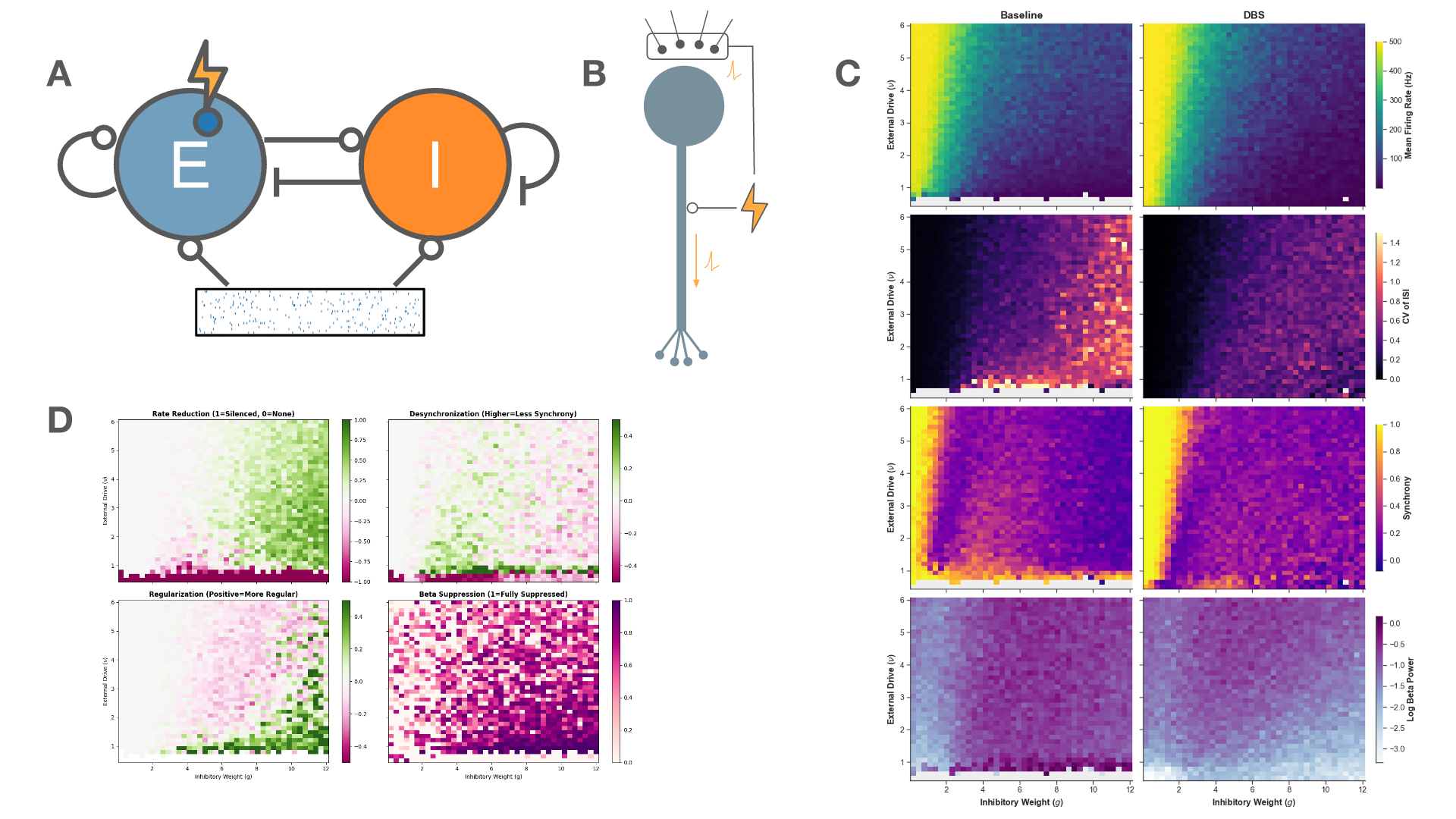 Figure 1. A: Schematic of the network architecture. A subset of the excitatory population is the target of stimulation. B: Schematic of the stimulation model. C: The firing rate, regularity, synchrony, and beta-band power across the parameter space for baseline (left) and 130 Hz stimulation (right). D: The effect of stimulation on metrics of therapeutic efficacy
References- https://doi.org/10.1016/b978-0-444-53497-2.00010-3
- https://doi.org/10.1038/s41582-018-0128-2.
- https://doi.org/10.1001/archneur.63.9.1266
- https://doi.org/10.1023/A:1008925309027
- https://doi.org/10.1162/089976698300017502
- https://doi.org/10.1016/j.expneurol.2008.11.024
- https://doi.org/10.1093/brain/awh616
- https://doi.org/10.1523/jneurosci.23-05-01916.2003
- https://doi.org/10.1152/jn.00697.2006
- https://doi.org/10.1002/mds.22419
- https://doi.org/10.1016/j.baga.2011.05.001
- https://doi.org/10.1038/nature15694
AcknowledgementI wish to acknowledge everyone in the Neural Systems & Brain Signals Processing Lab and Krembil Computational Neuroscience for their help and support, especially David Crompton, Xiangyu Ma, and Zoe Paraskevopoulos. I also want to acknowledge CIHR and NSERC for their funding for my doctoral research.