IntroductionSome neural systems are assumed to operate near a critical point between order and disorder, where collective dynamics enable efficient information processing and computational capabilities [1,2]. Neuromorphic hardware systems provide an experimental platform for investigating such network dynamics in an engineered system. Networks of coupled oscillators have been proposed as promising systems for studying synchronization, stochastic spiking dynamics, and potential signatures of critical dynamics in neural-like systems [3]. We study the synchronization behavior of a network of stochastic relaxation-type oscillators driven by noise that generate neuron-like spiking in a neuromorphic hardware system with event-based spike timing readout.
MethodsWe experimentally investigate a network of 36 neuron-inspired oscillators. Each node of the network is implemented as a relaxation-type oscillator based on a programmable unijunction transistor, which implements neuron-like threshold firing dynamics. Stochastic spike generation is induced through externally injected electrical noise, leading to Poisson-like spiking dynamics. The oscillators are coupled via resistive connections in an all-to-all topology with tunable coupling strength. Spike events are recorded using a novel event-based readout system that captures the precise spike times for all oscillators, enabling spike-train based analysis of the resulting network dynamics.
ResultsTo quantify synchronization in the oscillator network, we compute the mean spike time tiling coefficient (STTC) across all oscillator pairs, a spike-train based correlation measure that quantifies temporal spike coincidences while remaining robust to differences in firing rate. While systematically varying the coupling resistances, the mean STTC increases continuously with coupling strength, indicating a gradual emergence of collective synchronization in the oscillator network (Fig. 1). This behavior is consistent with theoretical predictions for synchronization transitions in ensembles of coupled oscillators, where increasing coupling promotes phase locking and collective dynamics across the network.
DiscussionPhase transitions are frequently discussed in the context of collective neural dynamics and potential signatures of criticality in the brain [1,2,4]. While the observed behavior is consistent with a continuous synchronization transition, the presence of such a transition alone does not constitute sufficient evidence for criticality. Additional signatures such as scale-free activity statistics or critical scaling of network correlations are required to establish critical dynamics. Our results show that neuromorphic oscillator networks provide a controllable experimental platform for studying collective spike dynamics. Future work will investigate statistical indicators of criticality and the influence of coupling architecture and noise.
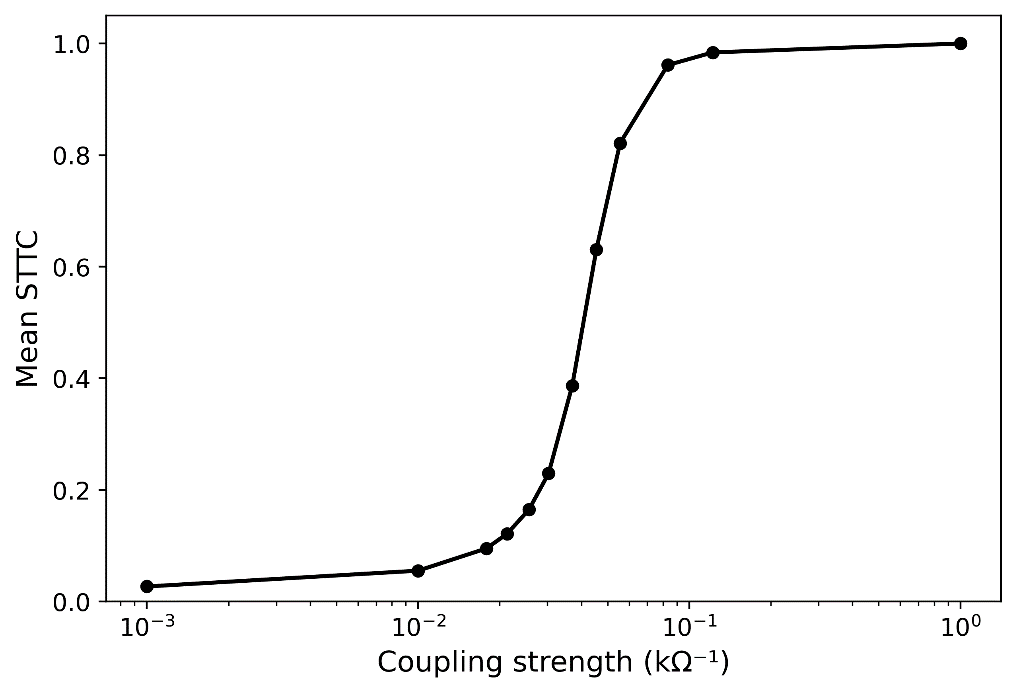 Figure 1. Mean spike time tiling coefficient (STTC) as a function of coupling strength in a network of 36 coupled stochastic relaxation-type oscillators. Increasing coupling drives the system from weakly correlated spiking activity toward global synchronization, indicating a continuous synchronization transition.
References1. Beggs, J. M., & Plenz, D. (2003). Neuronal Avalanches in Neocortical Circuits. Journal of Neuroscience, 23(35), 11167-11177.
https://doi.org/10.1523/JNEUROSCI.23-35-11167.20032. Shew, W. L., & Plenz, D. (2012). The Functional Benefits of Criticality in the Cortex. Neuroscientist, 19(1), 88-100.
https://doi.org/10.1177/10738584124454873. Feketa, P., Meurer, T., & Kohlstedt, H. (2022). Structural plasticity driven by task performance leads to criticality signatures in neuromorphic oscillator networks. Scientific Reports, 12(1), 15321.
https://doi.org/10.1038/s41598-022-19386-z4. Chialvo, D. (2010). Emergent complex neural dynamics. Nature Physics, 6(10), 744-750.
https://doi.org/10.1038/nphys1803Acknowledgement-