IntroductionParkinson's disease (PD) is characterised by elevated oscillatory activity in the low-beta frequency range (13–20 Hz), a hallmark correlated with hypokinesia and is thought to arise from pathophysiological changes within the basal ganglia thalamocortical (BGTC) network. Phase-dependent deep brain stimulation (pdDBS) is a proposed alternative stimulation strategy to clinically standard high-frequency DBS, delivering pulses at targeted phases of the beta oscillatory cycle to either synchronise or desynchronise oscillatory amplitude. Despite experimental and computational work in the field, existing investigations of pdDBS have yet to examine how patient-specific responses to stimulation shape oscillatory dynamics at the network level.
MethodsWe employ a BGTC neural mass model [1], to investigate the effects of phase-dependent DBS across 8 populations in the BGTC network (Figure 1). Model parameters are estimated through simulation-based inference using biologically informed priors, fit to reproduce pathological oscillatory activity seen in PD [2]. We use a novel method for modelling STN DBS incorporating orthodromic and antidromic invasion of axonal collaterals [3], describing how stimulation perturbs effective firing rates across the network. Approximate Bayesian Computation is used to optimise DBS activation parameters and stimulation phase for maximal suppression of oscillatory activity.
ResultsConsistent with existing models, the BGTC model successfully reproduces plausible firing rates and spectra in line with animal models. Applying the optimisation framework across a range of STN DBS activation parameters, initial results show that the optimal stimulation phase for oscillatory suppression depends on the relative activation of fibre pathways during stimulation. Consistent with experimental findings, this suppression is accompanied by increased oscillatory activity at adjacent frequency bands.
DiscussionThis work offers a framework for understanding patient-specific responses to phase-dependent DBS, showing that optimal stimulation phases are not universal but vary according to how DBS perturbs the BGTC network through different fibre pathways. Beyond its immediate relevance to optimising phase-dependent DBS in PD, the framework generalises to various pulsatile brain stimulation strategies aimed at shifting oscillatory dynamics towards less pathological states. Ongoing work will extend the analysis to network level responses to stimulation and evaluating responses when GPi is used as the stimulation target.
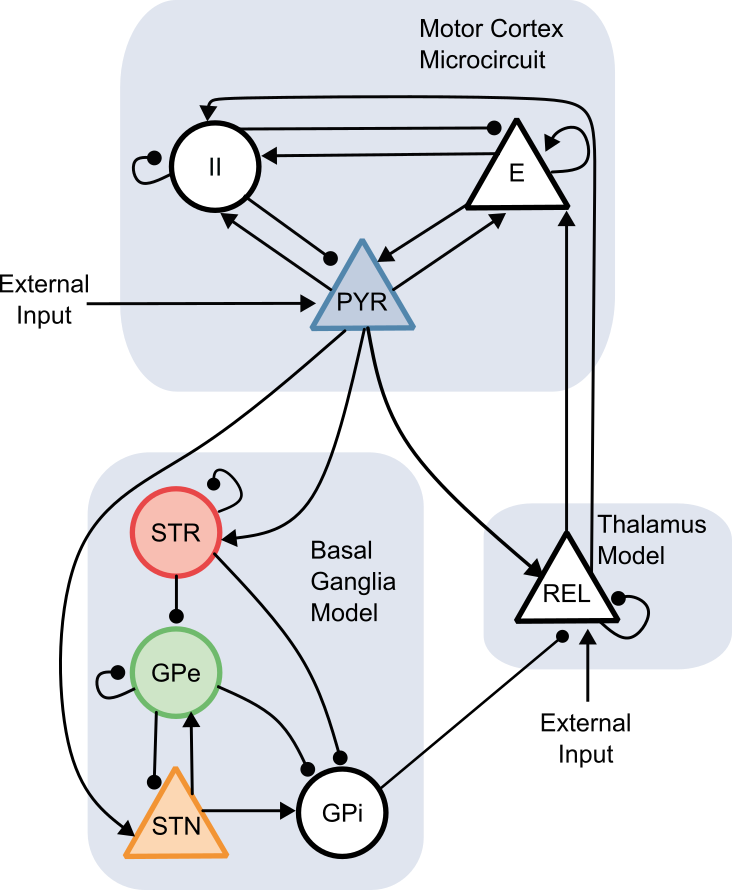 Figure 1. The BGTC circuit connectivity implemented in the neural mass model includes cortical excitatory (E), inhibitory interneuron (II), and deep pyramidal (DP) populations, as well as the striatum, globus pallidus externus (GPe), globus pallidus internus (GPi), subthalamic nucleus (STN), and thalamic relay nuclei (REL). Shaded regions indicate nodes with spectral data used for model fitting.
References1. van Albada, S. J., et al. (2009). Mean-field modeling of the basal ganglia-thalamocortical system. II: Dynamics of parkinsonian oscillations. Journal of Theoretical Biology, 257(4), 664–688.
https://doi.org/10.1016/j.jtbi.2008.12.0132. West, T. O., et al. (2022). Stimulating at the right time to recover network states in a model of the cortico-basal ganglia-thalamic circuit. PLOS Computational Biology, 18(3), e1009887.
https://doi.org/10.1371/journal.pcbi.10098873. Crompton, et al. (2025, April 24). A Unified Computational Framework for Implementing Impact of Deep Brain Stimulation in Neural Circuits. [Conference Presentation]. Krembil Research Day, Toronto, Canada
AcknowledgementWe acknowledge the financial support of the Branch Out Neurological Foundation and the Max-Planck Center for Neural Science and Technology (P.K) as well as the Natural Sciences and Engineering Council (NSERC) RGPIN-2022-05181 (L.M).