IntroductionTranscranial magnetic stimulation (TMS) is a promising non-invasive neuromodulation procedure. The magnetic field generated by the TMS coil induces a short-lasting electric field and elicits firing in targeted cortical neurons. In experiments targeting the human motor cortex, TMS produced repetitive descending cortical volleys known as D- and I-waves representing sustained strong firing activity for about 10ms post stimulation. The underlying biophysical mechanisms remains incompletely understood [1]. We aim to address this gap by leveraging novel modeling approaches.MethodsWe propose a novel model of I-wave generation (Fig. 1) A). Our model builds upon a recent electric-field-coupling approach that computes precise somatic current fluctuations of Layer 5 pyramidal tract neurons (L5PT) in the motor cortex [2]. This approach reproduces the sensitivity of an average input current to those neurons to changes in the TMS-coil orientation. The activity of the L5PT neurons is modeled by a Fokker-Planck-based stochastic population model, which allows for the recovery of the membrane potential distribution of the targeted neurons as well as a spike density. From this spike density we further compute a voltage signal that can be compared to epidural recordings of I-waves at the spinal cord.ResultsOur model is able to replicate signal characteristics of I-waves [3, 4] within biophysically plausible parameter ranges (Fig. 1) B). It further reproduces key experimental findings, including the sensitivity of I-waves to coil orientation, electric field strength, and synaptic parameters. Finally, we extended the analysis of quantitative I-wave characteristic by peak-to-peak delays and amplitude ratios that may be more tractable for experimental comparison and compared those between our model and existing data.DiscussionUsing our method, we were able to reproduce I-wave characteristics in unprecedented detail. The use of a neural population model for computing the I-waves allowed for a sophisticated analysis of the influence of many parametric dependencies that are commonly reserved for computationally inexpensive neural mass models, while still retaining sudden transient effects that are outside the applicability of traditional mean field models. Our comparison to measured data proved this approach to be promising and gives rise to a bottom-up biophysically based parsimonious I-wave model that may enable predictions for changes of motor pathways under various influences, such as plasticity, medication, or pathology.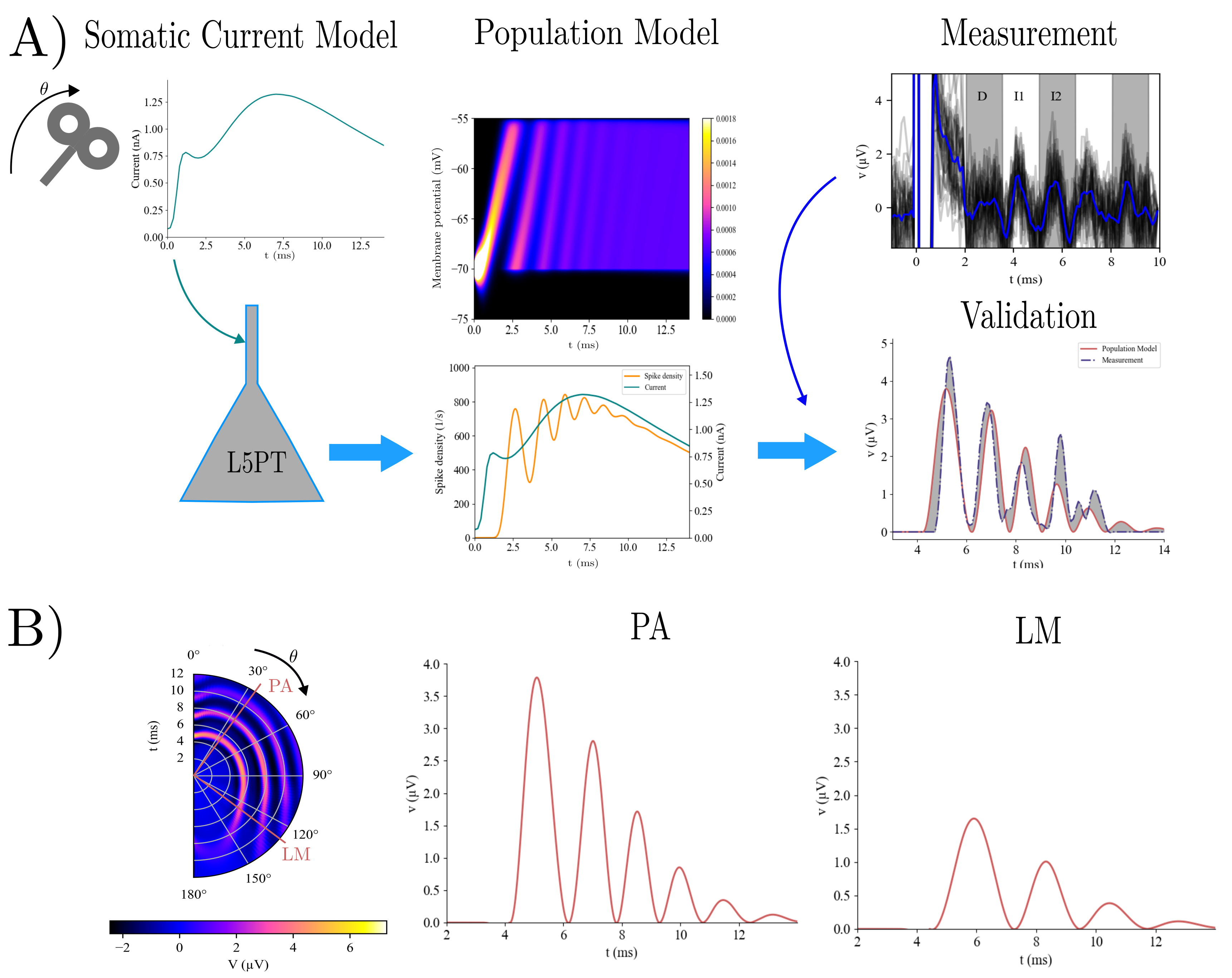 Figure 1. A) The somatic current model [3] generates coil orientation-sensitive somatic currents (first column). They are then applied to the L5PT model which computes membrane potential distribution and spike density for it (second column). This is then transformed to a potential and compared to measured I-waves. B) Orientation dependency of I-waves (first column) and potentials for putative parietal-anter
References1. Ziemann, U. (2020). I-waves in motor cortex revisited. Exp. brain research, 238(7), 1601-1610.
2. Miller, A., Knösche, T. R., & Weise, K. (2025). A coupling model of transcranial magnetic stimulation induced electric fields to neural state variables. bioRxiv, 2025-08.
3. Di Lazzaro, V., & Ziemann, U. (2013). The contribution of transcranial magnetic stimulation in the functional evaluation of microcircuits in human motor cortex. Front. in neural circ., 7, 18.
4. Di Lazzaro, V., Pilato, F., Oliviero, A., Dileone, M., Saturno, E., Mazzone, P., ... & Rothwell, J. C. (2006). Origin of facilitation of motor-evoked potentials after paired magnetic stimulation: direct recording of epidural activity in conscious humans. Jrnl of neurophys., 96(4), 1765-1771.
Acknowledgement-