IntroductionThe cerebellum is involved in motor, cognitive, and affective functions. A critical prerequisite for cerebellar MRI analyses is the isolation from the brain as spatial normalization to whole-brain templates misaligns the cerebellum, compromising accuracy. To this end, specialized tools like SUIT [1] were developed. However, current software has two key limitations: a. They were developed on healthy adults, lacking robustness across diverse populations; b. They use single-modality input, ignoring complementary contrasts like T2w. This work introduces a 3D U-Net [2] for cerebellar isolation that solves both problems, producing reliable results across lifespan and a dual-input architecture for improved accuracy.
MethodsWe combined 5 different databases (N=101), spanning ages 0-76 years. Raw images were registered to the MNI152NLin6Asym template[3] where cropping was applied via a fixed bounding box. We implemented a 3D U-Net with four encoding/decoding stages. Each stage contains 3D convolutions, instance normalization, and LeakyReLU. The network accepts dual-channel inputs for T1w and T2w modality images and handles missing modalities via zero-padding. Skip connections preserve spatial details for accurate boundary delineation. Model outputs were transformed back to native space and postprocessed. The performance was measured by Dice Score Coefficient (DSC) and Hausdorff Distance.
Results
We compared our U-Net against SUIT across the lifespan. On adult data (SUIT's optimal population), our U-Net achieved lower Hausdorff distances, indicating superior boundary alignment. Critically, SUIT failed completely on neonatal and elderly degenerative cases (24.4% failure rate), while U-Net performed consistently across all ages. For multi-modality evaluation, U-Net outperformed SUIT with single modalities (T1w or T2w). Combined T1w+T2w inputs yielded significantly better results than either alone, demonstrating successful fusion of complementary contrast information (See Figure 1).DiscussionThis study presents a 3D U-Net for cerebellar isolation trained on diverse multi-modal data (0-76 years, including pathology). The model outperformed SUIT across both metrics, particularly in boundary precision, and generalized effectively across the lifespan where SUIT failed. A key strength is handling T1w/T2w inputs individually or jointly for improved robustness and accuracy. Another contribution is our expertly curated dataset of 101 hand-corrected masks for other researchers. Limitations include a modest sample size for rare pathologies and a focus on structural MRI only. So, in the future, we will expand to other contrasts and populations.
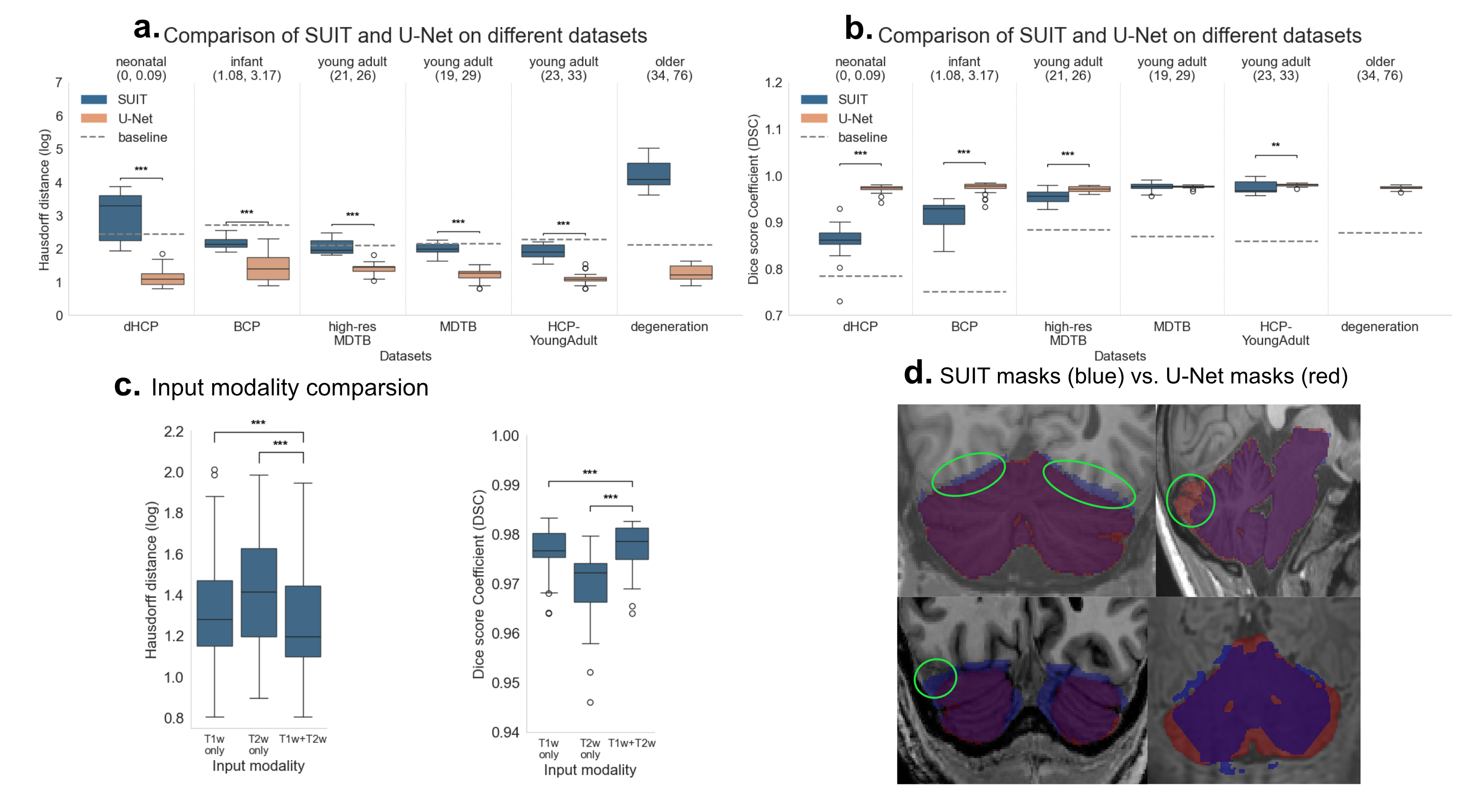 Figure 1. Isolation analysis. Comparison of U-Net VS SUIT for (a) Hausdorff Distance (HD) and (b) Dice Score Coefficient (DSC). c shows performance for different input modalities in the full datasets. Horizontal lines between bars with asterisks denote significant differences (paired t-tests). Baseline: Average mask prediction. d shows resulting mask in problematic subjects.
References1. Diedrichsen, J. (2006). A spatially unbiased atlas template of the human cerebellum.
NeuroImage, 33(1), 127–138.
https://doi.org/10.1016/j.neuroimage.2006.05.0562. Ronneberger, O., Fischer, P., Brox, T. (2015). U-Net: Convolutional Networks for Biomedical Image Segmentation.
Medical Image Computing and Computer-Assisted Intervention – MICCAI 2015, 9351, 234-241. Springer.
https://doi.org/10.1007/978-3-319-24574-4_283. Fonov, V., Evans, A., McKinstry, R., Almli, C., & Collins, D. (2009). Unbiased nonlinear average age-appropriate brain templates from birth to adulthood.
NeuroImage, 47(Supplement 1), S102.
https://doi.org/10.1016/S1053-8119(09)70884-5AcknowledgementThis research was funded by the Raynor Cerebellum Project. We thank the Brain and Mind Institute at Western University for data acquisition and support. We acknowledge the contributors of the public datasets used in this work: dHCP, BCP, and HCP-YoungAdult. We are grateful to the expert raters for manual mask validation.