IntroductionBiological intelligence is far more adaptive, autonomous and efficient than current artificial intelligence, despite recent advances. Neuroethological comparisons and computational simulations show that nervous systems across phyla share a conserved modular organization for information flow from sensation to behavior [1](Fig. 1). Differences between mammals and primitive soft-bodied invertebrates are largely in kind and amount of detail handled by different modules. 4 computations (What is it? Where is it? How do I feel about it? What should I do?) compose waking consciousness, while cognitive mapping enables intricate subjective experience, adding the question What is it doing? We explore these computations in agent-based simulations.
MethodsThe agent-based simulation Cyberslug [2] was modeled on the core decision-making circuitry of a relatively simple animal, the predatory sea slug Pleurobranchaea californica, which retains character of the last common ancestor of bilaterally symmetric animals. Cyberslug is essentially an easily-scalable hybrid dynamical system which reproduces Pleurobranchaea’s decision-making in foraging. With small, biologically-plausible additions to Cyberslug, we developed the ASIMOV model with reward‑dependent plasticity for sensory valuation [3], as well as a Feature Association Matrix (FAM), a memory module inspired by hippocampal architecture [4]. Agents were tested in various simulated spatial environments with olfactory cues, coded in NetLogo.
ResultsThe modular neural organization of Pleurobranchaea was shown to be markedly similar to that of vertebrates and other invertebrates (e.g., insects, cephalopods) providing a conserved core circuitry for computational modeling and expansion [1,2]. Cyberslug reproduced adaptive cost‑benefit decision‑making in foraging [2]. ASIMOV extensions captured realistic sensory valuation, including addiction‑like dynamics [3]. Addition of the FAM showed how episodic memory and spatial cognitive mapping emerge from simple associative learning rules. This enabled the latest ASIMOV-FAM agent for efficient spatial navigation, one‑shot learning, and improved performance in sparse‑reward environments compared to standard reinforcement learning [4].
DiscussionOur results show that conserved modular architectures can organize the flow of information in animals and support naturalistic behavior, episodic memory, and cognitive mapping in artificial agents. Simple associative mechanisms analogous to hippocampal function were sufficient for sequence learning, spatial cognitive mapping, and recall, highlighting a plausible computational basis for subjective‑like experience and flexible intelligence. Our incremental elaboration of biologically grounded circuits produce increasingly complex cognition and dynamic behavior, providing a scalable computational framework for neuroethological studies, as well as further development of flexible, autonomous artificial intelligence (AI).
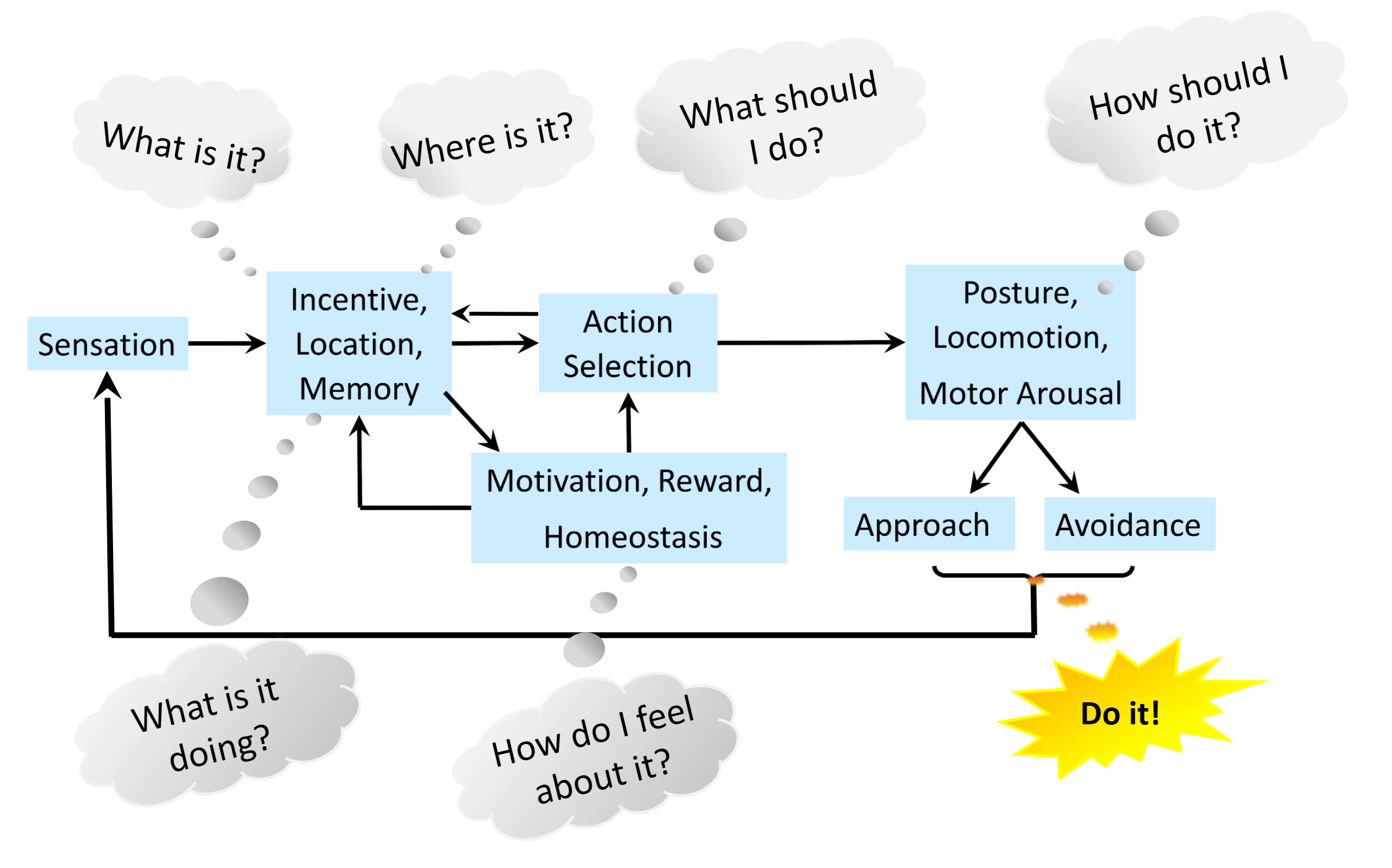 Figure 1. Both simple and complex animals handle flow of information from sensation to behavior with a common modular nervous system organization. Stimuli characteristics, incentives and locations are integrated with memory, motivation and affect for decisive action selection, with 5 critical computations from “What is it?” to “How should I do it?”, and cognitive mapping adding “What is it doing?”.
References- Gribkova, E. D., Lee, C. A., Brown, J. W., Cui, J., Liu, Y., Norekian, T., & Gillette, R. (2023). A common modular design of nervous systems originating in soft-bodied invertebrates. Frontiers in physiology, 14, 1263453.
- Brown, J. W., Caetano-Anollés, D., Catanho, M., Gribkova, E., Ryckman, N., ... & Gillette, R. (2018). Implementing goal-directed foraging decisions of a simpler nervous system in simulation. Eneuro, 5(1).
- Gribkova, E. D., Catanho, M., & Gillette, R. (2020). Simple aesthetic sense and addiction emerge in neural relations of cost-benefit decision in foraging. Scientific reports, 10(1), 9627.
- Gribkova, E. D., Chowdhary, G., & Gillette, R. (2024). Cognitive mapping and episodic memory emerge from simple associative learning rules. Neurocomputing, 595, 127812.
AcknowledgementThis work was supported by the Office of Naval Research (MURI grant N00014-19-1-2373).