IntroductionSynaptic plasticity underlies learning and memory. To prevent instability from unconstrained Hebbian modifications, neurons engage homeostatic processes to globally adjust synaptic weights and membrane excitability [1]. Despite co-occurring, Hebbian and homeostatic plasticity are traditionally modeled independently, leaving their molecular crosstalk unresolved [2]. Recent evidence identifies stargazin, a TARP, as a critical link: it undergoes phosphorylation during long-term potentiation (LTP) and dephosphorylation during homeostatic downscaling [3], and interacts with Kv7.2 subunits to modulate intrinsic excitability [4]. No existing model unifies this coupling across scales; we present a multi-resolution framework that bridges this gap.
MethodsWe developed a multi-scale model extending resource competition principles [5] from single synapses to the whole neuron. At the biophysical level, calcium-dependent competition between kinases and phosphatases governs stargazin phosphorylation, which regulates AMPAR trafficking across synapses and Kv7.2 surface expression. A reduced formulation eliminates fast variables (calcium quasi-steady-state, AMPAR equilibrium) to yield a tractable per-synapse/per-branch description. A conceptual model further condenses dynamics into three coupled variables (weights, resources, excitability), enabling investigation of network-level consequences.
ResultsSimulations reproduced the timescale separation between fast calcium transients, rapid LTP-driven AMPAR insertion, and gradual resource-constrained downscaling (Fig. 1). The biophysical model produces three compensatory tiers: AMPAR redistribution via pool competition (seconds–minutes), M-current adjustment via Kv7.2 trafficking (hours), and synaptic scaling via stargazin pool dynamics (days). Under 48-hour TTX and bicuculline protocols, the model reproduces bidirectional scaling consistent with experimental data [1]. The reduced and conceptual models preserve quantitative accuracy with fewer variables, enabling network-level investigation.
DiscussionOur findings provide a biophysical account of how neurons maintain stability while preserving the capacity for input-specific memory allocation. The three-tier model hierarchy (from molecular cascades to analytically tractable abstraction) enables both detailed validation against experimental data and the investigation of how homeostasis interacts with ongoing learning dynamics in network settings. The model highlights the necessity of multi-scale molecular crosstalk, positioning stargazin as a core integrator of synaptic plasticity and multi-scale homeostasis.. Embedding the conceptual model in recurrent circuits allows us to investigate how this multi-scale, compartmentalized integration constrains learning and computation.
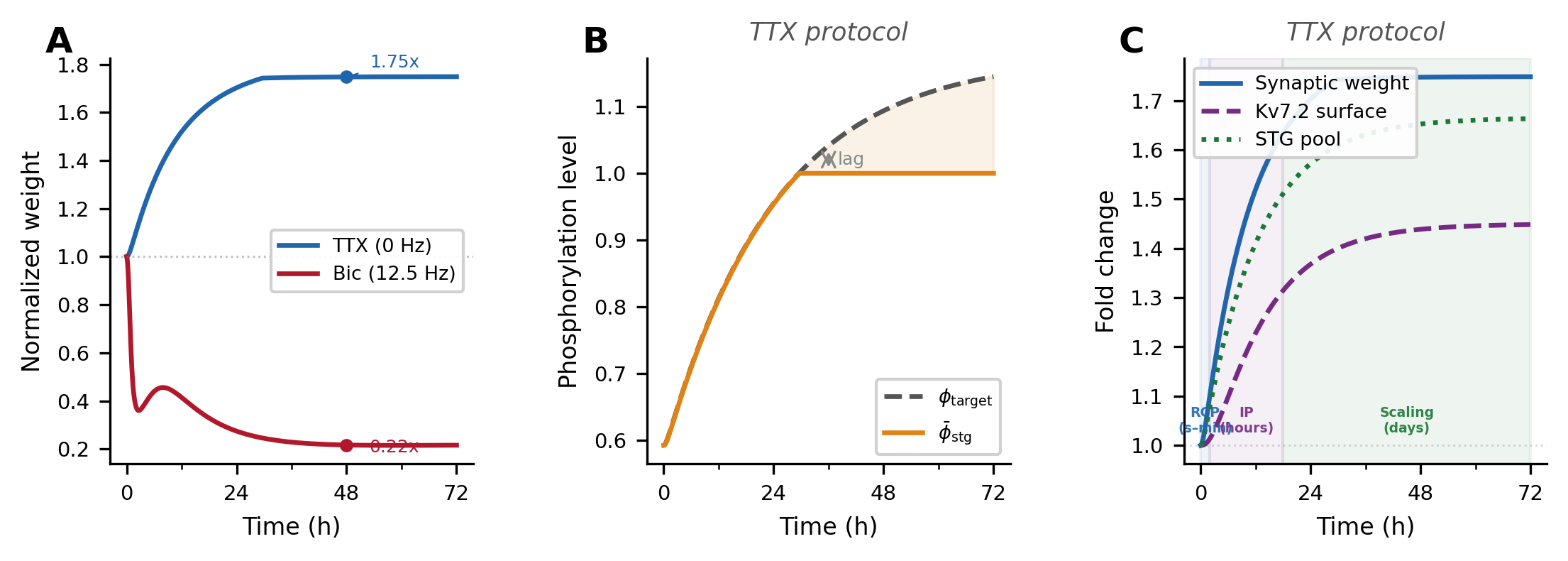 Figure 1. Simulated homeostatic response to inactivity (TTX). (A) Multiplicative synaptic scaling: upscaling (1.75×) and downscaling (0.22×) at 48 h. (B) Stargazin phosphorylation (φ̄_stg) lags the homeostatic target (φ_target) due to enzymatic inertia. (C) Three compensatory tiers emerge sequentially: AMPAR redistribution (seconds–min), Kv7.2 adjustment (hours), and synaptic scaling (days).
References[1] Turrigiano, G. G., Leslie, K. R., Desai, N. S., Rutherford, L. C., & Nelson, S. B. (1998). Activity-dependent scaling of quantal amplitude in neocortical neurons. Nature, 391(6670), 892-896.
[2] Turrigiano, G. G. (2017). The dialectic of Hebb and homeostasis. Philosophical Transactions of the Royal Society B, 372(1715), 20160258.
[3] Louros, S. R., Caldeira, G. L., & Carvalho, A. L. (2018). Stargazin Dephosphorylation Mediates Homeostatic Synaptic Downscaling of Excitatory Synapses. Frontiers in Molecular Neuroscience, 11, 328.
[4] Rodrigues, M. V., et al. (2024). Type I TARPs regulate Kv7.2 potassium channels and susceptibility to seizures. bioRxiv.
[5] Triesch, J., Vo, A. D., & Hafner, A. S. (2018). Competition for synaptic building blocks shapes synaptic plasticity. eLife, 7, e37836.
AcknowledgementThis work was supported by national funds through FCT—Foundation for Science and Technology, I.P., under the project HetSyn (2023.13758.PEX).