IntroductionFunctional connectivity (FC) describes statistical dependencies between the activity of neurons or groups of neurons [1]. Comparing FC with anatomical connectivity (SC) has emerged as a promising avenue to study how brain structure supports function [1,2]. Studies have reported a wide range of SC–FC correspondence values [1,2], highlighting the need for theoretical insights into these relationships [3]. We derive here a closed-form analytical mapping from SC to FC for any oscillator network, showing that shared presynaptic inputs govern coactivity and identifying an optimal regime of maximal SC–FC alignment, with a lower bound on SC reconstruction from FC. An empirical whole-brain larval zebrafish connectome is used for validation [4,5].
MethodsWe develop an analytical framework linking SC to FC in coupled neural systems. We study coupled neural oscillators on a heterogeneous, weighted and directed network using the Kuramoto model [3]. A second-order perturbative expansion is obtained in the reduced coupling λ/N around the uncoupled regime, valid for arbitrary network size and topology. Time-averaged correlations are expanded and a stationary filter identifies finite contributions as T→∞ (Fig. 1a). Averaging over intrinsic frequencies drawn from a Cauchy–Lorentz distribution of width γ yields a closed-form prediction of FC. The coupling strength λ* maximising SC–FC alignment is obtained analytically by minimising a normalised Frobenius distance between predicted and simulated FC.
ResultsFunctional connectivity is determined by shared presynaptic inputs and not by direct synaptic connections. The stationary expansion retains only a second-order structure proportional to KKᵀ (Fig. 1b), yielding Ĉ = I + (5λ²)/(4γ²N²) · (KKᵀ - diag(KKᵀ)). First-order terms cancel, so direct connections do not contribute to FC, and the first anatomical fingerprint appears through shared-input structure. The optimal coupling λ*, derived solely from K, defines a theoretical lower bound on SC–FC reconstruction error (Fig. 1c). Simulations on an empirical whole-brain larval zebrafish connectome [4] show an excellent agreement between predicted and simulated FC (cosine similarity ≥ 0.97) across the valid coupling regime (Fig. 1d).
DiscussionOur closed-form expression reveals three results not accessible from simulation alone. First, stationary coactivity is determined by shared presynaptic inputs rather than by direct synaptic connections. Second, direct connections do not contribute to stationary coactivity in the canonical Kuramoto model, cautioning against using raw FC as a direct estimator of SC. Third, the explicit prefactor 5/(4γ²) obtained through a non-trivial analytical derivation, reveals that broader intrinsic-frequency dispersion weakens the structural imprint on FC, making reconstruction of SC from FC harder in heterogeneous neural populations.
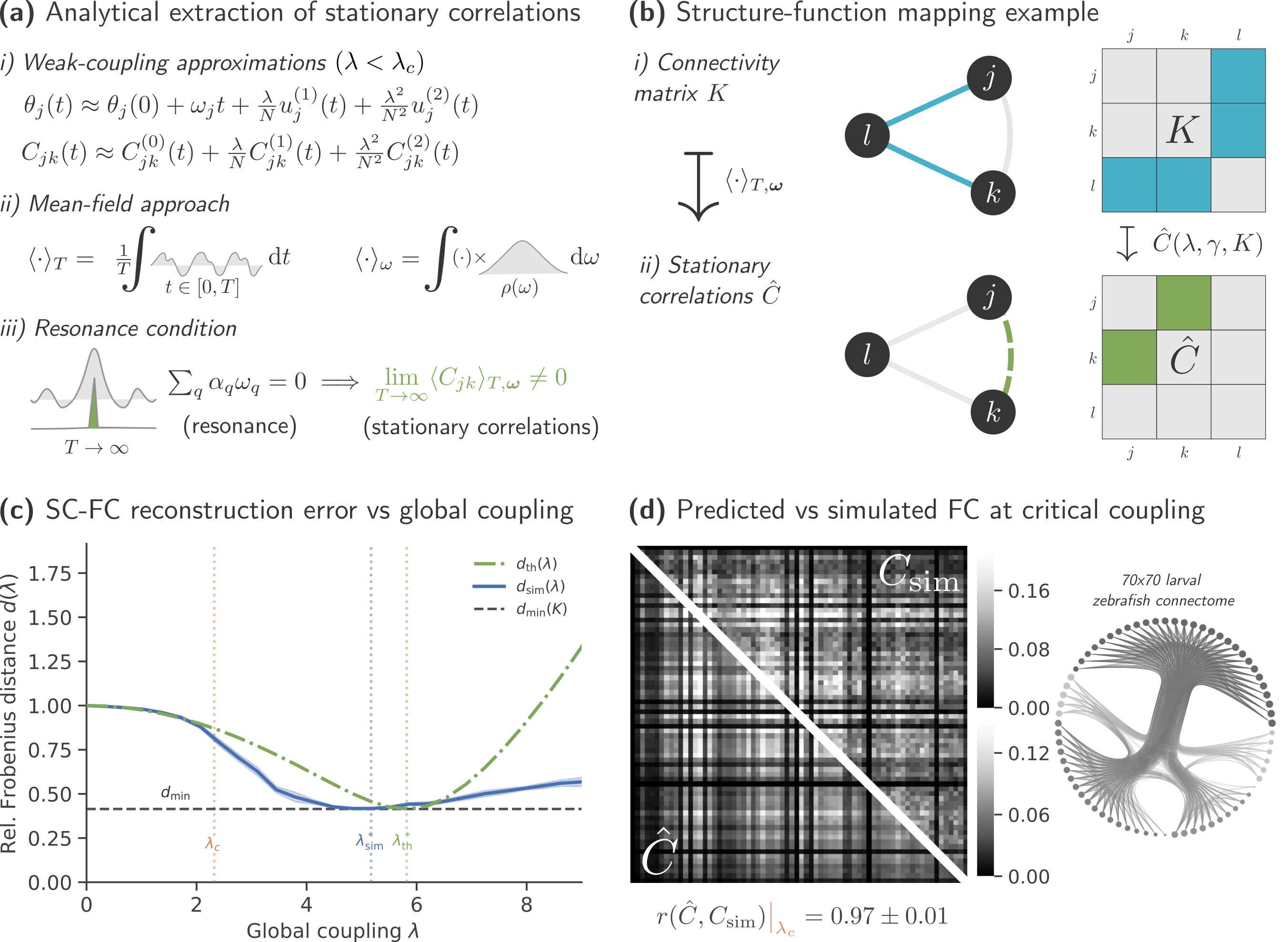 Figure 1. Predicting coactivity from anatomy in neural oscillators. (a) Derivation of predicted functional connectivity: phase trajectories are expanded, correlations averaged, and stationary terms selected. (b) Example for N=2 oscillators. (c) SC–FC reconstruction error follows theory up to synchronization (λc = 2.32). (d) Predicted and simulated FC remain highly similar (cosine similarity ≥ 0.97).
References[1] Fotiadis, P., et al. (2024).
Structure–function coupling in macroscale human brain networks.
Nature Reviews Neuroscience, 25(10), 688–704.
[2] Zamani Esfahlani, et al. (2022).
Local structure-function relationships in human brain networks across the lifespan.
Nature Communications, 13(1), 2053.
[3] Pope, M., et al. (2021).
Modular origins of high-amplitude cofluctuations in fine-scale functional connectivity dynamics.
Proceedings of the National Academy of Sciences, 118(46), e2109380118.
[4] Kunst, M., et al. (2019).
A Cellular-Resolution Atlas of the Larval Zebrafish Brain.
Neuron, 103(1), 21-38.e5.
[5] Légaré, A., et al. (2025).
Structural and genetic determinants of zebrafish functional brain networks.
Science Advances, 11(28), eadv7576.
AcknowledgementWe thank Benjamin Claveau, Antoine Légaré and Vincent Thibeault for helpful discussions, and Paul De Koninck’s lab for generating the data that initiated this project.