IntroductionThe well-known link between neural dynamics of spatial navigation and hippocampus is reflected in characteristic phenomena like neurons encoding spatial and temporal variables, and oscillatory dynamics such as phase precession in locomotion and sharp-wave ripples at rest. Existing computational models like oscillatory interference models, continuous attractor network and deep learning models either account for oscillatory behaviors or spatial coding within a rate-coded framework, capturing only a subset of features not addressing rest or temporal dynamics [1,2,3]. We propose an oscillatory hippocampus model that comprehensively captures these constructs, providing a unified framework to study translation of neural activity into navigation.
MethodsA complex valued deep oscillatory neural network is trained to estimate position coordinates of a 1D trajectory from limb oscillations and environmental visual cues of a quadruped (animal) that alternates between motion and rest [4]. The oscillatory layers in the network include a central layer with an intrinsic theta band (4-8 Hz) enabling study of hippocampal spatial navigation. The network’s complex hidden layer activations are analyzed to study the encoding of spatiotemporal information. Statistic measures are applied to the mean firing rates across spatial and temporal bins to identify place and time cells. Oscillatory behaviors are shown using Hebbian learning and regression analyses on the complex oscillatory layer activations.
ResultsPlace cells identified from the complex activations were found to tile the traversed trajectory. Time cells were observed to encode elapsed time during the task, independent of state of motion or rest. Position and velocity were encoded through oscillator population dynamics - position reflected in the mean phase and velocity in the mean frequency of the oscillator population. Sharp-wave ripple–like events generated via Hebbian learning exhibited higher amplitudes at periods of rest, indicating increased synchrony among oscillators. These findings are consistent with existing experimental observations, offering new insights into how spatiotemporal information can be represented through the joint encoding of frequency, phase, and amplitude.
DiscussionSpatial and temporal representations emerged naturally as the model learned to map sensorimotor inputs to position. Rate-coded properties were evident at the level of individual neurons, and oscillatory phenomena at the level of neuronal populations. The internal oscillatory dynamics are interpretable through the parameters of amplitude, phase and frequency. These results suggest that the proposed model offers a unified framework that can capture spatiotemporal representations during motion and rest. Its ability to encode information in interpretable oscillatory variables enables investigation of broader hippocampal functions - navigation, associative memory, and working memory, across diverse task structures and environmental conditions.
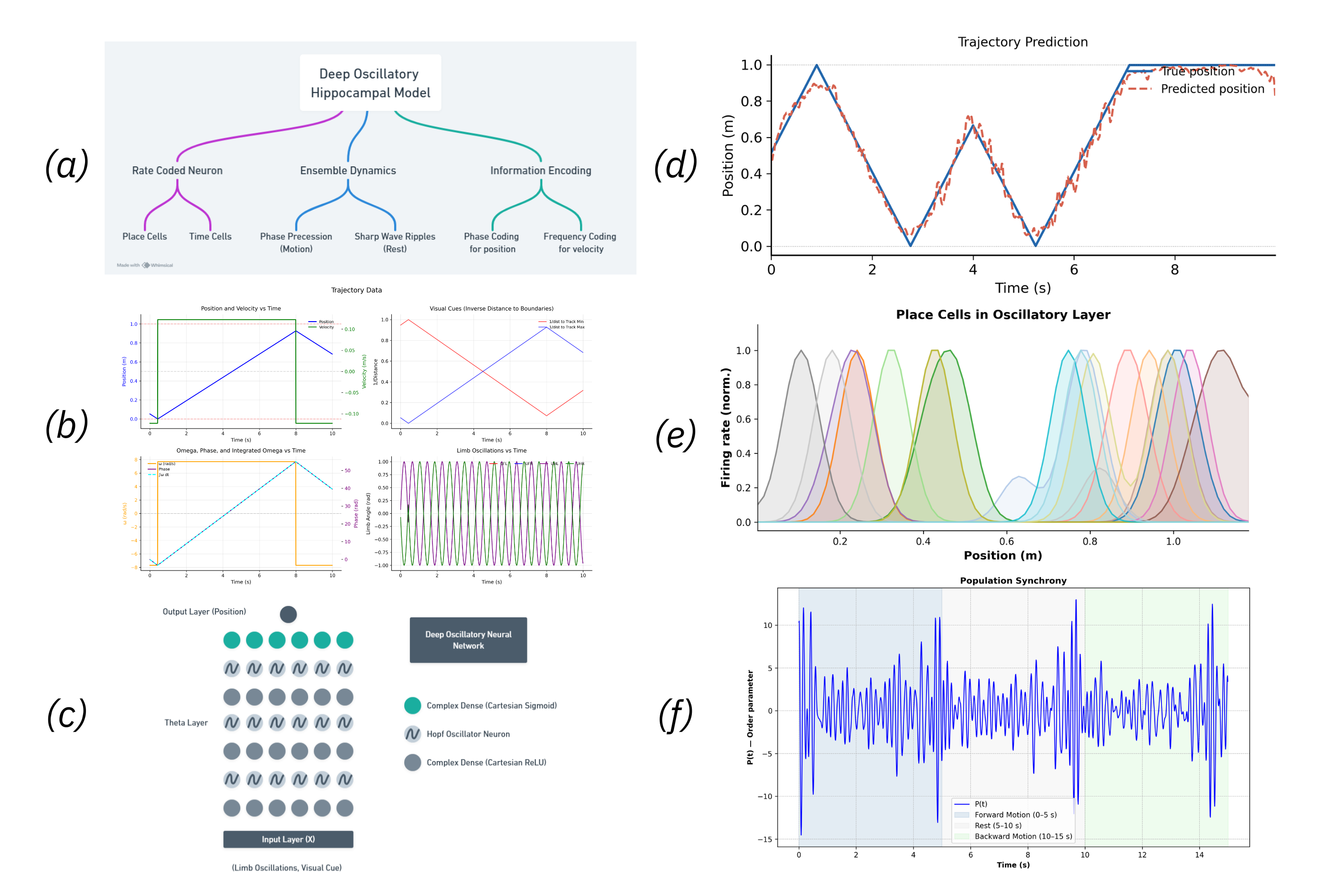 Figure 1. (a) Model Flowchart, (b) Input Data, (c) Oscillatory Neural Network Diagram, (d) Trajectory Prediction, (e) Place Cells - different colors correspond to different neurons, (f) Sharp Wave Ripples
References1. O’Keefe, J., & Recce, M. L. (1993). Phase relationship between hippocampal place units and the EEG theta rhythm. Hippocampus, 3(3), 317–330.
https://doi.org/10.1002/hipo.4500303072. Burgess, N., Barry, C., & O’Keefe, J. (2007). An oscillatory interference model of grid cell firing. Hippocampus, 17(9), 801–812.
https://doi.org/10.1002/hipo.203273. Buzsáki, G. (2015). Hippocampal sharp wave–ripple: A cognitive biomarker for episodic memory and planning. Hippocampus, 25(10), 1073–1188.
https://doi.org/10.1002/hipo.224884. Rohan, N. R., Vigneswaran, C., Ghosh, S., Rajendran, K., Gaurav, A., & Chakravarthy, V. S. (2025). Deep oscillatory neural network. Scientific Reports, 15(1), 40968.
AcknowledgementMy supervisor Prof. V. Srinivasa Chakravarthy,
Mentors from Computational Neuroscience Lab and the Dept. of Medical Sciences and Technology
More importantly, my parents.