IntroductionCurrent knowledge on the cellular composition and local connectivity of the cerebellar cortex has enabled the reconstruction of detailed microcircuit models [1, 2]. However, up to now, none of these models take into account the real convoluted shape of the cerebellar cortex. We aim at reconstructing and simulating atlas-mapped mouse cerebellar regions, capturing the relationship between structure, dynamics, and function.
We have developed a pipeline to reconstruct the mouse cerebellar cortex embedded into the Allen Mouse Brain Atlas (AMBA) [3]. Using the Brain Scaffold Builder (BSB) framework [1], we placed, oriented, bent and connected the neurons. The generated circuit can be simulated and validated against experimental findings.
MethodsWe extracted a column of the mouse declive (vermal part of the Lobule VI) from the AMBA (Fig. 1A). We placed cells based on literature densities [1], including the unipolar brush cells [4], and proposed a new strategy to place Purkinje cells based on linear density [5] (Fig. 1D). To connect the cells, we computed the orientation and depth [6] of each voxel (Fig. 1BC). These fields were used to bend the cells’ neurites following the local curvature (Fig. 1E). We applied voxel intersection on these bended cells [1]. We assigned point-neuron electrical parameters for each cell type and synaptic parameters for each connection type [7]. We compared this model to our previous nonspecific and regular-paralleliped circuit (canonical circuit) [1].
ResultsOur pipeline employed constraints for each neuron type, and the produced circuit indeed preserved the morphological properties of the canonical circuit, such as maintaining fibers parallel for granule cells (Fig. 1E). More importantly, the pipeline guaranteed a coherent connectome, which matched the synaptic convergences/divergences of the canonical circuit. We proved that, without proper bending and scaling, the number of synapses would be underestimated, especially for longer intersomatic distances.
Finally, we simulated that circuit using the BSB interfacing with the NEST simulator [8] in resting state and under stimulus. The signal propagation and population-specific firing properties were well reproduced, as in the canonical circuit.
DiscussionThe developed pipeline is able to leverage atlas data to estimate the heterogeneous spatial properties of the cerebellum, embedding them into circuit reconstructions. The atlas registration will also facilitate the integration of our model into larger brain circuits [9]. The morphology bending algorithm will be soon enhanced in order to adapt the spatial distribution of neurites to match the expected densities of fibers in the considered regions.
We plan to leverage the Blue Brain Cell Atlas pipeline [6] to reconstruct the whole declive as well as different regions of the cerebellar cortex, to study how the heterogeneity of their local properties gives rise to differences in their structure and function at the macroscale level.
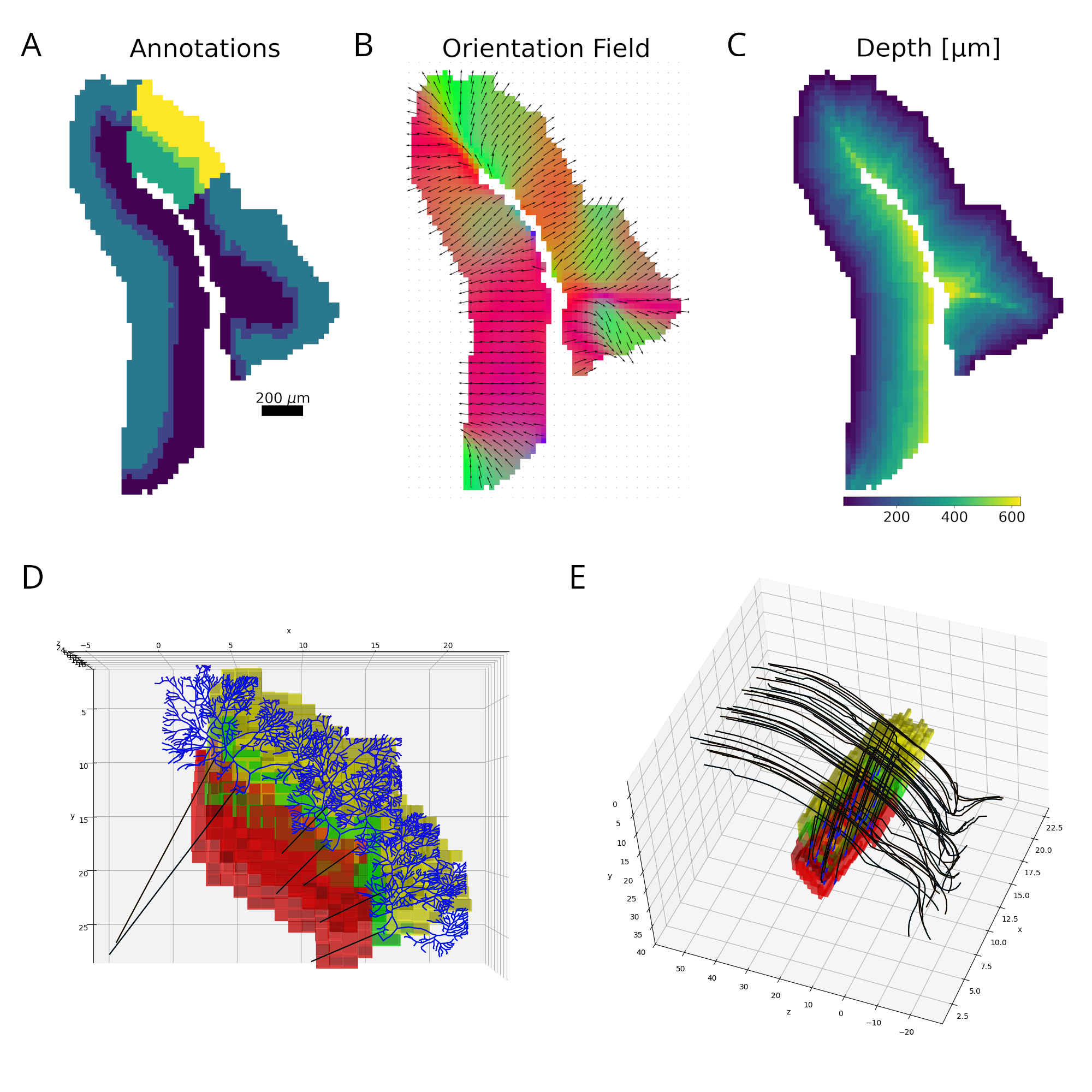 Figure 1. Reconstruction pipeline. A. Declive layers shown in colors with the selected column highlighted. B. Orientation field showing the local axons’ main axis. Colors represent the vectors’ norm. C. Distance to the outside border, following the orientation field. D. E. Purkinje and granule cells´ morphology scaled and bent according to the declive shape.
References1.
https://doi.org/10.1038/s42003-022-04213-y2.
https://doi.org/10.1038/s41598-025-25727-53.
https://doi.org/10.1111/j.1601-183X.2009.00552.x4.
https://doi.org/10.1007/s00429-013-0531-95.
https://doi.org/10.1002/jnr.242066.
https://doi.org/10.1371/journal.pcbi.10107397.
https://doi.org/10.3389/fncom.2019.000688.
https://doi.org/10.4249/scholarpedia.14309.
https://doi.org/10.1523/ENEURO.0111-17.2017