IntroductionPredictive coding proposes that cortical circuits continually compare incoming sensory signals with top-down expectations and propagate mismatches across a hierarchy to refine perception and behaviour [1,2]. Although influential, many existing models remain abstract and do not explain how deep cortical layers transform superficial prediction errors into broadcast predictions. They often omit spiking dynamics, laminar specialization, interneuron diversity, and compartmental dendritic processing [3,4]. Here we present a biologically grounded model of cortical Layer 5 in primary visual cortex that links signed prediction errors in Layer 2/3 to feedback-gated prediction broadcasting through dendritic coincidence and inhibitory control.
MethodsWe extended our hierarchical spiking predictive-coding framework by building on our previous Layer 4 sensory encoding model and Layer 2/3 prediction-error circuit [5,6]. Layer 5 pyramidal neurons were modelled as two-compartment spiking units with somatic input from PE+ neurons, encoding features present in feedforward input but absent from feedback, and PE- neurons, encoding features predicted by feedback but absent from feedforward input. Apical dendrites received top-down feedback. A local VIP-PV-SOM microcircuit gated dendritic Ca
2+ spikes and burst output (Fig. 1) [3,4,7]. Connectivity followed Gabor-based feature tuning, and simulations tested aligned strong, aligned weak, and mismatched feedback conditions.
ResultsThe model reproduced distinct Layer 5 output regimes across conditions. When feedback was aligned with sensory evidence, VIP-mediated disinhibition enabled apical Ca
2+ spikes, loosened dendritic excitation-inhibition balance, and drove strong burst firing in pyramidal neurons. With aligned but weaker feedforward input, bursting persisted at lower rates. In contrast, mismatched feedback-maintained SOM/PV inhibition, suppressed dendritic amplification, and produced predominantly tonic firing. Decoding Layer 5 population activity reconstructed a refined sensory prediction by integrating complementary signals from both PE+ and PE- populations, linking local error signals to updated top-down output.
DiscussionThese findings identify Layer 5 as a conditional broadcast stage in hierarchical predictive coding, where dendritic coincidence detection determines whether local evidence is sufficient to support a top-down prediction. By combining laminar circuit organization, interneuron diversity, feature-selective connectivity, and spiking dynamics, the model links cortical physiology with predictive computation in a mechanistic way. It also generates experimentally testable predictions about feedback-gated bursting, dendritic coincidence, compartment-specific inhibition, and precision-weighted prediction in cortical circuits, while providing a compact framework for biologically inspired and neuromorphic inference systems.
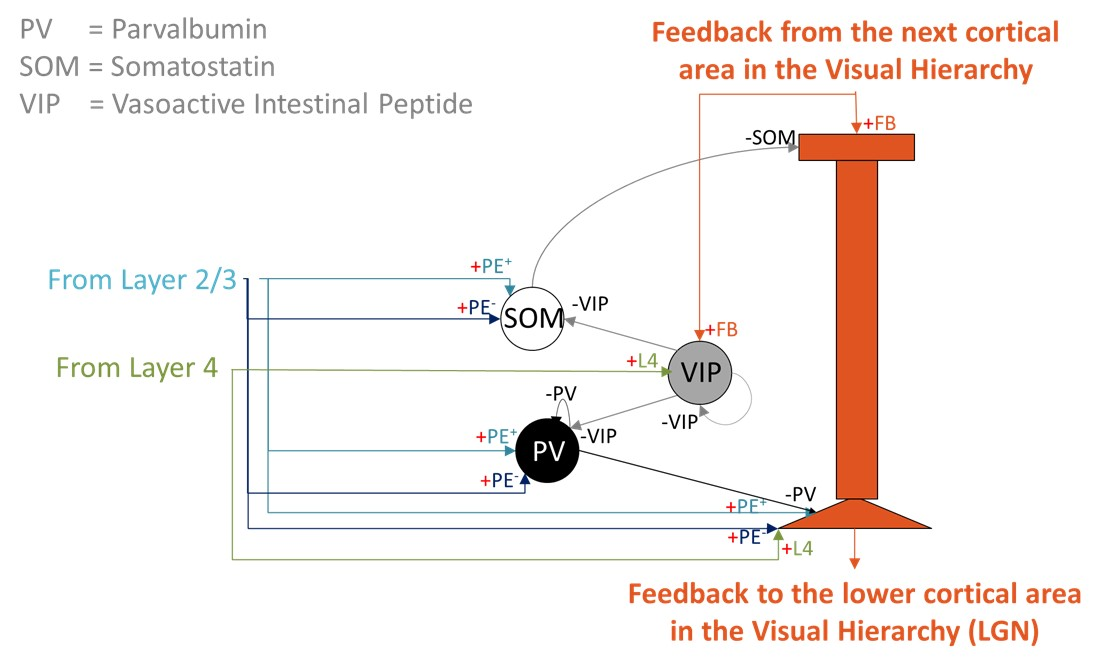 Layer 5 predictive-coding microcircuit. A two-compartment Layer 5 pyramidal neuron integrates somatic input from Layer 2/3 prediction-error populations (PE+ and PE-) and Layer 4 feature neurons with apical feedback from higher cortical areas. A local VIP-PV-SOM motif regulates apical Ca2+ spikes and burst output.References
 - Rao, R. P. N., & Ballard, D. H. (1999). Nature Neuroscience, 2, 79-87.
- Keller, G. B., & Mrsic-Flogel, T. D. (2018). Neuron, 100, 424-435.
- Hertäg, L., & Clopath, C. (2022). PNAS, 119, e2115699119.
- Mikulasch, F. A., et al. (2023). Trends in Neurosciences, 46, 45-59.
- Nemati, E., Davey, C. E., Meffin, H., & Burkitt, A. N. (2025). bioRxiv. 10.1101/2025.10.20.683584.
- Nemati, E., Davey, C. E., Meffin, H., & Burkitt, A. N. (2025). bioRxiv. 10.1101/2025.11.01.686040.
- Larkum, M. (2013). Trends in Neurosciences, 36, 141-151.
AcknowledgementANB and HM acknowledge support by the Australian Government through the Australian Research
Council’s Discovery Projects funding scheme [DP220101166].
EN acknowledges support from a Melbourne Research Scholarship, and the Diane Lemaire and Dee
& John Collier Travel Scholarships at the University of Melbourne.