IntroductionBox jellyfish (Tripedalia cystophora) are animals without a centralized brain [1]. Despite their small decentralized nervous system, they can perform visually guided obstacle avoidance behavior (OAB) [2], which is crucial for survival in their natural habitat. Recent work has shown that box jellyfish are even capable of associative learning and identified the learning center to be the rhopalial nervous system (RNS) [2]. These abilities raise the question which level of neural complexity is required to perform such actions. Here we investigate the innate OAB with a minimal sensorimotor architecture including a multilayer perceptron (MLP) optimized with a biologically plausible learning algorithm not including gradient descent.
MethodsWe developed a rectangular two-dimensional simulation platform containing walls and obstacles with varying luminance values. Agents, each steered by an MLP, receive these values by a vector depending on the directional visual sensors (Fig.1) along with a physical sensor indicating a previous collision. Inputs are fed into the MLP to make the movement decision, resulting in a movement trajectory. Agents are rewarded when randomly placed food items are retrieved and penalized for collisions, resulting in a fitness value. Weights of the MLP are optimized by evolutionary search using fitness, following a neuroevolutionary paradigm used for autonomous navigation and neural control systems [3,4]. Agents are then tested in different environments.
ResultsIn different runs with various environmental and fitness conditions, agents consistently developed OAB strategies by trying to minimize collisions while continuing to forage (Fig. 1). We study the quality of OAB when training parameters, including training time and training arenas, are varied and find that agents show best behavior for an intermediate amount of training time and in arenas where strong contrasts between wall elements where present. Overall, trajectories showed qualitative and quantitative similarities to the innate behavior of true box jellyfish. In particular, learning to avoid high-contrast objects does not lead to avoidance of objects with uniform luminosity irrespective of their distance [2].
DiscussionOur results show that evolutionary training enables small MLPs to successfully control OAB in agents mimicking box jellyfish. Whereas MLPs are feedforward neural networks, the biological RNS is a recurrent neural network [1], and therefore, future work will integrate more biologically plausible neural network architectures. Furthermore, in a next step, we will examine how the successfully learned innate OAB leads to associative learning by using our highly customizable setup in circular arenas with differing wall contrasts, similar to the experiments performed in [2]. Ultimately, our results will enable us to derive minimal requirements for neural architectures underlying associative learning, allowing for comparisons across organisms [5].
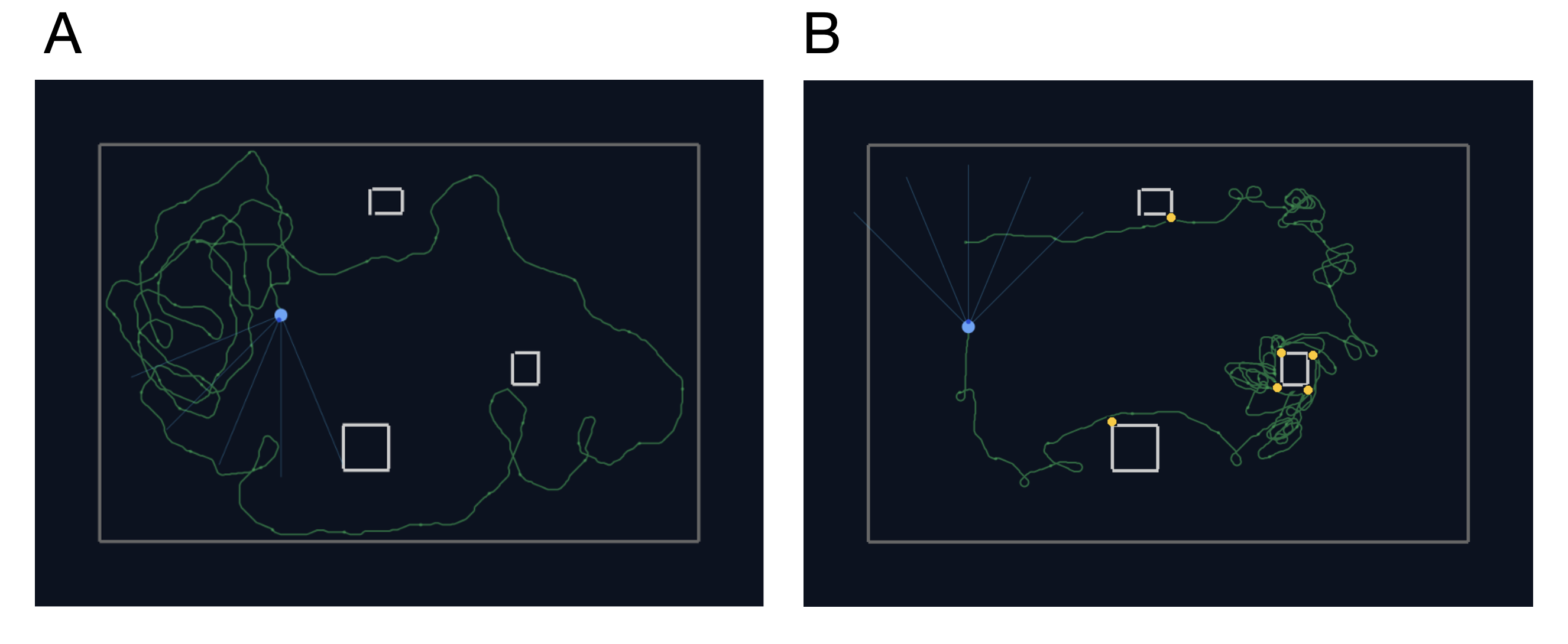 Example trajectories (green) of an agent (light blue circle with blue rays indicating visual sensors) in an arena with three high-contrast obstacles. A: The agent forages where no obstacles are present. It also frequents the part of the arena with obstacles, but never collides with them. B: Trajectory for an agent with less training times, leading to frequent collisions (yellow dots).References
1. Nielsen, Sofie K.D. et al. (2021). Journal of Comparative Neurology.
https://doi.org/10.1002/cne.251482. Bielecki, J. et al. (2023). Curr. Biol.
https://doi.org/10.1016/j.cub.2023.08.0563. Floreano, D., & Mondada, F. (1998). Neural Networks.
https://doi.org/10.1016/S0893-6080(98)00082-3 4. Whitley, D. et al. (1993). Machine Learning.
https://doi.org/10.1023/A:10226740303965. Zhou, Baohua et al. (2022).
elife.
https://doi.org/10.7554/eLife.72067AcknowledgementWe would like to thank Christoph Speckgens and Hermann Kohlstedt for helpful discussions. Funded by the Deutsche Forschungsgemeinschaft (DFG, German Research Foundation) – Project-ID 434434223 – SFB 1461.