IntroductionNeural signals exhibit systematic changes across the lifespan. In particular, the 1/f slope of the neural power spectral density (PSD), a measure of power decay with frequency, shows age-dependent decline from infancy to old age. Another PSD feature, the peak power of gamma oscillations (20-66 Hz), elicited by visual stimulus, varies non-monotonically with age, while increasing from childhood to adolescence and decreasing later. While these neural features show promise as physiological markers of ageing, researchers could not capture their age-related variation together using a single model. Moreover, signal’s non-linearity, often measured by Higuchi fractal dimension (HFD), exhibits inconsistent changes with ageing.
MethodsHere, we model the neural signals via stochastic fractional harmonic oscillator (sFHO) (Fig.1 top), that captures the non-Markovian and fractal nature of the signals [1]. It intrinsically includes memory through its non-integer derivatives ‘alpha’. We use the observed monotonic decline of slope with age to get inferences about HFD from the model (Fig. 1A and B). The model explains age-related changes in power and centre frequency of stimulus-induced gamma oscillations (Fig. 1C) and resolves the conflicting findings of HFD. Moreover, using just mathematics, it predicts that in order to have a decline in EEG gamma power in old age, the gamma power should increase from childhood to adolescence.
ResultsTo understand the underlying neural mechanism, I hypothesize a relation of excitation-inhibition (E-I) ratio with the non-integer derivative and age (Fig. 1D). I show how the E-I ratio could be increasing with age monotonically (fig. 1F) despite a non-monotonic change in the individual concentration of excitation and inhibition neurotransmitters (Fig. 1E). Taking a bold step forward, I use this framework to estimate human life expectancy in existing electroencephalogram (EEG) and electrocorticogram (ECoG) datasets of healthy adults and epileptic patients as 76.9 and 69.7 years respectively that was consistent with population statistics.
DiscussionThe present model captures the changes in PSD features from infancy to old age, in place of focusing only either on childhood-related growth or degeneration in late stages of life, thereby, providing a unified framework. It could help in constraining neural mechanisms governing ageing and has huge potential for future individual lifespan estimation and disease-risk assessment.
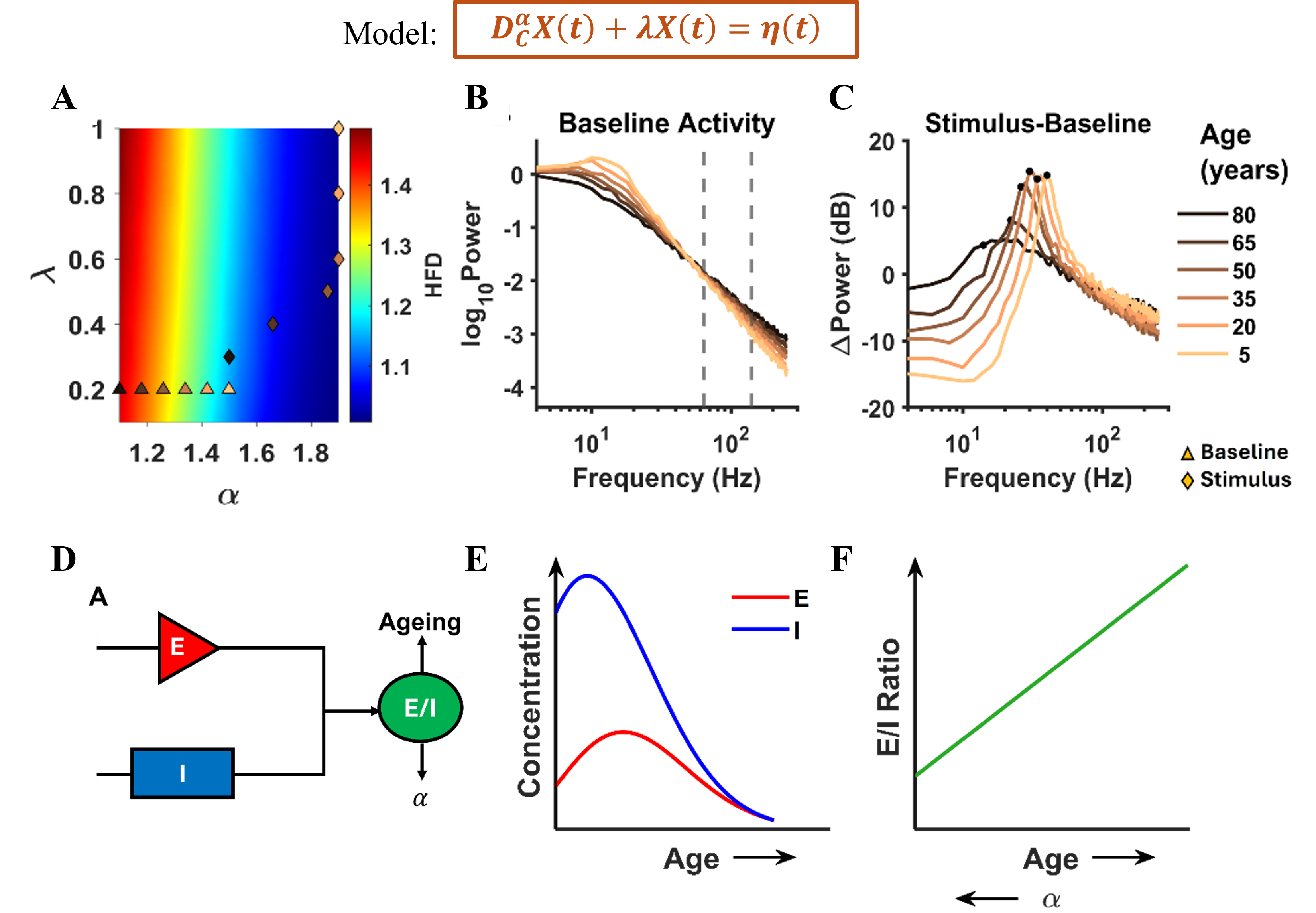 Figure 1. Age-related inferences: Top: Model equation. (A) HFD variation with α and λ. (B), (C) The PSDs and ΔPower (in dB) corresponding to triangles and diamonds respectively. (D) Illustration of E/I dependence on ageing and α. (E) The concentration of excitatory and inhibitory neurotransmitters varying non-monotonically with age. (F) Corresponding monotonic E/I ratio with age and α.
References- Aggarwal, S. (2025). Decoding human lifespan from neural noise and explaining age-related changes in fractal dimension and gamma oscillations using fractional harmonic oscillator (p. 2025.09.13.675905). bioRxiv. https://doi.org/10.1101/2025.09.13.675905
AcknowledgementThe author expresses gratitude towards Prof. Banibrata Mukhopadhyay, Department of Physics, IISc, Prof. Supratim Ray, Centre for Neuroscience, IISc and Dr. Surya Prakash for scientific discussions and guidance that enriches the quality of this work.