Authors: Robert Louis Treuting
1, Eric Rawls*
1,2Affiliations:
1Department of Psychology, University of North Carolina Wilmington, Wilmington, NC, USA,
2Department of Psychiatry and Behavioral Sciences, University of Minnesota Twin Cities, Minneapolis, MN, USA
*Email:
[email protected]IntroductionMedial frontal delta activity is a plausible control signal because the Reward Positivity (RewP) tracks outcome evaluation and prediction errors, and our prior simultaneous EEG-fMRI work localized key signed prediction-error contributions of the RewP to medial frontal cortex [1,2]. Here we tested whether 2 Hz transcranial alternating current stimulation (tACS) targeting this generator changes motivated cognitive control. We predicted that stimulation would alter latent decision parameters in an Expected Value of Control Stroop rather than merely speeding responses [2,3].MethodsSeven healthy participants completed a reward×efficacy Stroop with congruent/incongruent targets across sham and active 2 Hz medial frontal tACS sessions. Accuracy was analyzed with binomial generalized linear mixed models and reaction time with Gamma models. We then fit a hierarchical Wiener diffusion model in brms to decompose behavior into drift rate (mu), boundary separation (bs), and nondecision time (ndt). In a second model restricted to active trials, sine and cosine terms indexed the phase of stimulation at the prior trial’s feedback.ResultsActive stimulation improved accuracy (χ²(1)=8.76, p=0.003) without a main reaction-time benefit, arguing against nonspecific speeding. In the diffusion model, stimulation shifted all three latent components: drift, boundary, and nondecision time. Posterior contrasts showed robust drift benefits throughout incongruent trials and selective benefits in congruent trials when reward or efficacy was low (Fig. 1). In active trials, prior-feedback phase predicted subsequent drift (feed_cos=0.39 [0.19, 0.59]; feed_sin=-0.26 [-0.48, -0.05]), consistent with causal modulation of a RewP-linked medial frontal mechanism for updating expected value of control from recent outcomes [1,2].DiscussionThese results suggest that medial frontal delta stimulation does not simply energize behavior. Instead, it changes how outcome information is converted into the next trial’s control state. Computationally, active 2 Hz tACS improved evidence accumulation while also reshaping caution and peripheral processing.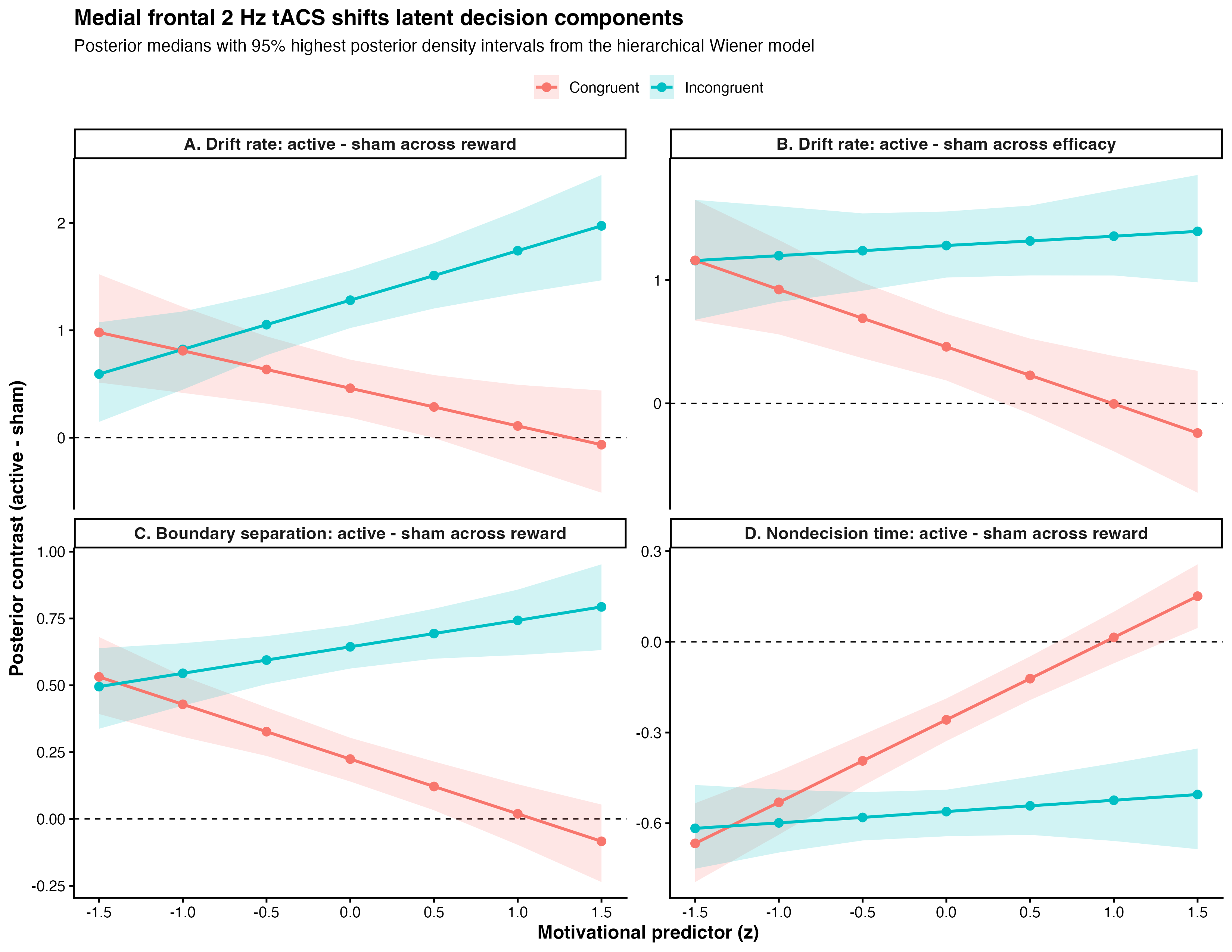 Figure 1. Active minus sham posterior contrasts from the hierarchical Wiener diffusion model. Top panels show drift-rate changes across reward and efficacy, separated by congruency. Bottom panels show boundary-separation and nondecision-time changes across reward. Points indicate posterior medians; ribbons show 95% highest posterior density intervals.
References[1] Rawls, E., Demro, C., Teich, C. D., Zhang, J., Wang, A., Heilbronner, S. R., Mueller, B. A., Sponheim, S. R., & MacDonald, A. W., III. (2026). The search for RewP: Dissociating cortical generators of electrophysiological signed and unsigned prediction errors using simultaneous EEG-fMRI [Manuscript in preparation].
[2] Frömer, R., Lin, H., Dean Wolf, C. K., Inzlicht, M., & Shenhav, A. (2021). Expectations of reward and efficacy guide cognitive control allocation. Nature Communications, 12, 1030.
[3] Ratcliff, R., & McKoon, G. (2008). The diffusion decision model. Neural Computation, 20(4), 873–922.
AcknowledgmentsWe thank the Brain, Data, and Causality Lab and our University of Minnesota collaborators for the prior simultaneous EEG-fMRI work that motivated this study, and for foundational discussion of RewP source modeling and expected value of control.