Beatriz Barros
1,2, Raquel Figueiredo
1,2,
Renato Duarte*1, 2
1Center for Neuroscience and Cell Biology (CNC-UC), University of Coimbra, Portugal
2Centre for Innovative Biomedicine and Biotechnology (CiBB), University of Coimbra, Portugal
*Email:
[email protected]IntroductionA single cortical neuron simultaneously expresses Hebbian STDP proximally and cooperative plasticity distally, couples excitatory and inhibitory weight changes, and maintains homeostatic stability across timescales spanning seconds to days. Computational models treat these phenomena separately, yet the underlying molecular cascades are shared, shaped by local dendritic morphology and chemical composition. This convergence means that compartment-specific learning rules, local E/I balance, and multi-timescale homeostasis are not independent, but mechanistically coupled through intracellular dynamics. What emerges computationally from this coupling, and how it reshapes our understanding of single-neuron learning, remains an open question.MethodsWe build on a three-compartment neuron model [2], augmented with active, electrogenic dendritic processes (Fig. 1). Local calcium currents feed a slow dendritic integrator that drives calcium-dependent plasticity [3] at every synapse. Compartment-specific learning emerges naturally: bAP-dominated proximal calcium produces Hebbian STDP, while VGCC/NMDAR-dominated distal calcium yields cooperative plasticity. Inhibitory synapses read the same calcium with inverted thresholds, coupling E/I balance without explicit homeostatic targets. We extend this via stargazin phosphorylation [4], anchoring AMPAR trafficking, Kv7.2-mediated intrinsic excitability, and synaptic scaling in a three-tier cascade spanning seconds to days.ResultsA single plasticity rule, operating on compartment-resolved calcium trace, produces Hebbian STDP proximally (bAP-dominated) and cooperative, timing-independent plasticity distally (VGCC/NMDAR-dominated), matching recent in vivo observations [1]. Shared calcium maintains coupled E/I balance locally, without explicit homeostatic targets, and allows accurate stimulus representation from the response to localized perturbations. The stargazin cascade reproduces multiphasic homeostatic dynamics with intrinsic plasticity preceding synaptic scaling. We show that the apparent diversity of cortical plasticity rules is an emergent phenomenon, a consequence of intracellular dynamics and proceed to investigate its functional consequences.DiscussionCompartment-specific signaling produces qualitatively different learning rules from the same mechanism, reframing credit assignment in cortical circuits [1] and emphasizing intracellular signaling as a primary locus of learning and memory. Stimulus associations, selectivity, and stability emerge from dendritic biophysics and are co-modulated with shared electrochemical substrates. Beyond the biophysical details, the framework we present here raises broader questions: can local, compartmentalized balance serve as a natural learning objective? And how does coupling different adaptation mechanisms shape information representation and memorization, with intracellular dynamics acting as a stack-like memory?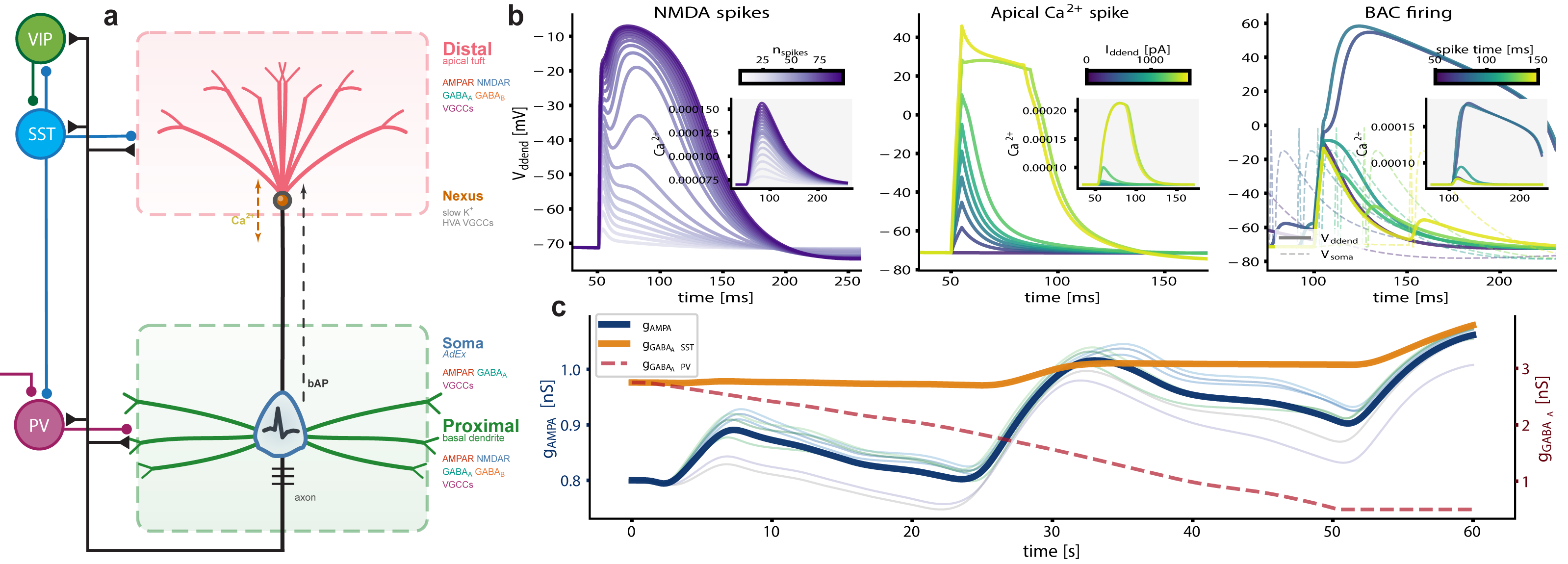 Figure 1. Augmented tripod neuron with compartment-specific electrogenic events and coupled E/I plasticity. (a) Circuit schematic with compartment-resolved receptors and interneuron targeting. (b) NMDA plateaus, apical Ca²⁺ spikes, and BAC firing with dendritic calcium transients (insets). (c) Shared calcium couples excitatory and inhibitory weight dynamics, actively maintaining E/I balance.
References[1] Wright, W. J., Hedrick, N. G., & Komiyama, T. (2025). Distinct synaptic plasticity rules operate across dendritic compartments in vivo during learning. Science, 388(6744), 322-328.
[2] Quaresima, A., Fitz, H., Duarte, R., van den Broek, D., Hagoort, P., & Petersson, K. M. (2023). The Tripod neuron: a minimal structural reduction of the dendritic tree. The Journal of Physiology, 601(15), 3265-3295.
[3] Graupner, M. & Brunel, N. (2012). Calcium-based plasticity model explains sensitivity of synaptic changes to spike pattern, rate, and dendritic location. PNAS, 109(10), 3991-3996.
[4] Rodrigues, M. V. et al. (2024). Type I TARPs regulate Kv7.2 potassium channels and susceptibility to seizures. bioRxiv, 2024.08.09.607194.
AcknowledgmentsThis work was supported by national funds through FCT—Foundation for Science and Technology, I.P., under the project HetSyn (2023.13758.PEX).