Introduction Recent technological advances allowing us to simultaneously record across thousands of neurons have revealed the presence of distributed representations across the brain [1]. However, the network processes and information pathways that create these distributed representations are still poorly understood. To identify these distributed representations, we measured shared information across brain areas, by introducing a new directed connectivity measure, Reduced Rank Connectivity (RRC). RRC is defined through communication subspaces between neural areas, and by comparing these subspaces we can measure the extent of distributed signals across the brain.
Methods We analyzed Neuropixels recordings from the Allen Institute from 54 mice performing a go/no-go visual change detection task, focusing on six visual cortical areas (V1, LM, AL, RL, AM, PM), as well as the thalamus (LP) and hippocampus (CA1), across two sessions: active behavior and passive replay [2]. To estimate shared information, we applied Reduced Rank Regression (RRR) [3], which predicts target activity from a low-dimensional subspace of a source population. We define the total predictable target activity as a new connectivity measure, called RRC, and distances between subspaces quantify the similarity of shared information across neural areas.
Results We applied RRR to cortical and subcortical areas to analyze information flow across all area pairs combinations. We showed that model performance, defined as the squared correlation between predicted and test data, saturated with only a few predictive dimensions. These results identify low-dimensional communication subspaces between neural areas (Fig. 1a). We observed consistent shared information across the visual cortex, while predictability was lower for subcortical areas (Fig. 1b). Connectivity computed using RRR differed significantly from structural connectivity [4] (Fig. 1c). Our results also show that RRC is modulated by the animal’s engagement with the task (active vs. passive).
Discussion Using RRR on multi-area cortical recordings, we identified robust shared information across visual areas during a discrimination task. RRR performance provides a connectivity measure that captures predictive subspaces rather than coarse averages. The results suggest the presence of low-dimensional communication subspaces between neural areas. Cortical areas can be more easily predicted by their own activity than subcortical areas through these communication subspaces during visual processing. RRC differed from structural connectivity and was modulated by behavioral state.
Figure 1. Low-dimensional communication subspaces define RRC. (a) Prediction performance vs. rank; saturation defines optimal number of ranks and RRC. (b) Average RRC across animals; cortical areas are more predictable than subc

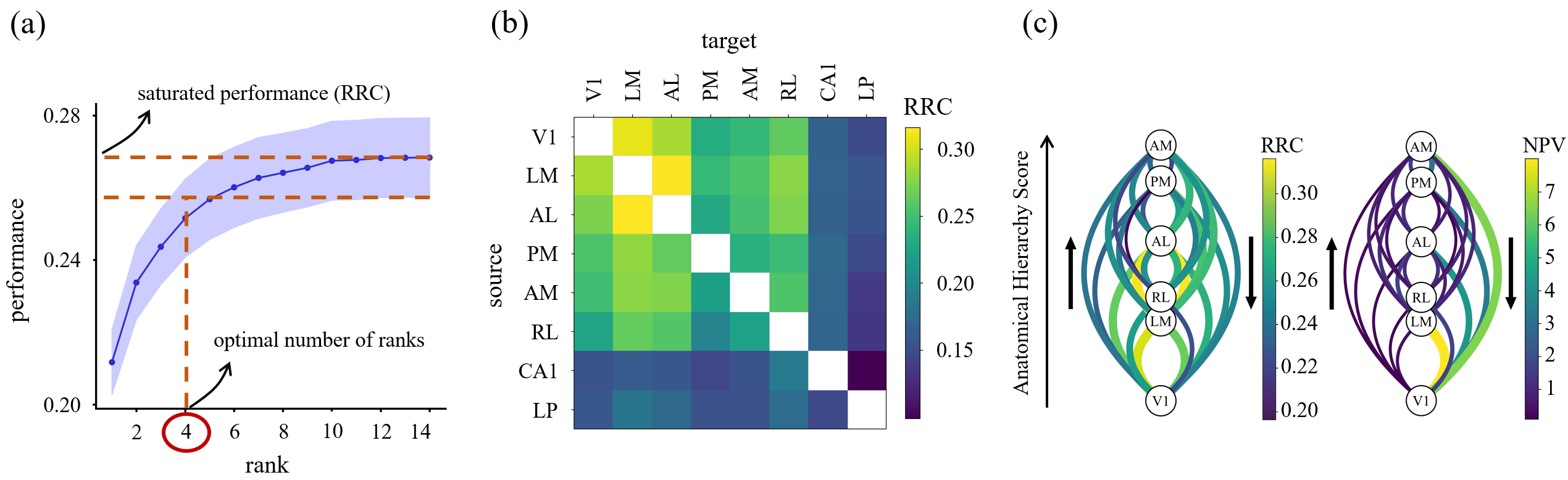 Figure 1. Low-dimensional communication subspaces define RRC. (a) Prediction performance vs. rank; saturation defines optimal number of ranks and RRC. (b) Average RRC across animals; cortical areas are more predictable than subc