John D. Griffiths*1,2,3,4, Kevin Kadak
1,3, Yupeng Tian
1,5,6
1Krembil Centre for Neuroinformatics, Centre for Addiction and Mental Health, Toronto, Canada
2Department of Psychiatry, University of Toronto, Canada
3Institute of Medical Sciences, University of Toronto, Canada
4Institute of Biomedical Engineering, University of Toronto, Canada
5Dept. Mathematics, University of Toronto, Canada
6Fields Institute for Mathematical Sciences, Toronto, Canada
*Email:
[email protected]IntroductionRepetitive transcranial magnetic stimulation (rTMS) and transcranial focused ultrasound stimulation (rTFUS) are noninvasive neuromodulation techniques with established and promising clinical applications, respectively.Though their primary mechanisms of action differ (electromagnetic vs. acoustic),both exert clinically relevant effects through stimulation-induced synaptic plasticity. Despite rich neurophysiological understanding of plasticity, a validated theoretical framework describing noninvasive neurostimulation-induced plasticity remains to be developed. We present a unified mean-field modelling framework for rTMS- and rTFUS-induced plasticity, grounded in calcium-dependent plasticity theory embedded in a corticothalamic circuit[1,2,3].MethodsWe extended the Fung-Robinson calcium-dependent plasticity model [1] by embedding it in a multi-population corticothalamic circuit generating alpha oscillations, implemented in NFTsim. For rTMS validation, a within-subject TMS-EEG experiment (N=21; 5 visits) tested 5 iTBS protocols varying inter-burst frequency and pulses-per-burst, measuring motor-evoked potentials (MEPs) and resting-state EEG alpha power. For rTFUS, a novel equivalent-energy principle (Fig.1) scaled continuous FUS burst amplitudes to deliver equivalent energy to corresponding rTMS waveforms, enabling direct model comparison across modalities. Predictions were compared against published rTFUS motor plasticity data across varying inter-burst frequencies and durations [4,5].ResultsWeaker iTBS protocols (3Hz/3PPB, 5Hz/2PPB) produced paradoxically stronger LTP-like MEP facilitation than standard iTBS (5Hz/3PPB), while the strongest protocol (7Hz/3PPB) robustly sign-flipped to LTD. MEP and resting-state alpha power showed a consistent inverse relationship across all protocols, supporting EEG as a plasticity biomarker outside the motor system. The corticothalamic model reproduced correct MEP directionality in 5/5 protocols and rank-ordering in 4/5, and captured alpha directionality in 4/5.Applying the equivalent-energy principle to rTFUS, the same model replicated published cTB-FUS plasticity results and accounted for the LTD/LTP sign-flip in cTB-TMS (40s vs. 80s) but not cTB-FUS, explained by waveform shape alone [4,5].DiscussionThese findings support a 'less is more' principle: gentler stimulation paradoxically yields stronger plasticity effects, with over-stimulation causing sign-reversal to LTD. The consistent MEP-alpha inverse relationship opens the possibility of using scalp EEG as a protocol-agnostic plasticity readout. The equivalent-energy principle provides a principled bridge between rTMS and rTFUS modelling, enabling the same calcium-dependent corticothalamic framework to account for both modalities without re-parameterization. Together these results establish a foundation for in silico exploration of the largely unmapped rTMS/rTFUS protocol space, with direct implications for optimizing clinical neuromodulation [2,3].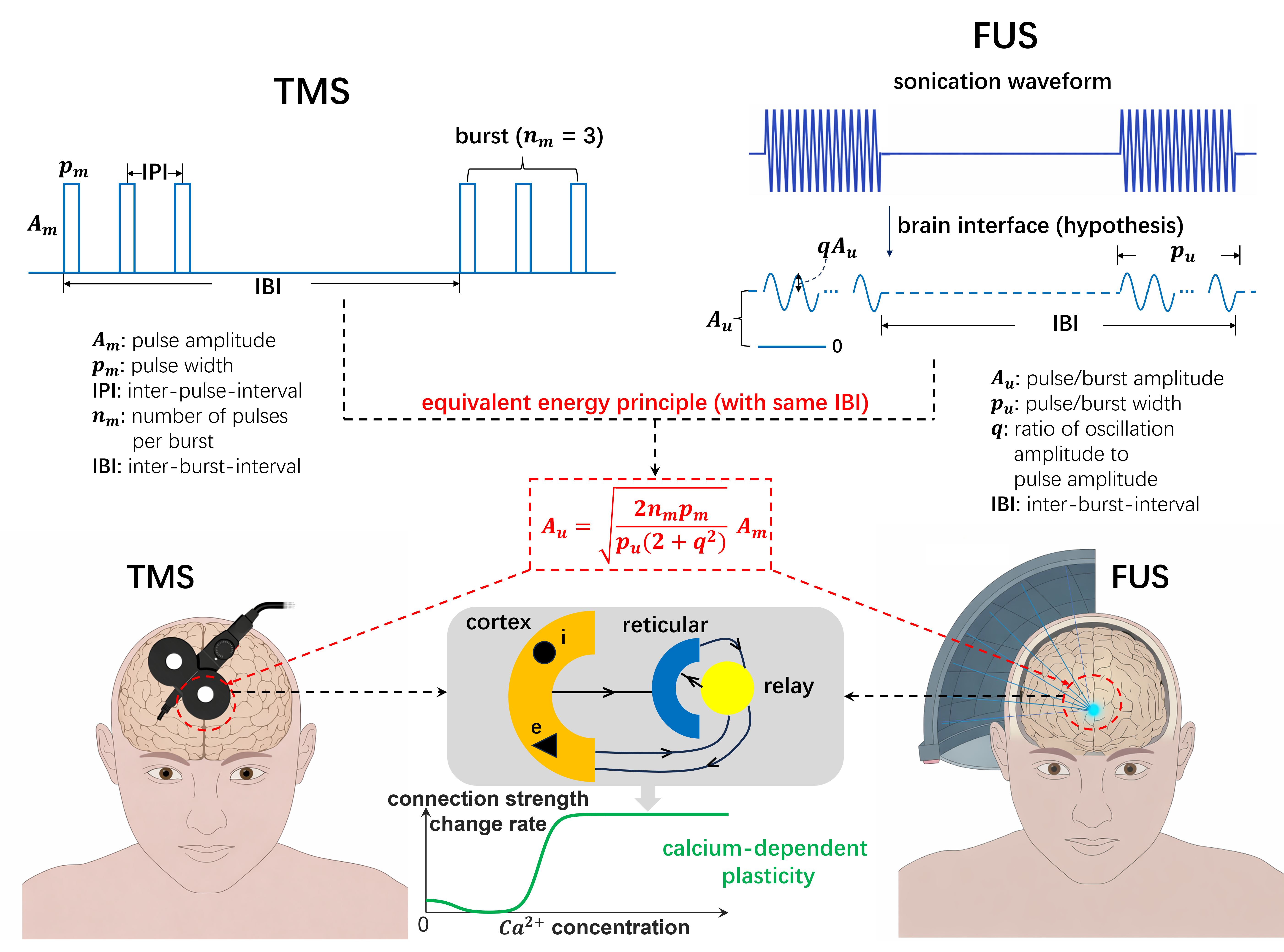 Figure 1. Equivalent energy principle for aligning rTMS and rTFUS plasticity models. rTMS delivers discrete pulse bursts; rTFUS delivers continuous bursts filtered by the skull interface to sub-1kHz sinusoids. The principle constrains parameters so both modalities deliver equal energy at the same carrier frequency, enabling unified mean-field modelling of calcium-dependent plasticity.
References- Fung & Robinson (2014). Neural field theory of synaptic metaplasticity with applications to theta burst stimulation. J Theor Biol, 340, 164–176. https://doi.org/10.1016/j.jtbi.2013.09.021
- Kadak K, et al. (2026, submitted). Less is more: gentle protocols induce stronger facilitatory effects than standard iTBS through calcium-dependent metaplasticity.
- Tian Y, et al. (2026, submitted). Equivalent energy principle and calcium-dependent plasticity theory unify TMS and FUS effects.
- Zeng K, et al. (2024). Motor cortex plasticity by theta burst transcranial ultrasound. Ann Neurol, 91(2), 238–252. https://doi.org/10.1002/ana.26294
- Gamboa OL, et al. (2010). Reversal of theta burst after-effect with prolonged stimulation. Exp Brain Res, 204(2), 181–187. https://doi.org/10.1007/s00221-010-2293-4
AcknolwedgmentsWe acknowledge funding from the Krembil Foundation, Labbatt Foundation, UofT EMHSeed, and Fields Institute for Mathematical Sciences, that supported this work.