Alberto Mazzoni1,2,*,
Federico Fattorini
1,2, Nicolò Meneghetti
1,2
1The Biorobotics Institute, Scuola Superiore Sant’Anna, Pisa, Italy
2Department of Excellence for Robotics and AI, Scuola Superiore Sant’Anna, Pisa, Italy
*Email:
[email protected]
IntroductionParkinson’s disease (PD) is a common neurodegenerative disorder causing severe impairments. Drug-resistant patients are treated with Deep Brain Stimulation (DBS) of the basal ganglia (BG), with current efforts focused on adaptive DBS. The most relevant biomarkers for adaptive DBS is the power in the beta ([12, 30] Hz) and gamma ([30, 100] Hz) range, yet the mechanisms underlying these rhythms remain unclear. Computational models can provide mechanistic insights into pathophysiology and test new stimulation treatments. Using spiking and morphological models, we show how beta and gamma resonances emerge from BG interactions, how DBS reshapes these dynamics, and how they are reflected in subthalamic nucleus local field potentials (LFPs).MethodsWe implemented a spiking model of the basal ganglia with six neuronal populations: three within the striatum, two within the external globus pallidus, and the subthalamic nucleus (STN) (Fig. 1A) [1]. Dopamine depletion was simulated by modulating striatal inputs. We dissected the network mechanisms underlying beta and gamma resonances and we simulated STN DBS, considering short-term synaptic plasticity (Fig. 1B) [2]. To simulate the signals recorded by DBS electrodes we developed a population of morphological STN neurons model and computed LFPs associated with network activity through volume conduction theory (Fig. 1C).ResultsWe show how beta oscillations arise from two independent loops in the BG model that strongly synchronize when dopamine is depleted [1]. STN DBS disrupts these oscillations, although without synaptic plasticity it requires unrealistically low stimulation levels (Fig 1B left). The model also supports the hypothesis that gamma-range stimulation can be as effective as the clinical standard of ~130 Hz used in PD (Fig. 1B right) [2]. Gamma oscillations emerge through recurrent inhibition in pallidal and striatal populations. Different from cortical ones, STN LFPs are largely noise-dominated due to weak correlations and symmetric neuronal morphology, becoming informative only when strong beta synchronization is present.DiscussionWe characterized in a spiking model of BG beta and gamma rhythmogenesis and their alteration due to PD-related dopamine depletion and DBS. Moreover, we investigated the origin of STN LFPs driving adaptive DBS, by integrating spiking and morphological modeling. Overall, we provide a multiscale framework for better understanding Parkinsonian dynamics and DBS mechanisms, showing how network modeling can clarify treatment mechanisms and guide improved stimulation strategies.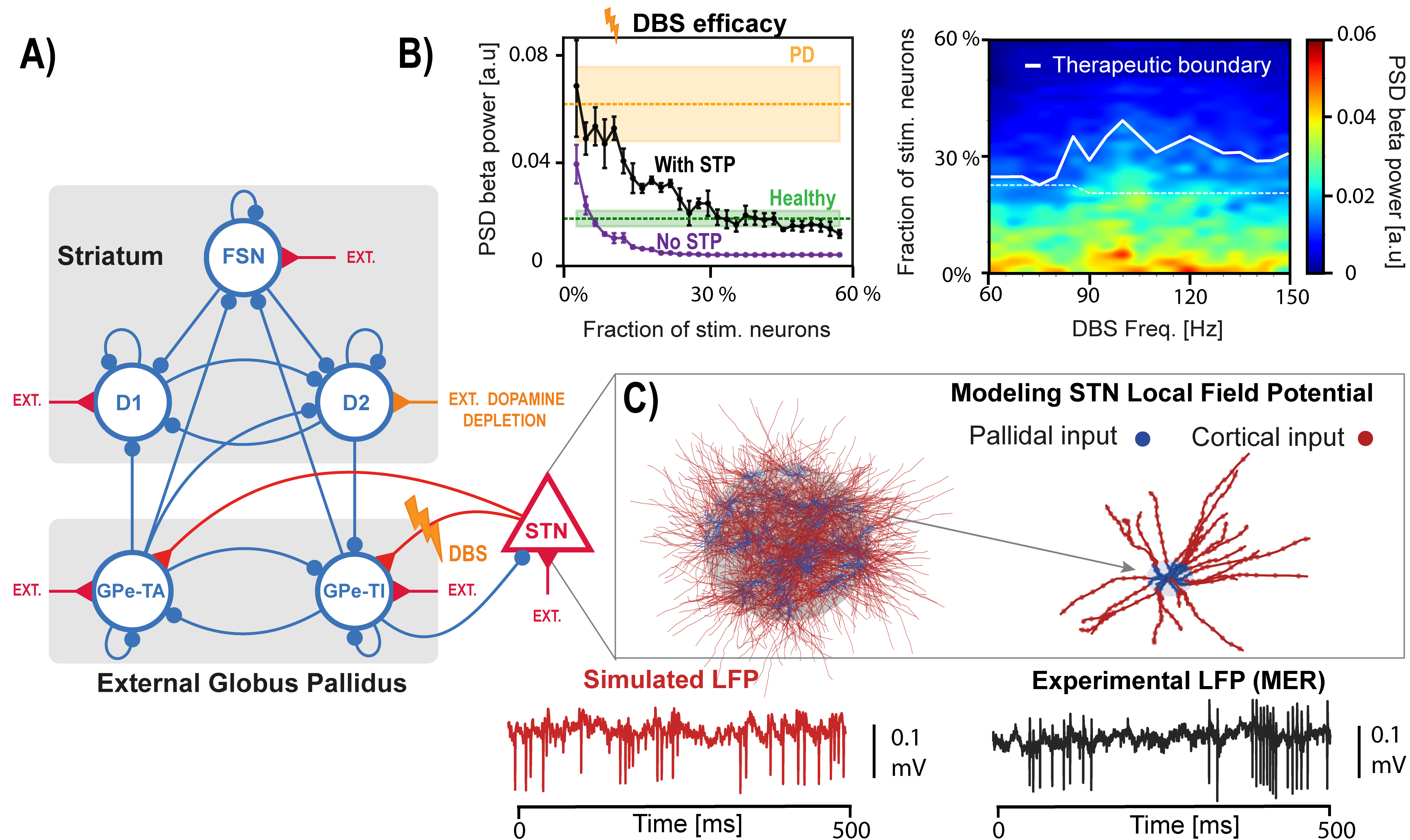 Figure 1. A) Spiking network model of the basal ganglia. B) Left: efficacy of STN DBS as a function of the fraction of stimulated neurons, with and without short-term plasticity (STP). Right: effect of stimulation frequencies on beta spectral power. C) Top: STN population and morphological neuron model receiving cortical and pallidal inputs. Bottom: simulated and recorded local field potentials (LFPs).
References1. Ortone, A., Vergani, A. A., Ahmadipour, M., Mannella, R., & Mazzoni, A. (2023). Dopamine depletion leads to pathological synchronization of distinct basal ganglia loops in the beta band. PLOS Computational Biology, 19(4), 1–31. https://doi.org/10.1371/journal.pcbi.1010645
2. Ahmadipour, M., Fattorini, F., Meneghetti, N., & Mazzoni, A. (2026). In silico model of basal ganglia deep brain stimulation in Parkinson’s disease captures range of effective parameters for pathological beta power suppression. PLOS Computational Biology, 22(2), e1013280. https://doi.org/10.1371/journal.pcbi.1013280
AcknowledgmentsThis work was supported by the Italian Ministry of University and Research, under the complementary actions to the NRRP ‘Fit4MedRob - Fit for Medical Robotics’ Grant (# PNC0000007).