Brett J. Kagan
*1, David Hogan
1, Andrew Doherty
1, Boon Kien Khoo
1, Johnson Zhou
1, Richard Salib
1, James Stewart
1, Kiaran Lawson
1, Alon Loeffler
1,
1Cortical Labs, Melbourne, Australia
2 The University of Melbourne, Department of Biochemistry and Pharmacology, Parkville, Melbourne, 3000, Australia
*Email:
[email protected]IntroductionNeural cultures are increasingly explored to understand the computational properties of neural systems due to the controllability and modifiability of these systems. However, BNNs can only be explored reliably as reliable information-processing systems if inputs are delivered in a temporally and structurally consistent manner. In practice, this requires stimulation with precisely controlled structure, microsecond-scale timing, multi-channel synchronization, and the ability to observe and respond to neural activity in real-time. Existing approaches depend on either depend on low-level hardware mechanisms, imposing prohibitive complexity for rapid iteration, or they sacrifice temporal and structural control, undermining consistency.MethodsTo resolve this problem. We developed a bespoke but scalable system (the CL1)1 that coupled with a easy to use Application Programming Interface ( CL API)2 to enables real-time, sub-millisecond closed-loop interactions with neural cultures. The system itself provides real-time closed-loop electrophysiology with integrated life support. For the API design approach, the CL API provides users with precise stimulation semantics, transactional admission, deterministic ordering, and explicit synchronization guarantees. This contract is presented through a declarative Python interface, enabling non-expert programmers to express complex stimulation and closed-loop behavior without managing low-level scheduling or hardware details.ResultsThe result is a scalable device for interacting with in-vitro neural cell cultures via electrophysiology in a closed-loop real-time environment coupled with an integrated life-support system. The devices are server rack stackable, generating up to 6TB of neural activity data per server rack per day, allowing detailed analysis of electrophysiological data, where each unit can run its own embodied environment. This allows an unparalleled investigation of nearly fully controllable neural systems to explore their dynamics in depth. The flexibility of the Cl1 means that information processing and computation in neural cultures can be explored in many ways, including as reservoir computing, in robotics4, or via games such "Pong"5 or “Doom”.DiscussionThe CL1 system coupled with the CL API offers a scalable system for exploring computational dynamics of biological neural networks. Aside from being possible to set up in traditional cell culture laboratories, these systems can be accessed remotely via the cloud where the cell culture methods are managed either by a dedicated company or by partner laboratory groups. This provides a tool for computational neuroscientists, who might otherwise not be able to access these neural cultures, to explore research questions at scale, with precision, and with rapid iteration loops. It is proposed that this availability will allow computational neuroscientists to be able to explore the dynamics of biological neural systems in way never possible before.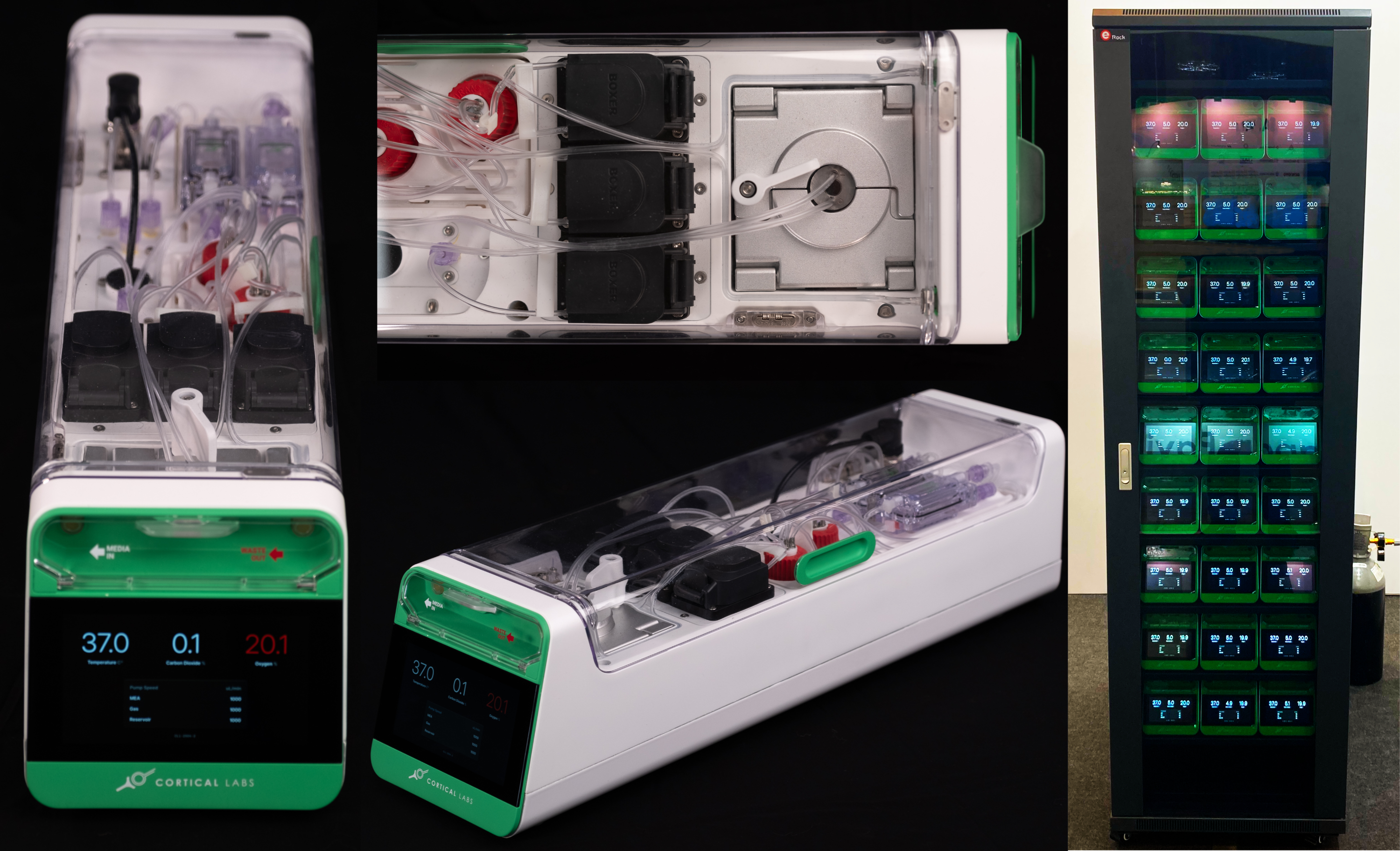 Figure 1. The CL-1 device is scalable desktop device compatible with standard server racks that allows real-time closed-loop interactions with neural cells via an MEA reader. The CL-1 has onboard hardware that interprets simple code via a Python API to allow rapid code development and experimental iterations coupled with a closed-loop perfusion circuit to automatically adjusts gas levels and temperature to
References1) Kagan, B. J. (2025). The CL1 as a platform technology to l