Loading…
Monday July 13, 2026 10:40am - 11:10am ADT
Benjamin S. Sipes*1, Ashish Raj1

1Department of Radiology and Biomedical Imaging, University of California, San Francisco, San Francisco, CA, United States

*Email: [email protected]

Introduction
Diffusion MRI (dMRI) tractography estimates the brain's white matter structural connectivity (SC) in vivo, but it cannot resolve the directionality of white matter pathways. Yet, much recent work has shown that genes and gene co-expression maps relate to SC across species [1-4]. Here we test whether gene co-expression gradients can infer connection directionality from undirected structural connectivity using the brain’s structure–function relationship.

Methods
We introduce asymmetry to SC (C) via a similarity transform with a node-level gauge parameterized by genetic gradients: C̃=ACA^-1, where A=diag(e^{Ga}), with G=[g_1,...,g_k] genetic gradient vectors and a=[a_1,...,a_k]^T gradient weights. We learn gradient weights by fitting a higher order network diffusion (HONeD) model of the SC graph Laplacian, ℒ=I-C̃D_{in}^-1, f(ℒ)=-κI-βℒ+ξℒ^2, to the residual of the Lyapunov equation, f(ℒ)^TΣ+Σf(ℒ)+I [5,6], with stationary covariance (Σ) estimated from functional neuroimaging. We compared our model's performance to ground truth directionality in three species: C. elegans, mouse, and macaque [7-10]. We then ran our model on 770 HCP subjects [11,12]. Public datasets supplied gene expression [13-17].

Results
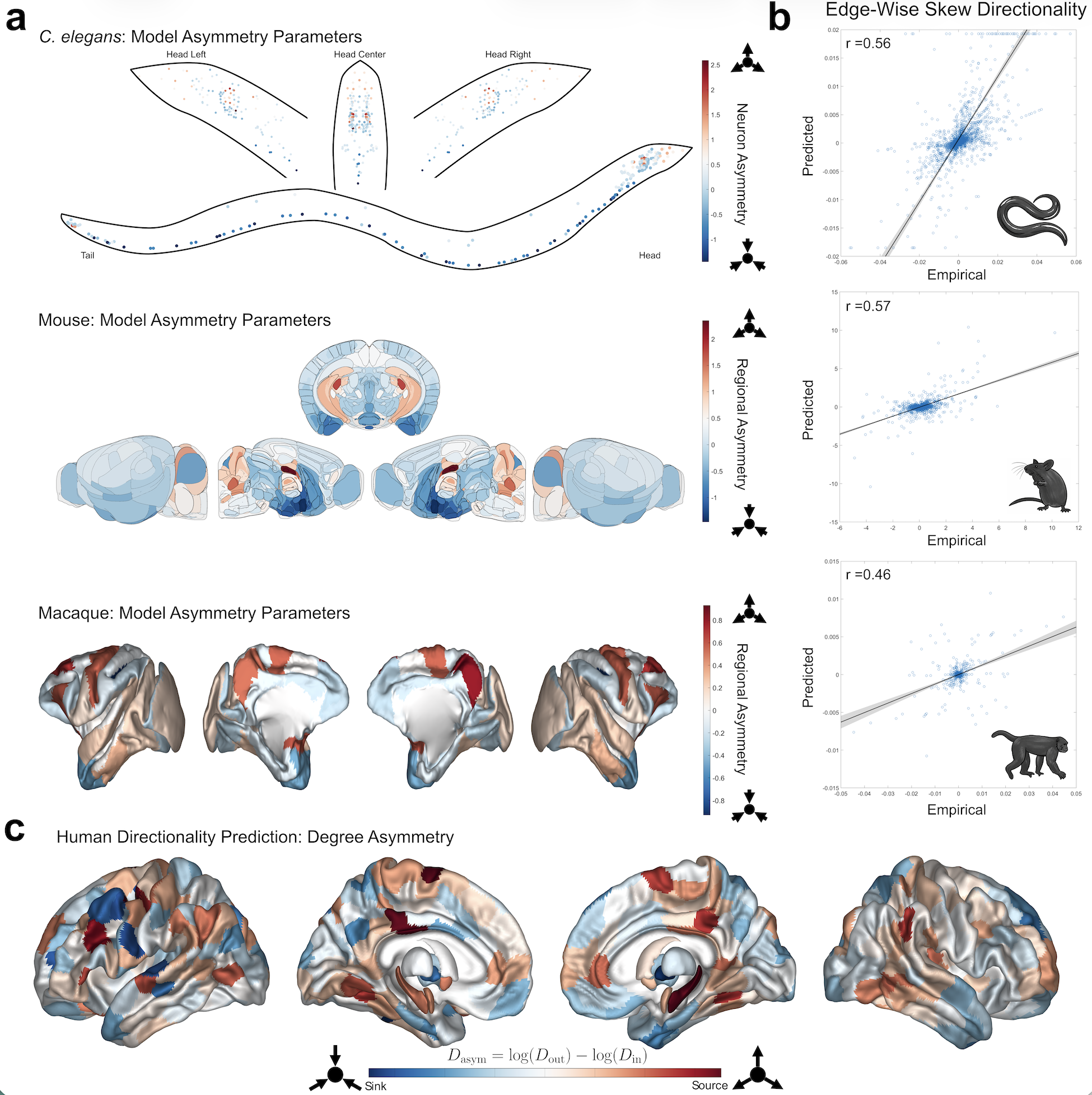
Model-predicted directionality significantly correlated with ground-truth directed edges in all three species. Our model predicted neuron-to-neuron synaptic directionality in C. elegans (r=0.56, p<10^-253) and tracer-based directionality in mouse (r=0.57, p<10^-37) and macaque (r=0.46, p<10^-44) (Fig.1a-b). The optimal numbers of genetic gradients was also different in each species (C. elegans: k=3; Mouse: k=5; Macaque: k=1). We found that humans had optimal test-retest reliability when using k=5 genetic gradients (ICC=0.46). Human predicted degree asymmetry suggests that the hippocampus and posterior cingulate are network sources while temporal poles are network sinks (Fig.1c).

Discussion
Although white matter pathways exhibit directionality, estimating their orientation has largely been restricted to tracer-based experiments and a small number of specialized imaging methods. Our results suggest that gene gradients combined with structure–function modeling provide a biologically grounded framework for inferring directed structural connectivity across species, supporting the idea that molecular gradients may encode directional biases in large-scale brain networks. Estimating human SC directionality is valuable not only for basic neuroscience, but also for evaluating circuit-level models of brain function and for studying diseases such as Alzheimer’s, Parkinson’s, and ALS that may propagate along structural pathways [18].

Figure 1. (a) Model-estimated directionality parameters (e^{Ga}) for the three non-human species: C. elegans (top), Mouse (middle), Macaque (bottom). In the C. elegans plot, each dot represents a single neuron. (b) Scatter plots comparing empirical to predicted skew edges with Pearson correlations listed at the top left (all p<10^{-37}). (c) Predicted human overall degree asymmetry for 414 brain regions.
Speakers
avatar for Benjamin Snow Sipes

Benjamin Snow Sipes

Graduate Student Researcher, University of California, San Francisco
My research develops computational approaches for understanding how brain structure shapes neural function. I use graph signal processing, spectral graph theory, and multimodal neuroimaging—including fMRI, diffusion MRI, and MEG—to study structure–function coupling, network... Read More →
Monday July 13, 2026 10:40am - 11:10am ADT
Ballroom B1

Sign up or log in to save this to your schedule, view media, leave feedback and see who's attending!

Share Modal

Share this link via

Or copy link